Arjuna Nritham – The Sacred Warrior Dance of Kerala
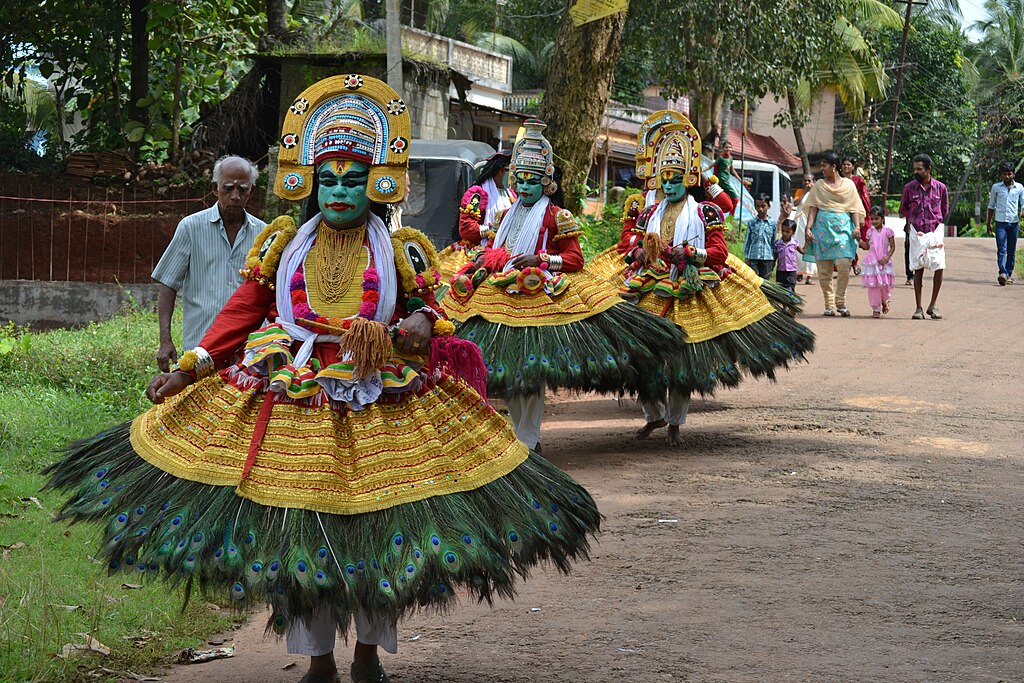
Courtesy: Manojk, CC BY-SA 3.0 via Wikimedia Commons
Arjuna Nritham, also called the Mayilpeeli Nritham, is one of Kerala’s most intriguing ritual dances—a synthesis of devotion, martial rhythm, and poetic narration[1]. The performance enacts the valor and penance of the Mahabharata hero Arjuna, who worshipped Lord Shiva to obtain the mighty Pashupatastra. Today, this dance survives mainly in temple festivals across Kottayam, Alappuzha, Idukki, and some parts of Ernakulam and Thrissurperformed by hereditary communities like the Ezhavas and Thiyyas[2].
The word “Nritham” denotes pure dance, yet Arjuna Nritham transcends that category—it is both a ritual offering and a folk narrative performance. The songs sung during the dance are known as Padams or Villupattu verses, narrating the story of Arjuna’s devotion and his encounter with Shiva in the hunter’s disguise[3].
Mythological and Cultural Origins
The mythic inspiration for Arjuna Nritham stems from the episode in the Mahabharata where Arjuna undertakes severe penance to please Lord Shiva. Moved by his dedication, Shiva appears as a hunter (Kirata) and tests the warrior’s humility before granting the divine weapon. This story, deeply rooted in Shaivite devotion, became a ritual expression in the villages of central Kerala[4].
Scholars view the art as a fusion of martial ritual and folk theatre. The rhythmic energy of Arjuna Nritham possibly evolved from ancient Kalari traditions and Villu Pattu (bow-song) storytelling—where rhythm, verse, and devotion merge seamlessly[5]. In temple contexts, the performance functions as an offering to Lord Shiva or Ayyappa, often staged on nights following major festivals.
Performance Style and Musical Structure
The performance of Arjuna Nritham unfolds as a rhythmic dialogue between the dancer and the accompanying singers. It begins with a short invocation song, known as Thottam, invoking deities like Lord Shiva or Ayyappa to sanctify the space[5]. Following the invocation, the dancer enters the stage area—usually an open courtyard in front of the temple—holding a bow and sometimes a small hand drum. The kalapradakshinam (circular step) introduces the performance, followed by increasingly intense rhythmic movements.
The rhythm of Arjuna Nritham is built on a seven-beat cycle called Ezhara Taalam, unique to this art form. The Thudi and Ilathalam set this pattern, while the vocalist narrates the episode in sync with the dancer’s steps. Each stanza of the Padam concludes with a flourish, and the dancer interprets it through Abhinaya (expressive gesture), stamping, and body rotations that signify both Arjuna’s penance and his martial prowess[6].
Distinct from purely aesthetic dances, Arjuna Nritham retains a ritual purpose. The dance is performed facing the deity’s sanctum, symbolizing a direct act of devotion rather than entertainment. The audience—usually devotees gathered after evening prayers—participate through rhythmic claps or chants, creating a sacred dialogue between performer, god, and community[7].
Musically, the art is deeply connected to Kerala’s Villu Pattu (bow-song) tradition, where narration and rhythm coexist. The lead singer (known as Paatukaran) sets the narrative pace, and the dancer improvises gestures to highlight key lines. This interactive model blurs the boundary between storyteller and performer, turning the ritual into a living oral drama. The lyrics are drawn from ancient Padams composed in a mix of Sanskritized Malayalam, containing moral reflections on penance, knowledge, and humility[10].
Unlike classical dances such as Kathakali or Mohiniyattam, Arjuna Nritham is not confined to a fixed stage grammar. It allows spontaneous adaptation—dancers can modify gestures, insert extempore verses, or extend a rhythmic segment based on the energy of the occasion. This flexibility gives the art a folk vitality and makes every performance unique. In many temples, the dance is performed overnight, with each segment narrating a distinct episode from Arjuna’s devotion, ending at dawn with a closing hymn called Mangalam[9].
Through its disciplined yet spontaneous form, Arjuna Nritham exemplifies the unity of Bhakti (devotion) and Nritha (movement). It remains not only a performance art but also a community prayer—where rhythm becomes reverence, and Arjuna’s story becomes a shared spiritual journey of those who witness it.
Costume and Makeup
The dancer’s attire is both simple and symbolic. A white or light-colored veshti (dhoti) is worn, folded short for mobility, and adorned with a waistband of metallic beads. The most distinctive feature is the Mayilpeeli—a waistband made of peacock feathers that lends the dance its alternate name, Mayilpeeli Nritham[8]. This element symbolizes Arjuna’s heroic association with divine energy and valor.
Makeup is minimal compared to classical forms like Kathakali. The face is lightly painted with green tones representing heroism (Veeram), while red and black strokes emphasize divine focus and control. The overall aesthetic bridges folk spontaneity and classical discipline, showing Kerala’s unique visual vocabulary of devotion and artistry[9].
Regional Presence and Contemporary Revival
Arjuna Nritham continues to thrive mainly in Kottayam, Pathanamthitta, and parts of Alappuzha districts—regions known for temple-centered community rituals. Local troupes, often supported by temple committees and cultural organizations, maintain hereditary performance lineages. In recent years, the Kerala Folklore Academy has documented and revived the art through workshops and festival presentations, ensuring transmission to younger performers[12].
Institutions such as the Kerala Tourism Department and academic researchers from Mahatma Gandhi University (Kottayam) have also begun cataloguing Arjuna Nritham as part of Kerala’s Intangible Cultural Heritage[13]. Yet, despite growing recognition, the art remains fragile—dependent on temple patronage, oral instruction, and limited financial support.
Connection with Other Ritual Arts of Kerala
Within the larger landscape of Kerala’s ritual performance culture, Arjuna Nritham stands as a bridge connecting martial devotion, oral storytelling, and community worship. It shares spiritual and aesthetic DNA with ritual arts like Theyyam, Padayani, and Mudiyettu, all of which translate myth into living experience[14]. These forms represent Kerala’s continuum of sacred theatre, where devotion and performance coalesce in public ritual spaces.
Like Theyyam, Arjuna Nritham is performed in open courtyards, often overnight, transforming ordinary temple grounds into sacred performance arenas. The performer becomes a medium of divine will rather than a mere entertainer. Both art forms employ rhythmic chanting, drumming, and flame-lit ambience to induce a trance-like intensity that blurs the line between human and divine[15].
Its connection with Padayani lies in their shared use of Thappu drums and expressive narrative cycles. Both arts depict episodes from the Mahabharata and Puranic mythology, but while Padayani incorporates masks and large effigies, Arjuna Nritham focuses on body movement and lyrical song. The two together form complementary expressions of Kerala’s ritual imagination — one sculptural, the other kinetic[5].
There are also subtle parallels with Velakali, the martial dance performed in Vaishnavite temples of Kottayam and Alappuzha. Both employ weapon postures, stamping patterns, and coordinated group formations that mirror ancient Kalaripayattu drills. While Velakali reenacts Krishna’s martial glories, Arjuna Nritham spiritualizes Arjuna’s penance, reflecting the dual heroism of devotion and discipline[7].
In the Malabar region, traditions like Thira and Poothan Thira express similar devotional fervor, yet focus on the goddess cults of Bhagavathy. Together, these ritual arts form a geographically continuous narrative: from Arjuna’s Shaivite devotion in central Kerala to the goddess worship of northern regions. This demonstrates how each district translates divine myth into localized form, enriching Kerala’s plural spiritual identity[11].
From an anthropological perspective, these interconnections show that Kerala’s ritual arts are not isolated genres but dynamic systems of shared symbolism. The drumbeat, circular dance pattern, invocation chants, and story cycles appear across these forms, binding them through a common philosophy: that art itself is a sacred act. In this shared rhythm, Arjuna Nritham finds its enduring place—as both a distinct Shaivite ritual and a member of Kerala’s vast spiritual performance family.
Conclusion
Arjuna Nritham endures as a living bridge between epic memory and collective worship. It embodies Kerala’s unique ability to merge spirituality with performance—where devotion becomes dance, and myth becomes moral reflection. In every beat of the Thudi and in each circular step of the dancer, the story of Arjuna’s quest for divine grace continues to echo across the temple courtyards of Kerala. Preserving this tradition means safeguarding not only an art form but an entire worldview of discipline, humility, and sacred storytelling.
References
- Kerala Tourism Official Portal (2024). Traditional Dance Forms of Kerala.
- Ayyappapanicker, K. (ed.) (2015). Kerala Literary & Cultural Encyclopaedia. Kerala Sahitya Akademi.
- Nambiar, C. V. (2018). Studies in Kerala Folk Rituals. DC Books.
- Paniker, K. Ayyappa (2009). Kerala Folk Culture Studies. Sahitya Pravarthaka Co-operative Society.
- Kerala Folklore Academy Journal, Vol. 12 (2021).
- Menon, A. Sreedhara (2012). Cultural Heritage of Kerala. Orient BlackSwan.
- Department of Culture, Government of Kerala (2023). Temple Arts of Central Kerala.
- Kerala Folklore Academy (2021). Traditional Arts of Kerala.
- Kumar, V. P. (2020). Folk Performances of Central Kerala. Insight Publications.
- Kerala Folklore Department Annual Bulletin (2019).
- Namboodiri, P. T. (2017). Folk Religion and Temple Arts of Kerala. Mathrubhumi Books.
- Kerala Folklore Academy Annual Report (2022).
- Mahatma Gandhi University Folklore Studies Department Newsletter (2023).
- Paniker, K. Ayyappa (2010). Ritual Arts of Kerala. Kerala Sahitya Academy.
- Menon, N. (ed.) (2016). Studies in South Indian Folk Performance. Delhi University Press.