The Cultural Resurgence of Kalapoottu Malsaram: Kerala’s Traditional Folkloric Bull Race

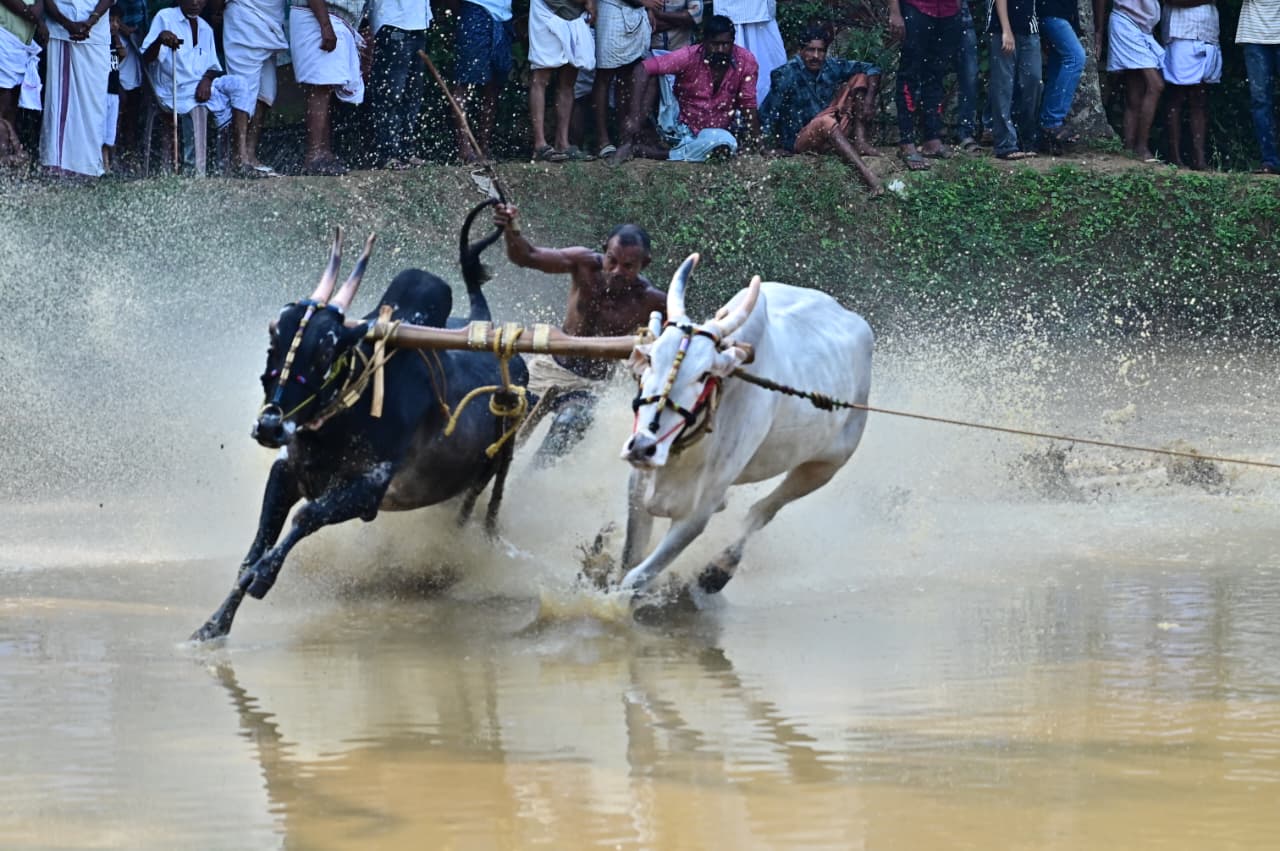
Image courtesy: Mr. Arjunan S Raj, Freelance Photographer
I. Executive Summary: The Muddy Track to Modernity
1.1. Overview of Kalapoottu
Kalapoottu Malsaram, a term meaning "yoking competition," is a dynamic and traditional Bull race integral to the agrarian life of Kerala, India. This traditional event, also widely known by regional names such as Maramadi, Kannupoottu, and Pothottam, features pairs of bullocks racing through freshly ploughed paddy fields known as kandams.1 The spectacle involves immense speed and dexterity, sometimes described colloquially as 'bull surfing'.1
1.2. Core Significance
The existence and function of the Malsaram are fundamentally rooted in Kerala's agro-ecology. It is explicitly a traditional event timed strategically after the heavy monsoon rains subside but crucially before the Bull are required for the main planting activities.1 Historically, this timing elevated the event beyond mere competition, linking community cohesion with essential farm labor and conditioning draught animals for the intensive agricultural season ahead.
1.3. Legal Status Snapshot
The Malsaram faced a protracted period of legal prohibition. Following a central government directive in 2011, which banned the exhibition and training of bulls as performing animals under the Prevention of Cruelty to Animals (PCA) Act, 1960, the event was largely deemed illegal.1 Subsequent court rulings in Kerala reinforced this ban between 2014 and 2015.3 However, this conflict was decisively addressed in the state legislature via the landmark Prevention of Cruelty to Animals (Kerala Amendment) Act, 2025. This Act granted conditional legal sanction to Kalapoottu and related Bull races, aligning Kerala’s legal framework with those established earlier by Tamil Nadu and Karnataka for their respective traditional sports.4
II. Introduction: Defining the Draught Sport of Kerala
2.1. Kalapoottu: The Interplay of Ritual, Agriculture, and Adrenaline
Kalapoottu Malsaram is characterized by its unique setting and high-stakes performance. The race is conducted in temporary, purpose-built arenas defined by vast stretches of wet, freshly ploughed paddy fields, or kandams, which serve as the stadium for the event.2 This environment makes the race highly physically demanding, testing the speed and power of the bullocks as well as the skill of the jockey navigating the waterlogged, uneven terrain.5
2.2. A Spectrum of Names and Lexical Ownership
The tradition’s deep entrenchment in Kerala society is evidenced by its diverse nomenclature across regions. While the collective term Kalapoottu refers to the yoking used for ploughing,5 regional identities have yielded specific names. In the southern districts, the event is commonly referred to as Maramadi.1 Conversely, in the northern districts, it is frequently known as Kannupoottu.6 Other common descriptive names include Pothottam1 and, in legislative documents recognizing these activities, Uzhavu (ploughing).4
This multiplicity of names is not merely a matter of linguistic variation but rather signifies regional cultural ownership. The practice evolved independently across Kerala’s diverse agro-climatic zones, suggesting a strong local cultural identity attached to the sport, thus reinforcing its deep societal roots among different agricultural communities.1
Standardized Terminology and Contextual Linkages of Kerala Bull Races
| Local Term | Regional Tendency | Key Activity & Context |
|---|---|---|
| Kalapoottu | General/Central | Competitive Yoking/Bull Race |
| Maramadi | Southern Districts | Bull Race in Mud (Bull Surfing)1 |
| Kannupoottu | Northern Districts | Bull Race4 |
| Pothottam | General/Descriptive | Bullock Race1 |
| Uzhavu | Legislative/Formal | Ploughing Race (referencing tilling)4 |
2.3. Differentiating Kalapoottu in the Dravidian Sports Landscape
Kalapoottu maintains a distinct identity when compared to analogous draught sports practiced elsewhere in South India. While the event shares a cultural lineage with other traditions, its form is unique. For instance, in Tamil Nadu, the well-known Jallikattu involves bull taming where participants attempt to grab money tied to the horns of bulls.7 Another Tamil Nadu event, the Rekla Race, often involves bullock carts racing on dry tracks, and the Kambala of Karnataka is a buffalo race held in similar muddy conditions.5 Kalapoottu, by contrast, is characterized specifically as a high-speed bullock race across a deeply ploughed, waterlogged field, demanding rapid transit and control across mud and water, earning its description as 'bull surfing'.1
III. Historical and Agro-Ecological Genesis
3.1. The Ancient Link to Paddy Cultivation (Kandam)
The genesis of Kalapoottu is intrinsically tied to the practical necessities of paddy cultivation. The event is traditionally scheduled to take place immediately following the monsoon season and just before the period when the Bull are needed for the intensive planting process.1 This timing is not coincidental; it suggests the Malsaram evolved initially as a systematic and sophisticated method of early field preparation.
Racing pairs of bullocks explosively across the waterlogged kandam efficiently churns the heavy, post-monsoon mud. This action achieves preliminary wet tilling, effectively breaking large soil clods and puddling the field, which is critical for preparing the ideal substrate for rice planting. By converting this necessary, functional work into a competitive ritual, the activity simultaneously reduces the total manual labor required for initial tilling while conditioning the animals for the physically taxing planting season ahead. The competitive element was likely introduced to incentivize the selection and training of the fastest, strongest draught animals, transforming a basic requirement into a celebrated local sport.8
3.2. The Economics of Draught Power and Livelihoods
In Kerala's traditional agrarian economy, the management and maintenance of high-quality draught cattle represent a significant investment and resource. The viability of many rural farming systems rests on the availability of robust, trained livestock. The 2025 legislative efforts specifically justified the continuation of Kalapoottu as a means to "protect the livelihood of cattle keepers".4
The ability of a bull pair to compete successfully in the Malsaram directly translates into socio-economic benefits. A winning team achieves local fame and "honours"5, which significantly increases the market value and breeding potential of the bulls. This competitive aspect creates a specialized economic niche for high-performance racing bulls, thereby reinforcing the economic viability of traditional cattle rearing for draught purposes, especially important in an era where farm mechanization often threatens traditional livestock practices. The sport provides a crucial specialized market that financially supports traditional cattle handlers.
3.3. Kerala's Draught Cattle Heritage and Conservation
The recent legislative sanction explicitly links the continuation of Bull races to the state goal of preserving specialized livestock. The 2025 Bill aims to "conserve native breeds".4 Kerala is home to several unique indigenous cattle lineages, including the Vechur cow, famous for its small stature, and the Kasaragod Dwarf cattle.9
While specialized racing bulls may sometimes derive from non-descript or cross-bred lineages optimized for power and speed, the legislative mandate provides a crucial policy anchor. By justifying the Malsaram as a conservation effort, the state creates a legal framework to support traditional cattle keeping and potentially link the sport's performance requirements to the long-term sustainability of indigenous, high-quality draught breeds. This proactive approach ensures the socio-cultural practice aligns with broader biodiversity and agricultural heritage objectives.
IV. The Anatomy of the Race (Malsaram Nuances)
4.1. The Arena and Track Specifications
The operational theater for Kalapoottu is distinct and temporary, utilizing land that will soon be converted into a productive paddy field. The track is described as a "vast stretch of freshly ploughed paddy fields" 2. While specific historical rules regarding exact dimensions are not detailed in historical records 1, typical race distances usually span "a few hundred meters" 5.
The physical challenge inherent in the arena itself defines the sport. Bullocks must generate explosive speed while navigating deep mud and water, making the event a unique test of traction, power, and momentum management. The deep, churned mud necessitates a unique posture and technique from the jockey, resulting in the sport’s characteristic dynamic motion.
4.2. Equipment, Mechanics, and the Jockey's Skill
In Kalapoottu, two bullocks of similar type and temperament are linked together by a kalappu (wooden yoke) 5. This yoke is often connected to a thin plank or crossbar upon which the jockey stands or “surfs” as the animals sprint. The jockey’s role is complex, requiring not only the capacity to motivate the animals but also immense physical strength and balance to manage the high speeds across the slippery, uneven surface without falling or losing control 5.
The physical training required for both animal and handler is rigorous, ensuring the pair can execute the race with maximal efficiency and control. The partnership between the jockey and the draught team is critical, requiring synchronized effort for success in the high-stakes, rapid-fire competition.
4.3. Competition Structure, Investment, and Honor
The competitive Malsaram structure involves significant incentives for participation. The primary rewards include cash awards, highly prized “honours,” and a rolling trophy bestowed upon the winning team 5. Beyond monetary gain, the true value of winning is the profound prestige and social capital conferred upon the animal owner and the jockey within their local community.
These races are often strategically integrated into the state’s most significant festivals, further amplifying their cultural capital. For example, one of the most famous Maramadi events is traditionally held at Anandhapalli in the Pathanamthitta district during the Onam festival 2. Placing the race during a major festival maximizes public attendance and attention, successfully transforming what originated as a purely functional agricultural necessity into a high-visibility cultural event. This elevation of status increases the socio-economic return on investment (in terms of fame and community recognition) associated with training and maintaining high-performance racing Bull.
V. Socio-Cultural Significance and Folklore: The Ritual of the Run
5.1. Community Cohesion and Identity
Kalapoottu Malsaram serves as a powerful community ritual, acting as a crucial social binder for agriculturists 6. In rural Kerala, the event transcends sport; it is an annual declaration of agricultural prowess and communal identity. The preparation for the event, the gathering of spectators from far and wide, and the shared excitement of the competition mobilize the community, reinforcing traditional social networks and a collective pride in the harvest cycle 2.
5.2. Festival Integration and Calendar
The specific post-monsoon timing of the race establishes it as a definitive marker in the annual cultural and agricultural calendar 1. By being tied to the conclusion of the heaviest rainfall and the commencement of critical preparatory work, the Malsaram provides a period of collective celebration and release before the intensive planting labor begins. This integration ensures the practice remains a fixed point of cultural reference, perpetuating its existence through generations.
The enduring existence of Kalapoottu illustrates the ritualization of agricultural labor. By introducing the high stakes of competition, prestige, and prizes to the functional task of wet tilling, the activity is elevated to a recognized high-status performance. This mechanism ensures the continuation of traditional agricultural practices and the necessary maintenance of specialized draught cattle even when faced with the increasing availability of mechanized alternatives.
5.3. Oral Traditions and the Cult of the Racing Bull
The Malsaram provides rich ground for the creation of local folklore. The central figures—the racing bulls and their jockeys—are elevated far beyond their functional roles.
The racing bull becomes a protagonist, celebrated not merely as livestock but as a prized athlete commanding respect and considerable economic investment. Oral traditions often focus on the lineage, speed, and specific temperament of famous winning bulls, granting them near-legendary status within the local narrative. Similarly, the jockeys are celebrated as local heroes, esteemed for their strength, agility, and unique mastery over the animals. Their success in steering the powerful team across the slippery terrain is viewed as a proxy for the entire village’s strength and agricultural vitality, fostering a concept of rural masculinity tied to physical prowess and mastery of the traditional environment 8.
5.4. Investment and Prestige
The significant investment farmers make in their specialized Bull, covering aspects like diet, training, and veterinary care, is motivated by more than just the immediate prize money. The recovery of this economic expenditure is heavily reliant on the intangible currency of prestige and social honor 5. A successful performance confers high social capital upon the owner and family, potentially translating into increased influence within local economic and social structures, thus perpetuating the cycle of investment and competition 4.
VI. The Decades of Conflict: Kalapoottu in the Legal Labyrinth
6.1. The Central Mandate and the PCA Act, 1960
The conflict surrounding Kalapoottu began with the enforcement of the Prevention of Cruelty to Animals (PCA) Act, 1960. In 2011, the Central Government banned the exhibition and training of bulls (along with five other animals) as performing animals under this act 1. This legislation laid the foundation for the eventual prohibition of Bull races across India, including Kerala.
6.2. Judicial Enforcement in Kerala (2014–2015)
The critical period of judicial scrutiny occurred between 2014 and 2015. A 2014 court ruling determined that the Central Government’s ban applied directly to the Kerala Bull race 1. Furthermore, in 2015, the Bull Race Club of India’s appeal to the Kerala High Court was dismissed, upholding the ban and confirming that Kalapoottu and Maramadi were prohibited under the PCA Act 1. Requests submitted by associations of agriculturists to district authorities, such as the District Collector of Ponnani, seeking permission for the events were consequently rejected on the grounds that they violated the provisions of the PCA Act 6. During this time, traditionalists attempted to legally differentiate Kalapoottu as an essential ‘agricultural tradition’ rather than merely a ‘performance.’ However, the courts initially dismissed this distinction, viewing the event primarily as a spectacle where animals were subjected to conditions that could be classified as cruelty under the PCA Act 3.
6.3. The Influence of the Animal Welfare Movement
The legal suppression of Kalapoottu was significantly influenced by the aggressive campaigning of animal welfare organizations, notably PETA India. Following successful litigation that led to the banning of cruel spectacles such as Jallikattu in Tamil Nadu 7, these groups sought nationwide enforcement of the ban against all bullock cart races and bullfighting events, implicitly targeting Kalapoottu 7.
Legal actions following complaints filed by PETA India resulted in enforcement and convictions. For example, twenty individuals were booked for organizing an illegal race in Thiruvananthapuram, with convictions eventually secured under both the PCA Act and sections of the Indian Penal Code (IPC), including sections 289 and 336 3. The use of IPC sections (related to rash acts or nuisance endangering human life) demonstrates that the legal challenge encompassed concerns not only over direct animal cruelty but also the public safety risks associated with racing powerful, possibly frantic bulls in public areas 3.
6.4. The Political Pressure and Legal Precedents
Faced with a decade of cultural deadlock and localized legal uncertainty, the State of Kerala recognized the necessity of a legislative solution. This urgency was amplified by the actions of neighboring states: Tamil Nadu had successfully legalized Jallikattu through a state law in 2017, and Karnataka had enacted a similar exemption for Kambala in 2018 4. These precedents provided Kerala with a constitutional roadmap for granting statutory protection to its own traditional Bull races.
Timeline of Legal Conflict and Resolution for Kerala Bull Races
| Year | Event | Legal/Regulatory Impact |
|---|---|---|
| 2011 | Central Government Notification | Ban on bulls as performing animals under PCA Act, 1960 1 |
| 2014 | Court Ruling / Animal Welfare Board Action | Ban confirmed to apply to Kerala Bull races (Kalapoottu / Maramadi) 1 |
| 2015 | Kerala High Court Ruling | Appeal rejected; ban on Kalapoottu upheld 1 |
| 2025 | Kerala Amendment Act | State-level exemption granted; conditional sanction given to Bull races 4 |
VII. Legislative Revival: The Prevention of Cruelty to Animals (Kerala Amendment) Act, 2025
7.1. The Passage of the 2025 Bill
In a significant legislative move, the Kerala Assembly passed the Prevention of Cruelty to Animals (Kerala Amendment) Bill, 2025, providing official legal sanction for traditional Bull races, including Kalapoottu, Kannupoottu, Maramadi, Uzhavu, and Pothottam. 4 The Bill was notably introduced and passed on the same day, marking a sharp departure from standard legislative procedure. 4 This expedited process underscored the deep political and cultural pressure felt within the state to resolve the long-standing legal ambiguity that had previously criminalized a revered tradition.
7.2. Statutory Exemption and Justification
The core legal strategy of the 2025 Act involves creating a state-level exemption from the Central PCA Act, 1960. The Bill inserts a new clause under Section 3 of the Central Act, legally recognizing these Bull races as a means to achieve specific public policy goals:
to promote agricultural traditions and culture, conserve native breeds and protect the livelihood of cattle keepers
.
4
Crucially, the Act also inserts a new Section 28A, which declares that the provisions of the Central PCA Act will not apply to Bull races conducted strictly in accordance with state-prescribed conditions.
4
By legally framing the practice as essential for the conservation
of native breeds and the livelihood
of traditional keepers, the state strategically constructs a constitutional argument rooted in protecting cultural rights and economic activity. This nuanced approach strengthens the state's position against potential future challenges that might focus solely on the ‘prevention of cruelty’ clause.
7.3. The New Regulatory Framework: Conditional Performance
The new law shifts the legal framework from blanket prohibition to controlled, mitigated performance. The state government is empowered under a new Section 38B to frame detailed rules and notify them in the Gazette for the scrutiny of the assembly. 4
To ensure that the events proceed without undue cruelty, specific mandatory conditions are imposed upon organizers:
- Prior Permission: Any event must secure prior permission from the District Collector. 4
- Veterinary Fitness: All participating animals must possess veterinary fitness certification before competing. 4
- Penalties: The law explicitly mandates penal action for any violations of the prescribed rules. 4
This conditional legalization framework requires proactive administrative and veterinary oversight, ensuring that the cultural practice of Kalapoottu is revived under strict parameters designed to mitigate the animal welfare concerns that led to the original ban.
VIII. Conclusion and Future Outlook
The legislative sanction of the Kalapoottu Malsaram through the 2025 Amendment Act represents a profound legal and cultural victory for Kerala’s agrarian communities. This resolution successfully attempts to synthesize the imperatives of cultural preservation and agricultural necessity with modern animal welfare standards.
The analysis confirms that Kalapoottu is far more than a simple sporting event; it is an enduring socio-economic mechanism. Its origins are functional, serving as a critical, high-efficiency method of preliminary wet tilling post-monsoon, thereby optimizing the field preparation process. Its continuation is sustained by the significant social capital and prestige conferred upon successful Bull owners and jockeys, which ritualizes labor and reinforces traditional identities.
The future success of the legally revived Malsaram will hinge heavily on enforcement. The regulatory framework requires diligent adherence to veterinary certification standards and meticulous management of public safety to avoid the public nuisance and endangerment charges previously brought against organizers. 3 Should Kerala successfully implement and maintain these stringent, state-prescribed conditions, the Kalapoottu Malsaram will solidify its status as a legally sanctioned, culturally vital agro-sport.
Furthermore, Kerala's legislative move establishes it alongside Tamil Nadu and Karnataka as part of a significant South Indian trend to reclaim and responsibly regulate traditional livestock sports, providing a model for other states seeking to protect their cultural heritage within modern legal boundaries.
References
- Government of India. (1960). Prevention of Cruelty to Animals Act, 1960. Available at: https://legislative.gov.in/
- Supreme Court of India. (2014). Animal Welfare Board of India vs. A. Nagaraja & Ors. Judgment on Jallikattu and animal sports. Full text available at: https://main.sci.gov.in/
- Kerala Legislative Assembly. (2025). Prevention of Cruelty to Animals (Kerala Amendment) Bill, 2025. Official proceedings and bill documents: https://niyamasabha.nic.in/
- Agricultural Department, Government of Kerala. Traditional Agrarian Practices of Kerala. Official resource page: https://www.keralaagriculture.gov.in/
- Menon, A. Sreedhara. (2007). A Survey of Kerala History. DC Books.
- Gurukkal, Rajan. (2020). Rethinking Classical Indo-Asian Traditions. Oxford University Press.
- Sasikanth, M.G. (2016). “Agrarian Rituals and Rural Competitions in Kerala.” Journal of South Indian Folklore Studies, Vol. 12.
- Institute of Social and Cultural Anthropology, University of Oxford. (2021). “Cattle-based Ritual Sports in South Asia.” https://anthro.ox.ac.uk/
- Animal Welfare Board of India. (2015–2023). Reports on animal welfare violations and guidelines for cattle sports. https://awbi.gov.in/
- Subramanian, T.S. (2016). “History of Jallikattu and Cattle Sports in Tamil Nadu.” The Hindu. https://www.thehindu.com/
- Press Information Bureau (PIB). Government of India. Updates on PCA Amendments and state exemptions. https://pib.gov.in/
- Ramakrishnan, V. (2013). Culture, Ecology and Agrarian Systems of Kerala. Centre for Development Studies (CDS), Trivandrum.
- Joseph, K.V. (2018). “Changing Dynamics of Kerala’s Agrarian Festivals.” Indian Folklore Research Journal, Vol. 22.
- Mathrubhumi. Special Report: “Kalapoottu and Rural Sports of Malabar.” https://www.mathrubhumi.com/
- Manorama Online. “Traditional Cattle Races Return in Kerala: A Timeline.” https://www.manoramaonline.com/
- Frontline Magazine. (2017). “Cattle, Culture and Law: The Jallikattu Debate.” https://frontline.thehindu.com/
- Nair, K.R. Gopalakrishnan. (1995). Folk Traditions of Kerala. Kerala Folklore Academy.
- Kerala Veterinary and Animal Sciences University (KVASU). Research on native cattle breeds of Kerala: https://kvasu.ac.in/
- Routledge Handbook of Indian Anthropology. (2019). Chapters on agrarian rituals, cattle symbolism, and rural performance traditions.
- Singh, K.S. (Ed.). (1992). People of India: Kerala. Anthropological Survey of India.