From Odiyan to Slenderman: The Remediation of Shapeshifting Lore in the Digital Gothic
The structural evolution of human fear is intrinsically linked to the technologies of its transmission. From the flickering embers of a village hearth in the Malabar region to the high-definition glare of a smartphone screen in a Kochi tech park, the "monsters" that inhabit the collective unconscious have not vanished; they have simply updated their interface. The contemporary obsession with "The Backrooms," "Creepypastas," and "Analog Horror" represents a digital renaissance of ancient folklore, a phenomenon where the primal dread of the unknown is remediated through the aesthetic of technological decay 1. This report examines the profound continuity between traditional Kerala legends—such as the Odiyan and various forms of Pretham—and the modern digital myths that fascinate younger audiences today. By analyzing the mechanisms of shapeshifting, liminality, and the 'uncanny valley,' we can discern how the 'folkloresque' adapts to the unique anxieties of the digital age, transforming oral traditions into a participatory, globalized gothic 2.
The Odiyan Paradigm: Feudal Terror and the Mastery of Odi
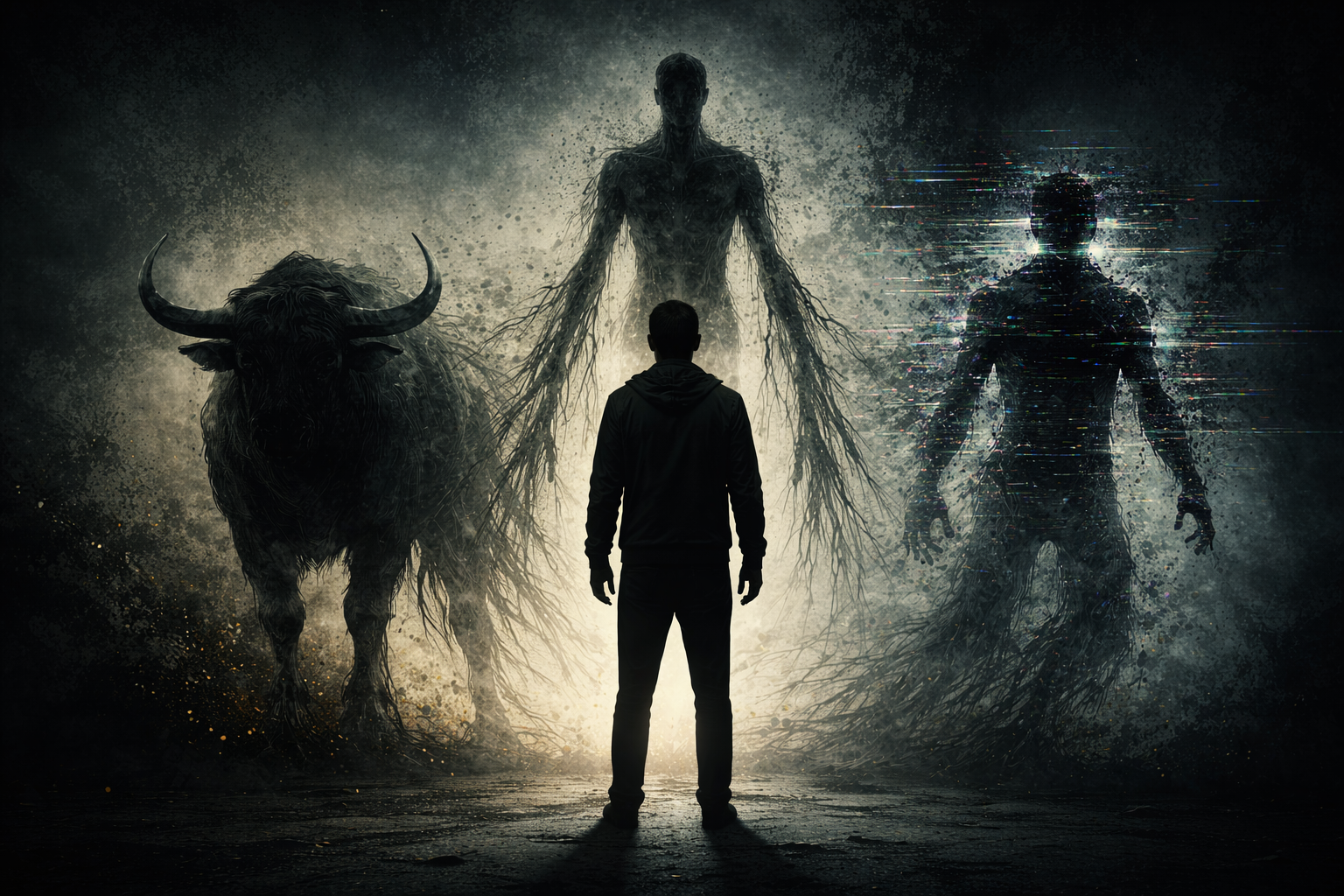
AI Generated Image: Silhouetted man confronting supernatural and digital horrors
The myth of the Odiyan remains one of the most potent symbols of supernatural dread in Northern Kerala, particularly within the Palakkad and Malappuram districts 6. Far from being a mere ghost story, the Odiyan legend is deeply rooted in the socio-political realities of caste marginalization and feudal conflict 8. The practitioners of "Odividya" were primarily members of oppressed communities, such as the Paraya, Pulayar, and Panan, who utilized these occult practices as a means of survival and asymmetrical defense in a rigid social hierarchy 7. The Odiyan was essentially a "shadow assassin," a figure hired by wealthy landowners to settle disputes or instill terror in rivals under the cover of moonless nights 6.
The core of the Odiyan’s power lay in shapeshifting, a process known as "Odimarayal" 10. This was not a magical poof of smoke but a gruesome, ritualistic procedure. Central to this transformation was "pilla thailam" or "pinna oil," a substance allegedly extracted from the fetuses of first-time pregnant women 6. Legend suggests that Odiyans would lure women into a trance, perform a "bamboo knife" extraction, and return the victim to their bed, only for the woman to perish shortly after without visible symptoms 6. By smearing this oil behind their ears, the Odiyan could transform into powerful animals like bulls, buffaloes, wild dogs, or even inanimate objects like stones and pillars 6.
The Ritual and Technical Specifications of Odividya
| Component | Description | Occult / Technical Purpose |
|---|---|---|
| Pilla Thailam | Oil from human fetuses 6 | Essential catalyst for physical transformation 6 |
| Naked State | Practitioners performed rituals undressed 6 | Maximizing the efficacy of magical energy 6 |
| Astrological Timing | Birth star and lunar position of victim 6 | Precision in psychological and physical targeting 8 |
| Odi Stick | Specialized stick for snapping the neck 6 | Physical mechanism for the "Odi" (break) kill 10 |
| Potty Choottu | Flickering phantom flames 10 | Luring victims into traps or marshes 10 |
The Odiyan’s effectiveness was as much psychological as it was physical. Their victims often died of "sheer fright" upon encountering an uncanny entity—a man-beast hybrid or a shadow that moved with lightning speed 6. This suggests that the Odiyan was a master of the "uncanny valley," a psychological threshold where the familiar becomes terrifyingly "off" 2. Scientific interpretations posit that Odiyans were likely skilled illusionists or individuals who wore animal skins to scavenge and intimidate, utilizing herbal potions to induce hallucinations in their prey 8.
The Digital Gothic: Creepypasta and the Architecture of Virtual Lore
As the oral traditions of the Malabar coast faced the pressures of urbanization, the "spirit of the woods" migrated into the "spirit of the machine" 12. The "Creepypasta" represents the modern evolution of the urban legend, characterized by its viral dissemination across networked digital media 2. Unlike traditional folklore, which evolved slowly through regional variations, Digital folklore is "crowdsourced," with multiple unconnected users contributing "evidence" to a shared tapestry of horror 2.
The Slenderman, perhaps the most iconic creepypasta figure, shares remarkable parallels with the Odiyan. Both are tall, faceless (or distorted), and haunt the peripheries of human vision 2. While the Odiyan haunts the "Kaavu" (sacred grove), the Slenderman is often associated with the "liminality" of forests or abandoned suburban spaces 3. The power of these figures lies in their "strategic incompleteness"—the lack of a definitive origin story allows the audience to project their own deepest anxieties onto the entity 3.
Comparative Evolution of Shape-shifting Entities
| Era | Primary Entity | Habitat | Transformation / Appearance | Mechanism of Fear |
|---|---|---|---|---|
| Traditional (Kerala) | Odiyan 8 | Paddy fields, sacred groves 8 | Animal / Shadow mimicry via oils 6 | Physical violence; scaring to death 6 |
| Early Digital | Slenderman 3 | Forests, playgrounds 15 | Facelessness; elongated limbs 3 | Surveillance; child abduction 3 |
| Analog Horror | Alternates 16 | Homes, TV screens 16 | Flawed human mimicry 16 | Metaphysical Awareness Disorder 16 |
| Liminal Horror | The Bacteria 17 | The Backrooms 17 | Skeletal, wire-like mimicry 17 | Psychological isolation; entrapment 5 |
In the digital era, the "Alternate" from the Mandela Catalogue series represents the most advanced form of this shapeshifting terror. These entities are "flawed impersonators" that attempt to blend in with normal humans but are betrayed by abnormal physiological characteristics, such as "overdriven" features or elongated faces 16. This is the digital equivalent of the Odiyan who might look like an ordinary man during the day but reveals "buffalo legs" or a "shadowy face" at night 6. The "Alternate" uses "voice/audio mimicry" to trick victims, just as the Odiyan was said to call a victim's name three times to lure them into the darkness 10.
Liminal Spaces: From the Kaavu to the Backrooms
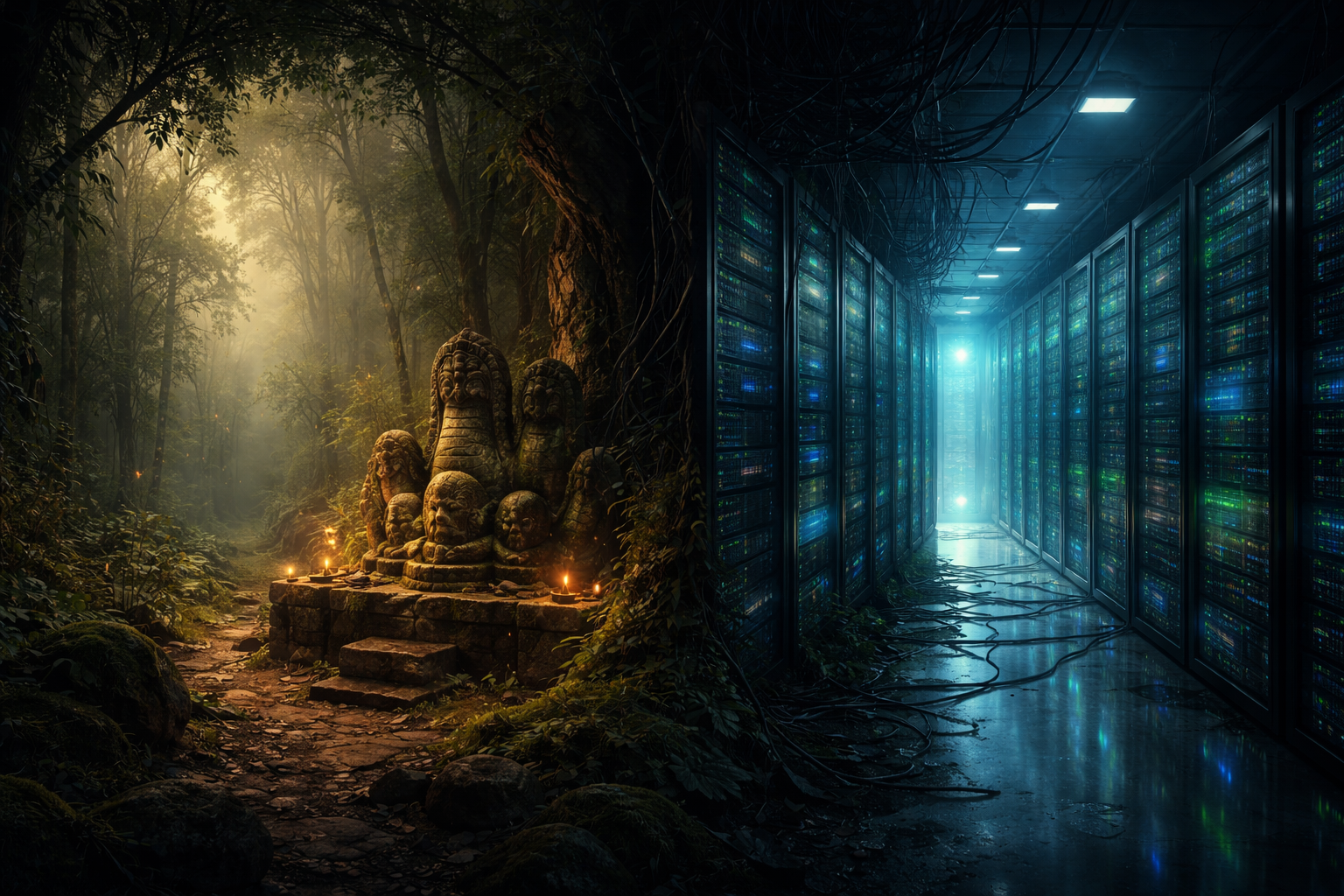
AI Generated Image: From traditional Kaavu to modern digital server room
The concept of liminality is central to both ancient Kerala lore and modern digital horror. "Liminal" refers to a threshold, a space that is "in-between" two states or purposes 5. In Kerala, the Kaavu (sacred grove) is a physical liminal space—a "sanctified patch of forest" that serves as the dwelling of Naga Raja (the snake king) or the Yakshi 21. These groves are remnants of the huge evergreen forests that once stretched across the land, and they are treated with "utmost respect for cleanliness and purity," as violating them is believed to bring about supernatural wrath 21.
Modern digital culture has reimagined this threshold as The Backrooms 15. Originating from a 4chan post in 2019, the Backrooms are an endless, repetitive maze of "featureless rooms painted in a monotonous yellow hue," lit by "buzzing fluorescent lights" 5. While the Kaavu is a guided, sacred liminality presided over by deities like Janus or Hecate in the broader global context, the Backrooms represent a "postmodern liminality"—spaces like airports, malls, and office buildings that have been "stripped of their original purpose" 5.
The Dynamics of Liminal Disorientation
The psychological impact of these spaces can be mathematically modeled by the relationship between environmental monotony and cognitive dissociation. If D is the degree of dissociation and M is the monotony of the environment over time t, the relationship can be expressed as:
D(t) = ∫0T k · M(t) dt
where k is the "uncanny constant" 5. In the Backrooms, the infinite repetition of the yellow wallpaper (M → ∞) leads to total psychological collapse or "Metaphysical Awareness Disorder" 16. Similarly, in Kerala's rural past, the total blackout of a moonless night in a forest patch created a high M value, leading travelers to experience Potty choottu or phantom lights that led them to their doom 10.
| Liminal Space | Origin | Key Visuals | Presiding Entity |
|---|---|---|---|
| Sarpa Kaavu | Traditional Kerala 21 | Ancient trees, snake idols, stone lamps 22 | Naga Raja / Yakshi 22 |
| The Backrooms | 2019 Creepypasta 17 | Yellow wallpaper, fluorescent lights 17 | The Bacteria / The Entity 5 |
| Technopark | Urban Kerala lore 19 | Corporate cubicles, dark parking lots 19 | "Hymavathi" ghost / Pranks 19 |
| Kochi Blackout | 1971 History/Legend 18 | Pitch black city, harbor cranes 18 | Unexploded pods / Alien lights 18 |
Analog Horror: The Aesthetic of Technological Trauma
The rise of "Analog Horror" is perhaps the most significant stylistic shift in modern digital storytelling. This subgenre utilizes "low-fi" editing to recreate the look and feel of VHS tapes and early television broadcasts 1. This aesthetic choice is not merely decorative; it is a weaponization of "false nostalgia" 1.
Analog horror series like Local58 or The Mandela Catalogue use technical tropes such as "choppy editing," "yellowing of the image," and "subtle glitches" to increase immersion 1. These effects mimic the "decay" of memory, making the horror feel like a "distorted half-forgotten dream" 1. This resonates perfectly with the Kerala tradition of oral storytelling, where tales of spirits like the Tholumadan are passed down through generations, each retelling adding a "spark or dramatic pause" that distorts the original "truth" 26.
Case Study: Tholumadan and the Remediation of Mental Trauma
The Malayalam web series Tholumadan (2024), directed by Richy KS, provides a masterclass in how traditional folklore can be remediated through the analog horror aesthetic 27. The story centers on a young boy, Appu, waiting for his father to return from the 1962 Indo-China war 27. The horror is psychological, blending the legend of the "Tholumadan"—a creature that kills men and wears their skin— with the reality of post-traumatic stress disorder (PTSD) 27.
This remediation is mirrored in the award-winning animation Kandittund! (Seen It!), which uses "traditional hand-drawn animation" to document the "vanishing myths" of an 89-year-old storyteller 12. By presenting spirits like the Eenam-Pechi (who eats pregnant women) in a black-and-white graphic novel style, the film makes these "homegrown legends" accessible to a generation raised on creepypastas and YouTube horror 12.
Digital Campfires: Reddit and the Urban Legend 2.0
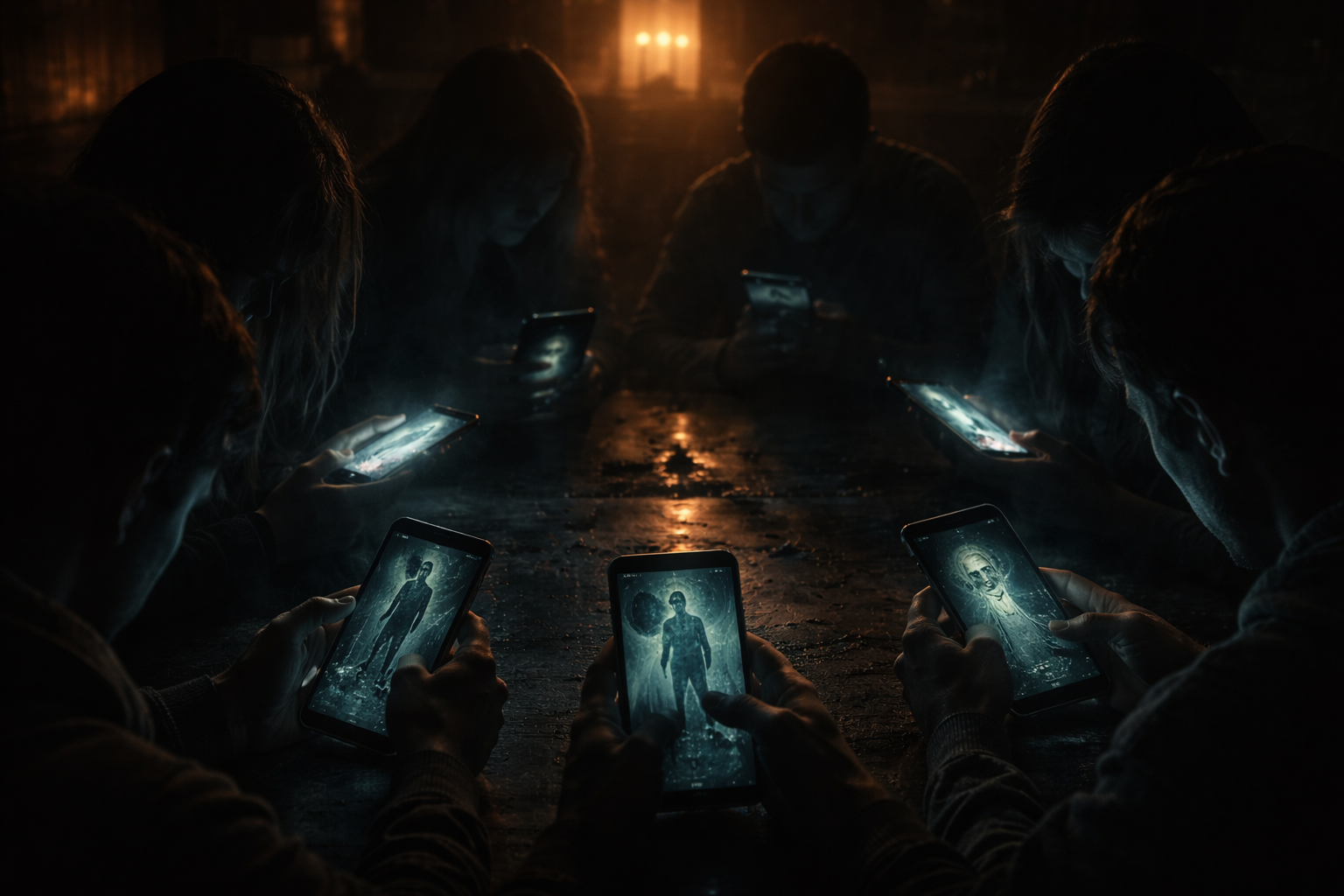
AI Generated Image: Digital Campfire with ghostly reflections on smartphone screens
Social media platforms have replaced the village bonfire as the site of collective myth-making. Reddit communities like r/Kerala and r/Kochi act as repositories for modern urban legends that blend traditional motifs with the anxieties of contemporary life 18.
Viral Urban Legends of Modern Kerala
| Legend Name | Setting | Core Event | Origins / Parallels |
|---|---|---|---|
| The Kochi Blackout | 1971 / Fort Kochi 18 | Unidentified jets drop pods that don't explode 18 | Wartime trauma meets UFO mythology 18 |
| Technopark Hymavathi | Kariyavattom / IT Corridor 19 | Ghost of a murdered girl roams the back gate 19 | "White Saree" ghost meets corporate surveillance 19 |
| The Hooved Man | Fort Kochi Church 18 | Man asks for a matchbox, reveals animal hooves 18 | Traditional "Chakkamukku" / Shape-shifters 19 |
| 19-Minute Video | Indian Social Media 34 | Viral video scam involving AI deepfakes 34 | Digital "Pretham" / Identity theft 34 |
| Theetaparambu | Kaloor, Kochi 35 | Ground where "night soil" was dumped 35 | Urban history turned into a "gross-out" myth 35 |
The "19-minute viral video" trend highlights the darker side of Digital folklore. In 2025, a frenzy erupted over a supposed explicit video, leading to the harassment of creators and the eventual arrest of an individual using "AI tools to create explicit visuals from one old photograph" 34. This is the modern "Pretham"—a digital ghost created through technology that haunts and "mentally harasses" its victims across the network 34. It reflects the same fear of reputation-destruction and social ostracization that the Odiyan myth leveraged in the feudal past 8.
Socio-Political Echoes: Caste, Surveillance, and Isolation
While the medium of horror has shifted from oral to digital, the underlying socio-political anxieties remain strikingly consistent. The Odiyan myth was a reflection of "caste marginalization and social conflicts" 8. The Odiyans were the "underdogs" who used the "inherent darkness they were pushed into" to gain visibility and power through fear 10.
In the digital age, horror stories frequently deal with "surveillance, isolation, and technology gone wrong" 3. Creepypastas like the "Backrooms" or "Slenderman" reflect the "fragmented, disconnected experiences" of the internet age, where individuals are constantly "connected yet strangely isolating" 5.
| Era | Socio-Political Tension | Horror Symbolism |
|---|---|---|
| Feudal Kerala | Caste oppression; land disputes 8 | The Odiyan as a marginalized, lethal "shadow" 8 |
| Colonial / Early Independence | War trauma; British camps 25 | "Tholumadan" as the broken soldier; "ghosts" in wells 25 |
| Digital Age | Surveillance; AI manipulation; Urban isolation 3 | Slenderman / Backrooms as the "unseen watcher" 3 |
The 2025 film Dies Irae (₹83 crore gross) exemplifies this by centering its horror on "paranormal disturbances" that mirror the protagonist's "affluent lifestyle spiraling out of control" 36. The twist—that the spirit is not a ghost but a "stalker's vengeful soul"—replaces the supernatural with the terrifyingly real threat of modern digital obsession 36.
The Future of Legend: AI, VR, and Immersive Mythology
The future of digital horror lies in "AI-driven storytelling" and "immersive myth-making" 26. We are entering an era where "narrative is no longer static; it responds" 26. AI models can now generate variations of existing urban legends, creating a "dynamic digital adaptation" that is "constantly evolving" 26.
Virtual and Augmented Reality will soon allow users to "step inside" stories, effectively becoming participants in their own hauntings 26. Imagine a VR experience where one must navigate a "Kaavu" at midnight, or "no-clip" through their own office into the Backrooms 17. This represents the ultimate "virtual legend-tripping," where the physical and the digital blur completely 2.
Search Trends and the 2025 Horror Landscape in Kerala
As of December 2025, the Malayalam film industry continues to lead in "genre-bending" thrillers and horror films 40. The "nostalgia effect" is a significant driver of search engagement, with older films like Sanam Teri Kasam finding new life among Gen Z audiences 36.
| Movie Title (2025) | Genre | Search Rank / Status |
|---|---|---|
| Marco | Brutal Action / Thriller | #1 Most Searched Malayalam Title 36 |
| Dies Irae | Horror Thriller | Top 5 Search; ₹83 Cr Box Office 36 |
| Lokah Chapter 1 | Fantasy / Vampiress | #1 Box Office (₹303 Cr) 37 |
| Nellikkampoyil Night Riders | Comedy-Horror | Highly anticipated OTT release 41 |
| Inspection Bungalow | Horror Comedy | First Malayalam horror-comedy web series 42 |
Conclusions: The Persistence of the Shape-shifter
The evolution "From Odiyan to Slenderman" is not a trajectory of replacement but one of remediation. The shape-shifter is a perennial figure because it embodies the fundamental human fear of the "imposter"— the entity that looks like us but is not one of us 11. Whether it is an Odiyan using "pilla oil" to mimic a bull in a Palakkad paddy field or an "Alternate" using a digital signal to mimic a face on a TV screen, the mechanism of terror remains the same: the distortion of the familiar 6.
Digital lore has democratized the supernatural. Where once you needed to be a "master of Odividya" or a "hereditary practitioner" to access the monstrous, today anyone with a smartphone and a 4chan account can contribute to the "architecture of belief" 2. The "Backrooms" and "Creepypastas" are the new "Kaavus"—liminal spaces where we confront the shadows of our modern, hyper-connected existence 15.
For the younger audience, these digital myths are not "fake"; they are "ontologically ambiguous" stories that reflect their anxieties about surveillance, identity, and the stability of reality itself 3. As urbanization erases the physical sacred groves, the digital gothic ensures that the monsters remain, flickering in the static of our screens, waiting for us to "answer the call" 1. The shadow has not disappeared; it has merely gone viral.
References
- Fisher, M. The Weird and the Eerie. Repeater Books.
- Foster, M. D. The Folkloresque: Reframing Folklore in a Popular Culture World. Utah State University Press.
- Blank, T. J. (Ed.). Folk Culture in the Digital Age. Utah State University Press.
- Derrida, J. Specters of Marx. Routledge.
- Augé, M. Non-Places: Introduction to an Anthropology of Supermodernity. Verso.
- Kunjunni Mash et al., Kerala Folklore Studies, Odiyan narratives.
- Ayyappapanicker, K. Folklore of Kerala. National Book Trust.
- Ganesh, K. N. Culture and Caste in Kerala. Oxford University Press.
- Ellis, B. Aliens, Ghosts, and Cults. University Press of Mississippi.
- Menon, A. Sreedhara. A Survey of Kerala History. DC Books.
- Freud, S. The Uncanny.
- Rao, A. et al. Kandittund! (Seen It!), Documentary Animation.
- Knudsen, B. T. “Liminality and Digital Space.” Journal of Cultural Studies.
- Victor Turner. The Ritual Process. Aldine.
- Backrooms Wiki & archived 4chan threads (2019).
- The Mandela Catalogue, Alex Kister.
- Local58, Kris Straub.
- Kerala Urban Legends, oral histories & media reports.
- Kerala Police Cyber Cell advisories on AI deepfake crimes.
- Film Federation of India & Malayalam Box Office Reports (2025).
- IMDB Pro & Google Trends India (Kerala – Horror & Thriller searches).
- Richy KS, Tholumadan (2024), Malayalam web series.