Fear as the Oldest Folklore Emotion
AI Generated Image
Long before written history, organised religion, or formal law, fear shaped human behaviour. Fear taught early communities where not to go, whom to avoid, and how to survive environments filled with uncertainty. folklore emerged as one of the earliest cultural systems through which fear was narrated, remembered, and transmitted across generations. Stories of spirits, dangerous places, and the returning dead were not entertainment alone; they were mnemonic tools designed to preserve collective experience.
Unlike rational instruction, fear-based stories endure because they are emotionally memorable. A warning spoken may be forgotten, but a story that unsettles the mind lingers. Across cultures, folklore has therefore relied on fear to encode social boundaries, moral limits, and environmental dangers. The persistence of frightening narratives—from ancient myths to modern urban legends—suggests that fear remains one of folklore’s most effective carriers.
In regions like Kerala, fear folklore is inseparable from landscape. Forest paths, wetlands, abandoned tharavadu houses, estate roads, and sacred groves are not merely physical locations but culturally charged spaces. folklore assigns these places stories, transforming geography into moral and emotional terrain. Similar processes can be observed globally, revealing fear as a universal folkloric language rather than a regional anomaly.
2. Folklore & Fear: A Theoretical Framework
Folklorists have long recognised fear as a functional element of traditional narratives. William R. Bascom identified folklore’s key social functions as education, validation of culture, maintenance of conformity, and release from social pressure. Fear-driven stories serve all four functions simultaneously. They teach caution, reinforce norms, discourage transgression, and allow communities to symbolically confront danger without direct exposure.
Anthropological approaches further reveal how fear folklore operates within liminal zones—spaces and moments that exist outside normal social order. Victor Turner described liminality as a state of ambiguity where conventional rules are suspended. Ghosts, spirits, and dangerous beings frequently appear in such liminal contexts: night-time, crossroads, thresholds, forests, burial grounds, and moments between life and death. Fear folklore thrives precisely in these in-between spaces.
Importantly, fear in folklore is rarely abstract. It is attached to specific actions and behaviours. Do not wander alone at night. Do not violate ritual boundaries. Do not ignore the dead. By embedding fear within narrative form, folklore transforms anxiety into structured cultural knowledge. What appears irrational on the surface often reveals a deeply practical logic when examined within its social context.
3. The Universal Fear Motif: Why Every Culture Has Ghosts
Among all fear-based folklore forms, ghost stories are the most universally distributed. From East Asia to Europe, Africa to the Americas, cultures separated by geography and history share remarkably similar ideas of the restless dead. This convergence cannot be explained solely through cultural contact. Instead, it points toward shared human concerns surrounding death, memory, and unfinished social obligations.
Ghosts typically emerge when death disrupts social order—through violence, neglect, injustice, or the absence of proper ritual closure. The dead who return in folklore are rarely those who lived fulfilled lives. They are figures of imbalance, carrying unresolved emotion into the world of the living. In this sense, ghosts function less as supernatural beings and more as narrative expressions of cultural anxiety.
Many traditions distinguish between benevolent ancestor spirits and dangerous ghosts. Ancestors are integrated into ritual life, while ghosts exist outside accepted frameworks. This distinction reflects a broader fear: not of death itself, but of death without meaning. Across cultures, ghost stories articulate this fear by giving narrative form to what societies struggle to resolve openly.
Kerala folklore offers clear parallels to global patterns. Figures such as the preta or restless spirit mirror revenant traditions found in Europe and Asia, while yakshi narratives echo global archetypes of dangerous female spirits. These similarities do not diminish local specificity; instead, they reveal how universal fear motifs adapt to local landscapes, social structures, and moral codes.
4. Folklore Behind Haunted Places: Why Certain Spaces Become Feared
Across cultures, fear-based folklore attaches itself not only to beings but to places. Haunted houses, abandoned villages, forest clearings, bridges, hospitals, and old roads repeatedly emerge as sites of supernatural narratives. Folklore studies suggest that such locations become feared not because of inherent danger, but because they represent social neglect, historical rupture, or moral ambiguity.
Places associated with death, isolation, or abandonment easily attract ghost legends because they lack everyday social regulation. When a space is no longer actively inhabited or ritually maintained, it becomes symbolically vulnerable. Folklore fills this vacuum by narrating the space as dangerous, thereby discouraging intrusion and reinforcing cultural boundaries. In this way, haunted-place stories often function as informal systems of spatial control.
Globally, similar patterns recur. European castles, Japanese abandoned hospitals, American plantations, and Southeast Asian forest paths all host ghost legends rooted in histories of violence, suffering, or social hierarchy. The architecture itself becomes a narrative container, preserving fear even when historical memory fades. Folklore thus transforms physical structures into mnemonic landscapes.
In Kerala, abandoned tharavadu houses, estate bungalows, forest roads, and sacred groves often carry stories of spirits or apparitions. These narratives reflect layered histories of land use, migration, colonial presence, and ritual change. Rather than viewing such stories as superstition, folklore analysis reveals them as cultural responses to shifting relationships between people, land, and memory.
5. Global Urban Legends: Fear Without Borders
AI Generated Image
Urban legends represent one of the most visible modern expressions of fear folklore. Though set in contemporary environments, these stories closely follow traditional folkloric structures. They are presented as true, linked to specific locations, and transmitted through personal testimony rather than authoritative texts. Their power lies in plausibility rather than proof.
Common urban legends—such as phantom hitchhikers, haunted elevators, mysterious phone calls, or hospital apparitions—appear across continents with minor local variations. The repetition of these motifs demonstrates how folklore adapts to modern anxieties: anonymity, technological dependence, urban isolation, and institutional authority. Fear shifts its setting, but not its narrative logic.
Unlike myths, urban legends rarely explain the cosmos. Instead, they warn. They caution against unsafe behaviour, unregulated spaces, and social trust extended too easily. The legend circulates because it feels immediately relevant, capable of happening to “someone like us.” This proximity is essential to fear-based folklore.
Kerala’s highway ghost stories, hostel apparitions, and hospital legends closely resemble global urban legends while retaining regional texture. The details change, but the structure remains constant, revealing a shared folkloric grammar through which modern fear is expressed.
6. Death Omens in World Folklore
AI Generated Image
Fear folklore is not limited to encounters with spirits; it also includes signs and omens that announce death before it occurs. Across cultures, animals, dreams, sounds, and natural phenomena are interpreted as warnings. Such beliefs reflect humanity’s long-standing desire to anticipate loss and prepare emotionally for mortality.
Birds are among the most common death messengers in folklore. The owl, crow, and raven appear repeatedly as ominous figures, associated with night, silence, and liminality. Similarly, unexplained sounds, sudden weather changes, or recurring dreams often function as narrative signals that death is approaching. These motifs recur globally with remarkable consistency.
Anthropologically, death omens can be understood as early interpretive systems for uncertainty. In pre-modern societies, where death often arrived without medical explanation, folklore provided symbolic frameworks to make sense of sudden loss. Even in modern contexts, such beliefs persist, not as predictive tools, but as emotional coping mechanisms.
Kerala folklore contains a rich body of death-omen traditions involving birds, dreams, and nocturnal sounds. When placed alongside Irish banshee lore, African animal omens, or East Asian spirit warnings, these beliefs reveal a shared human impulse to narrate death before it fully enters lived experience.
7. Revenant Stories: Why the Dead Return in Folklore
AI Generated image
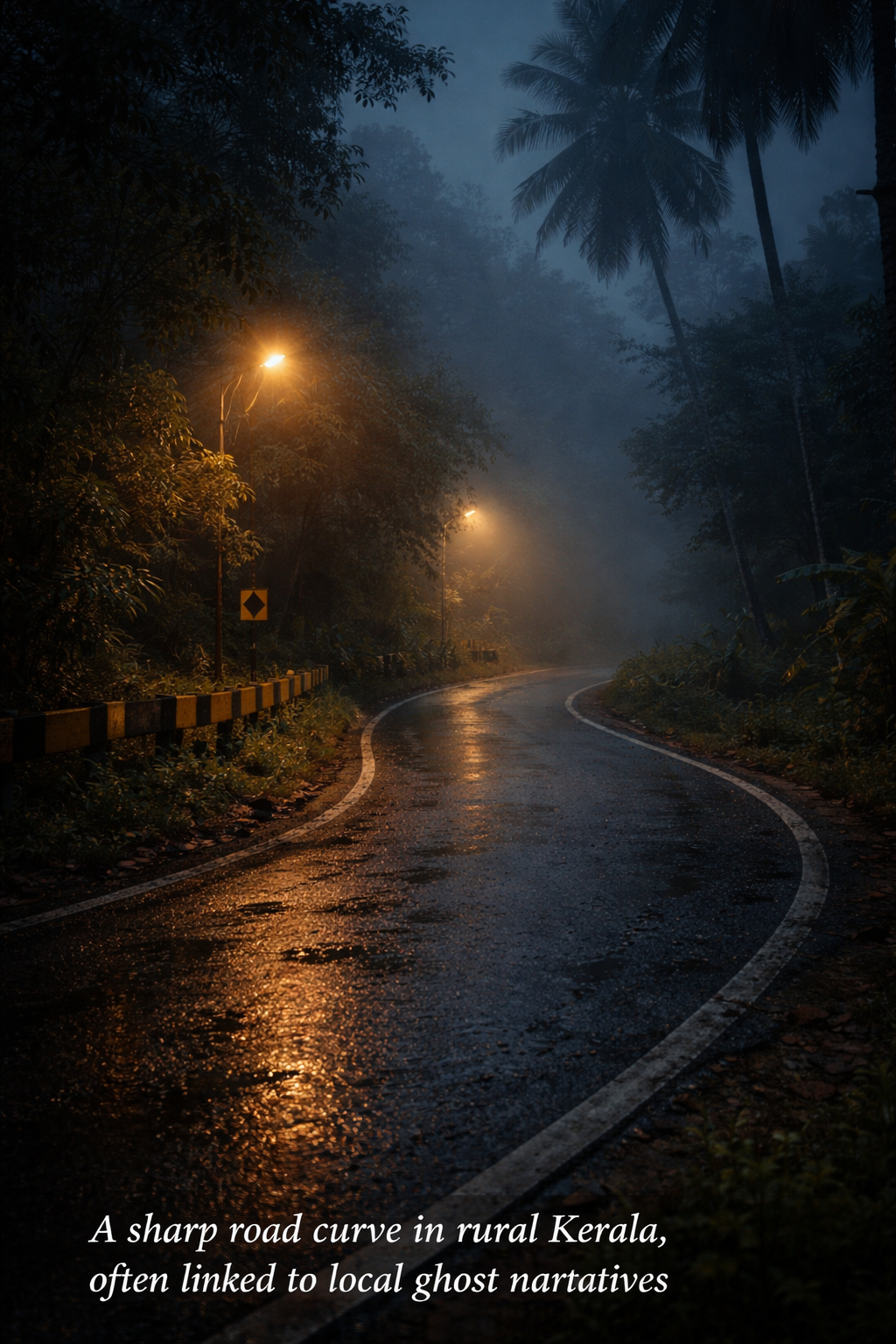
One of the most persistent motifs in global folklore is that of the revenant—the dead who return to the world of the living. Unlike abstract spirits, revenants are often depicted as recognizably human, bearing emotional ties, unresolved obligations, or moral grievances. Their return is rarely random; it is narratively justified by injustice, betrayal, improper death rites, or social transgression.
Revenant traditions appear across cultures under different names: European walking dead, East Asian hungry ghosts, African ancestral spirits, and South Asian restless souls. Despite cultural variation, these narratives share a core logic: death does not dissolve social responsibility. When social balance is disrupted, folklore imagines the dead as active agents demanding correction.
From a folkloristic perspective, revenant stories externalize guilt, memory, and unresolved conflict. They allow communities to speak about moral failure without direct accusation. By attributing unrest to the dead, societies symbolically negotiate accountability while maintaining social cohesion.
In Kerala folklore, spirits who return due to betrayal, denied rituals, or violent death closely parallel revenant traditions elsewhere. These stories function less as horror narratives and more as moral commentaries on obligation, justice, and remembrance.
8. Yakshi, La Llorona, and the White Lady: A Comparative Reading
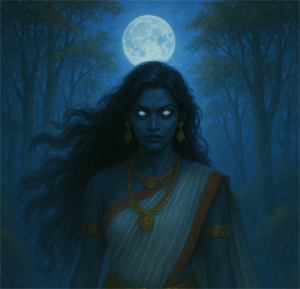
AI Generated image
Female ghost figures occupy a significant place in fear folklore worldwide. Often appearing as mourners, seductresses, or wandering figures near water or roads, these spirits embody cultural anxieties surrounding femininity, loss, and transgression. Their narratives frequently involve betrayal, abandonment, or social punishment.
The Yakshi of Kerala, La Llorona of Latin America, and the White Lady legends of Europe differ in cultural detail but converge structurally. Each represents a woman wronged or displaced, whose spirit continues to inhabit liminal spaces. Her presence serves as both warning and remembrance, reminding society of suppressed suffering.
Folklore analysis reveals that such figures are not merely ghost stories, but symbolic negotiations of gender norms and moral boundaries. They give narrative voice to experiences historically marginalized or silenced. Fear arises not solely from the apparition, but from the unresolved social tensions it represents.
By comparing these figures cross-culturally, folklore studies demonstrate how similar narrative solutions emerge in different societies when addressing grief, injustice, and gendered vulnerability.
9. Chathan and the Global Trickster Spirit
Not all fear-based folklore revolves around malevolent spirits. Many cultures narrate trickster beings who blur the line between danger and play. These spirits deceive, disrupt, and unsettle, yet are rarely purely evil. Their unpredictability generates fear, but also fascination.
Chathan in Kerala folklore exemplifies this category. Known for mischief, deception, and boundary-crossing, Chathan operates outside moral binaries. Similar figures appear worldwide: the African Anansi, the Native American Coyote, the Norse Loki, and various Southeast Asian forest spirits. Though culturally distinct, they share narrative traits of ambiguity and disruption.
Trickster spirits often emerge in periods of social transition. They embody uncertainty, challenge authority, and expose hypocrisy. Fear attached to these beings arises not from violence, but from instability. They remind societies that order is fragile and norms are negotiable.
By placing Chathan within a global trickster framework, folklore scholarship reveals how fear folklore can function as social critique, humor, and philosophical reflection rather than simple superstition.
10. Why Fear Folklore Survives Science and Modernity
Despite advances in science, medicine, and rational inquiry, fear-based folklore continues to thrive. Ghost stories, omens, and supernatural narratives persist not because people reject science, but because folklore operates in domains where empirical explanation offers limited emotional comfort. Fear folklore addresses uncertainty, loss, injustice, and mortality—areas where factual knowledge alone cannot resolve human anxiety.
Modernity has altered the language of fear, but not its structure. Where earlier societies feared forests and spirits, contemporary societies fear abandoned buildings, highways, institutions, and anonymous systems. Folklore adapts by relocating its narratives into new environments while preserving familiar motifs of warning, memory, and transgression.
From a folkloristic standpoint, the survival of fear narratives demonstrates that folklore is not a relic of pre-modern thought. It is a living cultural process that responds dynamically to social change, translating timeless anxieties into contemporary forms.
11. Digital Ghosts and the New Folklore of Fear
In the digital age, fear folklore has found new spaces of expression. Stories of haunted profiles, dead users appearing online, algorithmic presences, and lingering digital traces reflect emerging anxieties about identity, permanence, and surveillance. These narratives, though technologically framed, follow traditional folkloric patterns.
Digital ghosts differ from classical spirits in form, but not in function. They represent unresolved presence, memory without closure, and the fear that something persists beyond its proper boundary. Social media platforms, abandoned accounts, and artificial intelligence systems become the new liminal spaces where folklore attaches itself.
Such narratives illustrate how folklore continues to interpret unfamiliar technologies through symbolic storytelling. Fear arises not from the technology itself, but from uncertainty about control, authorship, and the boundary between life and afterlife in digital form.
12. Fear, Memory, and the Social Work of Ghost Stories
At its core, fear folklore is deeply connected to memory. Ghost stories remember what societies prefer to forget—violence, injustice, marginalization, and unacknowledged loss. By narrating these experiences through supernatural frameworks, cultures preserve difficult histories in indirect but enduring forms.
Folklore allows fear to be shared rather than isolated. The act of telling and retelling transforms private anxiety into collective meaning. In this way, ghost stories function as social tools, enabling communities to process trauma, negotiate morality, and articulate boundaries.
Whether expressed through ancestral spirits, revenants, tricksters, or digital apparitions, fear folklore remains a vital cultural language. It reminds us that what haunts societies is not the supernatural itself, but unresolved human experience.
Conclusion: Fear as a Universal Folkloric Language
Ghost stories exist in every society because fear is universal, but culturally shaped. Folklore provides the narrative structures through which fear becomes meaningful, communicable, and socially useful. These stories endure not as irrational beliefs, but as symbolic expressions of memory, morality, and uncertainty.
By examining fear folklore comparatively—across regions, cultures, and historical periods—we recognize a shared human impulse to narrate the unknown. From Kerala’s spirit traditions to global urban legends and digital ghosts, fear folklore reveals how societies confront what lies beyond explanation while remaining deeply human.
References
- Alan Dundes, International Folkloristics: Classic Contributions by the Founders of Folklore. Rowman & Littlefield, 1999.
- Alan Dundes, The Vampire: A Casebook. University of Wisconsin Press, 1998.
- Linda Dégh, Legend and Belief: Dialectics of a Folklore Genre. Indiana University Press, 2001.
- Carl Wilhelm von Sydow, “Geography and Folk-Tale Oikotypes,” in Selected Papers on Folklore. Copenhagen: Rosenkilde and Bagger, 1948.
- David J. Hufford, The Terror That Comes in the Night: An Experience-Centered Study of Supernatural Assault Traditions. University of Pennsylvania Press, 1982.
- Ronald L. Baker, Hoosier Folk Legends. Indiana University Press, 1982.
- Jacqueline Simpson and Steve Roud, A Dictionary of English Folklore. Oxford University Press, 2000.
- William Bascom, “The Forms of Folklore: Prose Narratives,” Journal of American Folklore, Vol. 78, No. 307 (1965).
- Jan Harold Brunvand, The Vanishing Hitchhiker: American Urban Legends and Their Meanings. W. W. Norton & Company, 1981.
- Jack Zipes (ed.), The Oxford Companion to Fairy Tales. Oxford University Press, 2000.
- Claude Lévi-Strauss, “The Structural Study of Myth,” Journal of American Folklore, Vol. 68, No. 270 (1955).
- Raghavan Payyanad, Folklore of Kerala. Kerala State Institute of Languages, multiple editions.
- M. G. S. Narayanan (ed.), Cultural Symbiosis in Kerala. Kerala Historical Society, 1972.