The Malabar Coast of Kerala, long celebrated as the "Garden of Spices," is a geographic and cultural threshold where monsoon winds have, for millennia, orchestrated a profound human synthesis. Within this landscape, the Mappila (Malabar Muslim) community has emerged not merely as a demographic group but as the custodians of a vibrant culinary tradition that functions as a living archive — a palimpsest layering ancient maritime trade, matrilineal domestic wisdom, and the resilient folklore of North Kerala upon one another.
To examine Mappila cuisine is to engage with centuries of exchange: Arab and Persian influences meeting Dravidian rice-and-coconut subsistence, producing dishes that are at once deeply local and gloriously cosmopolitan. This article traces that story — from the spice-route origins of the community to the wedding rituals, oral traditions, and coastal seafood craft that make Malabar Muslim food culture one of India's most distinctive.
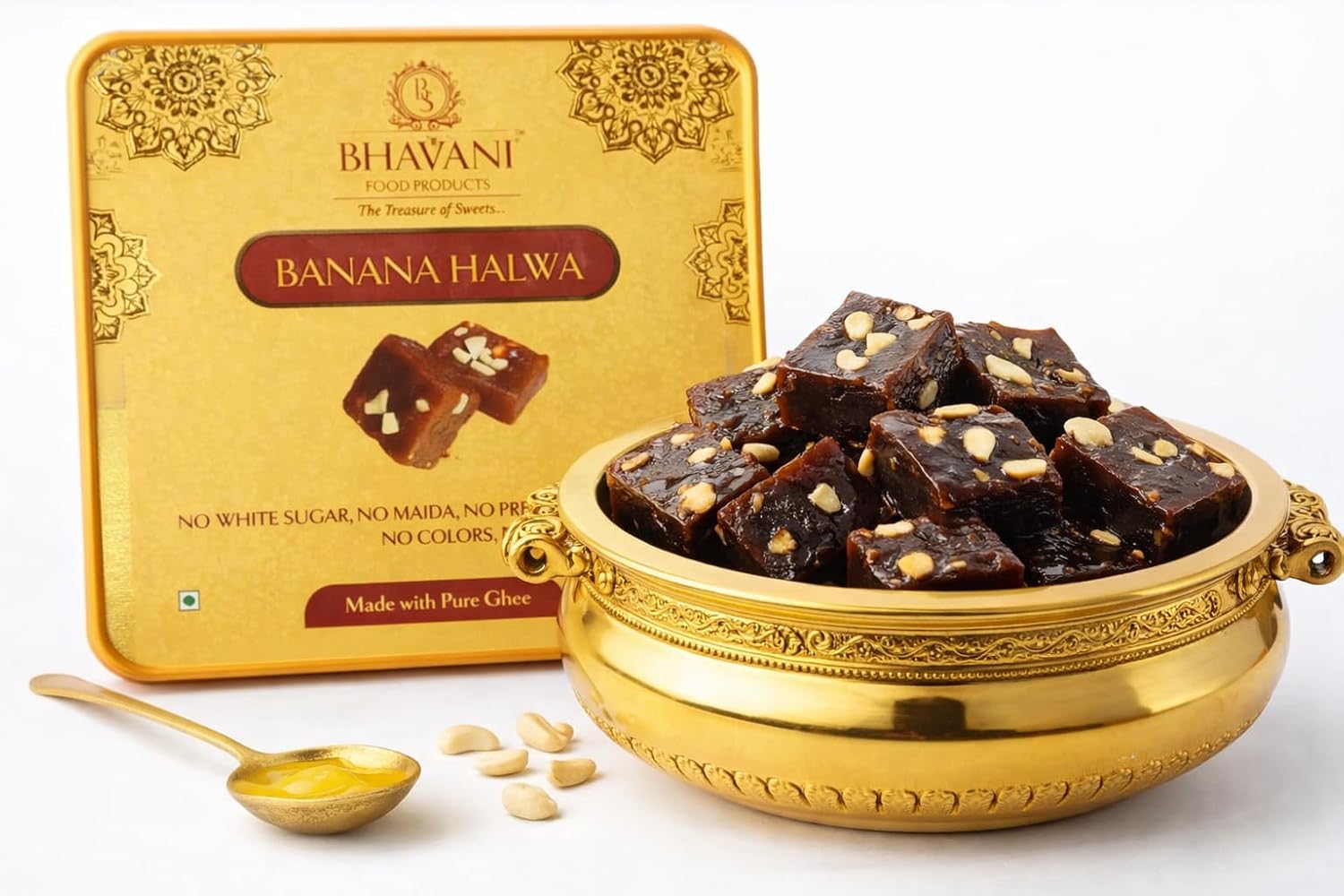
No exploration of Malabar Muslim food culture is complete without tasting Kozhikode Halwa — the glossy, chewy confection that has defined the sweet shops of Calicut for generations. Made from wheat starch, coconut oil, and aromatic spices, it is a flavour of heritage.
View on AmazonAs an Amazon Associate, KeralaFolklore.com earns from qualifying purchases.
The Ancient Lure: Spices, Trade, and the Birth of a Community
The genesis of Mappila culinary culture is inseparable from the ancient global demand for Malabar's "black gold" — pepper — and its aromatic companions: cardamom, ginger, and cinnamon. Records from Sumeria and ancient Egypt trace spice export from this coast as far back as 3000 BCE. Phoenicians, Babylonians, and Romans navigated the Indian Ocean to ports such as Muziris and Calicut, drawn by aromatics that held sacred, medicinal, and economic value across the ancient world.
| Era | Key Partners | Commodities | Culinary Impact |
|---|---|---|---|
| Pre-7th Century | Babylonians, Egyptians, Phoenicians | Pepper, Cinnamon, Teakwood | Early seasoning and preservation techniques |
| 7th–12th Century | Arab Traders (post-Islam) | Spices, Silk, Ginger | Introduction of ghee, meat-centric diets, dum cooking |
| 13th–16th Century | Persian & Chinese Merchants | Ceramics, Dates, Silk | Refined pastry forms and sweet–savory balance |
| 16th–19th Century | Portuguese, Dutch, British | Spices (monopolised), Coffee, Tea | Resistance narratives in food; introduction of European breads |
By the fourth century CE, Arab merchants had established dominance over Indian Ocean trade routes, using monsoon navigation and advanced dhow technology. Unlike later colonial regimes, these interactions were marked by cultural accommodation: extended monsoon layovers fostered settlement and intermarriage, giving rise to the Mappila community. The term Mappila is commonly traced to the honorific Maha Pillai ("Great Child"), reflecting the esteem the Zamorins of Calicut extended to these traders. The peaceful arrival of Islam layered Halal dietary ethics onto existing regional food habits without displacing indigenous culinary structures. What emerged was a hybrid ecology where Middle Eastern meat preferences met Kerala's rice-and-coconut economy.
The Matrilineal Hearth: Gendered Space and the Tharavaad Kitchen
In northern Malabar districts such as Kannur and Kozhikode, Mappila society was historically shaped by the Tharavaad (ancestral home) and matrilineal inheritance. This female-centred order elevated the kitchen from a functional space to a locus of authority, ritual, and cultural transmission. Culinary knowledge flowed matrilineally, and women became the community's primary cultural archivists — custodians of recipe memory no text could fully capture.
The Puthiyappila ("visiting husband") domestic arrangement transformed cooking into a performative expression of familial prestige. A Tharavaad's social reputation was measured by the diversity and refinement of dishes served to the groom, giving rise to an elaborate repertoire of Pathiris, seafood specialties, and festive sweets.
"Through the Tharavaad kitchen, Malabar women became the true archivists of a culinary tradition that no manuscript could fully preserve — their hands encoded memory in dough, batter, and spice."
The Wedding Narrative: From Vilikarathis to Salkarams
The traditional Mappila wedding is the ultimate repository of ancestral food tradition — a multi-week narrative journey that begins long before the Nikkah and unfolds through rituals that emphasise communal labour, reciprocal generosity, and shared identity.
The Vilikarathis and the Architecture of the Bajaar
Formal invitations are conducted by Vilikarathis — local women who visit every household in the community. They are skilled social navigators, acutely aware of kinship hierarchies and village politics. Upon their arrival, the host household prepares a bajaar — a "market" of snacks arranged on a large glass platter called a Kaasa — following a precise folk grammar: a base of savoury mixture (michar), topped with banana chips, sponge cakes, and finally ghee halwas, ladoos, and jalebis. Tradition forbids even offering water to the Vilikarathi before she has eaten. The scale of the bajaar directly reflects the host family's standing.
Arikuthu Cheral: The Symphony of Communal Labour
Ten days before the wedding, the bride's kin assemble for Arikuthu Cheral — the ceremonial pounding of rice. Women manually pound enormous quantities of rice into flour for Pathiri, Puttu, and Idiappam while also preparing foundational spices — chili, turmeric, coriander, garam masala — entirely from scratch. The deliberate rejection of commercial substitutes is a defining marker of Mappila culinary ethics: it embeds care, memory, and authenticity into every bite of the wedding feast.

Salkarams: Feasts of Friendship and Equality
The Salkaram extends the feast beyond immediate family to friends, neighbours, and allies, functioning as a mechanism of communal cohesion. Groups of eight to ten sit together on round palm-leaf mats (Supra) or low wooden stools (masara palaga), sharing food from a single large plate called a Dolungu — a practice inherited from Arab communal dining traditions that dissolves economic distinctions and reinforces collective identity.
| Course | Dish | Cultural Role |
|---|---|---|
| Welcome Drink | Fruit-flavoured water or almond milk | First marker of hospitality |
| Opening | Aleesa (wheat & chicken porridge) | Mildly spiced, served with sugar; bonds of warmth |
| Main Course | Thalassery Biriyani | Culinary centrepiece of every Mappila feast |
| Accompaniments | Raitha & Pickle | Balances richness with acidity and spice |
| Dessert | Payasam | Ritual "sweet ending" to the feast narrative |
| Digestive | Sulaimani tea | Final palate cleanser; Arab culinary legacy |
Thalassery Biriyani: Malabar Soul in Every Grain
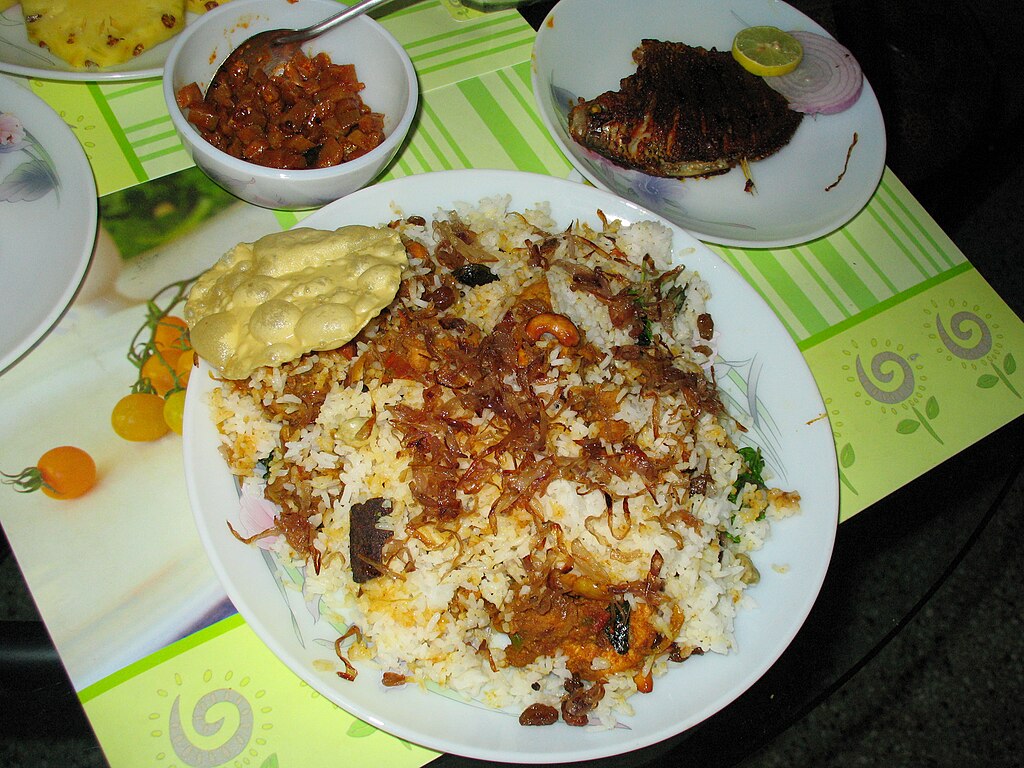
Thalassery Biriyani is the most widely recognised ambassador of Mappila cuisine, yet its identity lies in a deeply localised indigenisation of Mughal culinary frameworks. While biriyani entered India through Persian and Mughal channels, the Malabar variant evolved under the influence of indigenous grains and centuries of North Kerala Muslim refinement.
Its defining characteristic is the use of short-grain Khaima or Jeerakasala rice rather than long-grain Basmati. The rice is first fried in ghee, enabling it to absorb complex flavours while retaining its structural integrity. Cooking follows the dum method — layering meat masala and parboiled rice in a sealed vessel, slow-cooked with hot coals placed on the lid, trapping fragrant steam within.
The spice profile privileges fennel seeds (saunf) over cumin, complemented by Tellicherry black pepper and a restrained use of chili. The result is a lighter, more aromatic biriyani that reflects the refined palate of Malabar's mercantile classes — confident, layered, and unmistakably coastal.
The Taxonomy of Rice: Forty Faces of the Pathiri
If biriyani is the king of the Mappila feast, the Pathiri — a rice-flour flatbread — is its most versatile subject. Ethnographic estimates suggest nearly forty distinct varieties, reflecting an unmatched technical mastery over rice flour accumulated over generations.
Among the most celebrated are Ari Pathiri — ultra-thin, soft rice pancakes kneaded in boiling water, the daily staple served with meat or fish curries; Chatti Pathiri — a layered, lasagna-like dish of pancakes dipped in egg and filled with spiced meat, comparable in complexity to Turkish or Yemeni stuffed pastries; Meen Pathiri — rice pancakes stuffed with fish masala and steamed in banana leaves; Irachi Pathiri — stuffed, fried or steamed breads popular during Ramadan; and Neypathiri — thick, deep-fried rice breads flavoured with shallots, cumin, and coconut. The flakiness of certain varieties links to Middle Eastern pastry influences, yet the ingredients remain resolutely indigenous.
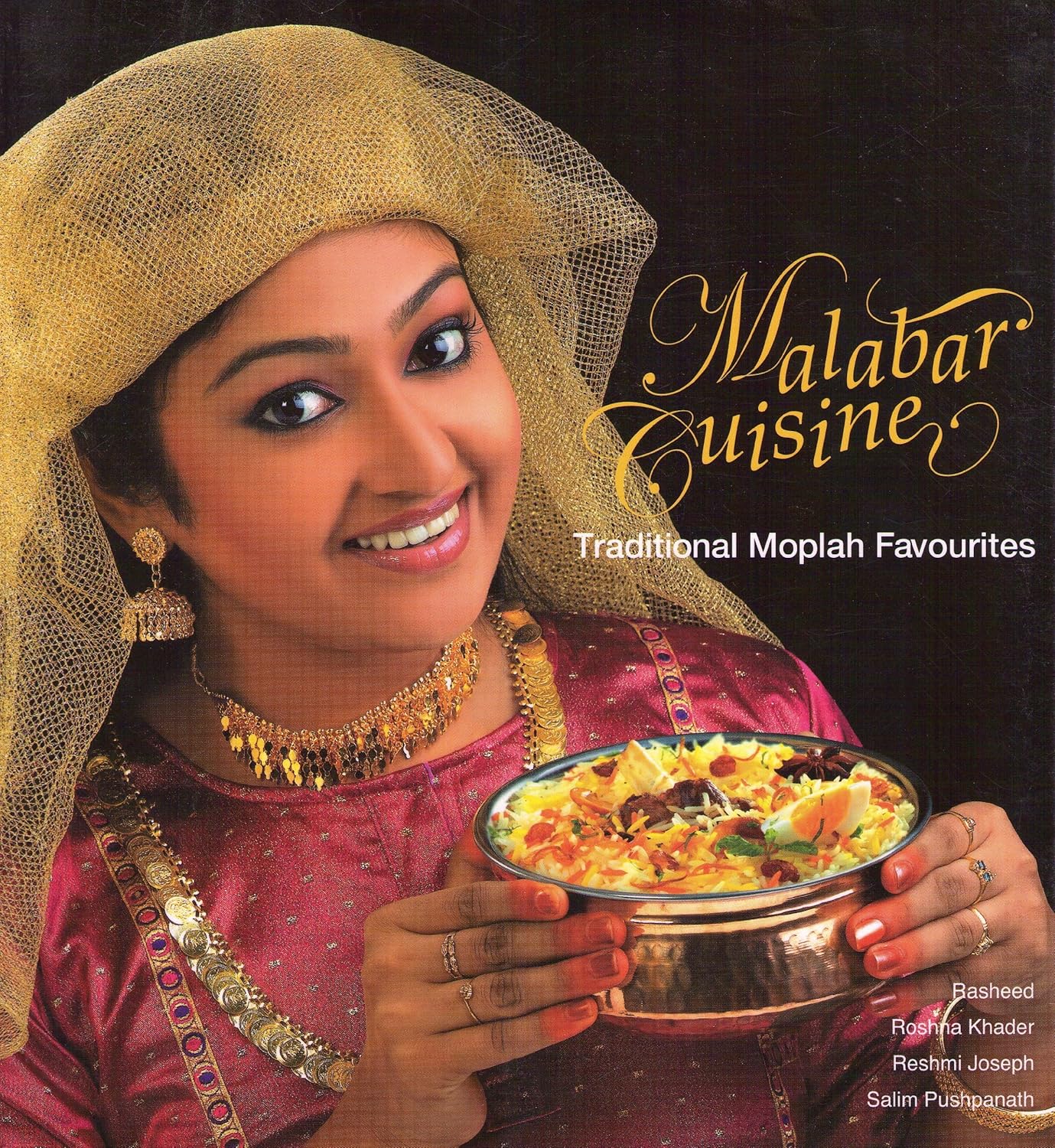
Deepen your understanding of Mappila culinary heritage with authoritative books on Malabar food traditions. From Ummi Abdulla's foundational works to scholarly explorations of North Kerala foodways, these volumes are indispensable for anyone passionate about this cuisine.
Browse on AmazonAs an Amazon Associate, KeralaFolklore.com earns from qualifying purchases.
The Coastal Harvest: Mussels and the Lore of the Sea
The maritime heritage of the Mappilas finds its most visceral expression in seafood — particularly in the use of Kallummakkaya (green mussels). Harvested from rocks lining the Malabar coast, these mussels are almost exclusively associated with Mappila cooking, marking a clear culinary boundary within Kerala's diverse coastal food cultures.

The signature preparation, Arikkadukka (stuffed mussels), is intensely laborious: shells are meticulously cleaned, stuffed with a spiced rice paste, steamed, and then deep-fried. This dish epitomises the Mappila genius for combining a maritime ingredient with the agrarian staple of rice through centuries-refined preservation and seasoning technique.
| Seafood Specialty | Main Ingredient | Cooking Method |
|---|---|---|
| Arikkadukka | Green Mussels | Stuffed with rice paste, steamed then deep-fried |
| Ayila Nirachathu | Mackerel | Stuffed with roasted coconut and spice masala; pan-fried |
| Chemeen Biriyani | Prawns | Layered dum cooking with aromatic Khaima rice |
| Meen Pathiri | Fish Masala | Steamed in banana leaf within a rice-flour casing |
Sweetness as Symbolism: Muttamala, Unnakaya & Kozhikode Halwa
Muttamala: The Golden Egg Chains
Muttamala — literally "egg necklace" — is an intricate wedding sweet made entirely from egg yolks. The yolks are poured through a tiny aperture into boiling sugar syrup, forming fine, thread-like strands resembling a golden garland. These strands are traditionally served atop Muttasirka, a white steamed pudding made from egg whites — ensuring complete utilisation of the egg with characteristic Mappila resourcefulness. Often garnished with cherries, Muttamala transforms a humble ingredient into an object of ceremony.
Unnakaya: The Spindle of Malabar

Unnakaya is a spindle-shaped sweet crafted from mashed, steamed ripe plantains — stuffed with grated coconut, sugar, cardamom, and fried raisins or nuts, then deep-fried in ghee or coconut oil. The result is a crisp exterior encasing a soft, melt-in-the-mouth interior. More than a snack, Unnakaya embodies the Malabar philosophy of culinary alchemy: taking modest, locally sourced ingredients and, through skilled technique, elevating them to something extraordinary.
And then there is Kozhikode Halwa — the glossy, dense, chewy confection that defines the sweet shops lining the streets of Calicut. Made from wheat starch (or sometimes maida), coconut oil or ghee, and sugar, with undertones of cardamom and cashew, it is perhaps the most iconic ambassador of Malabar Muslim sweet-making beyond the community itself.
The Sonic Landscape: Food and Hospitality in Mappila Paattu
Malabar folklore extends beyond the kitchen into the rich oral tradition of Mappila Paattu (Mappila songs) — compositions in Arabi-Malayalam, a hybrid script employing Arabic letters to write Malayalam. These songs encode the community's ethos, history, and ideals of heroism and hospitality. During weddings, the women's dance form Oppana is performed to these songs, which frequently reference the sweetness of the bride and the abundance of the feast.
| Song Genre | Primary Theme | Context of Performance |
|---|---|---|
| Mala | Praise of Sufi saints | Religious commemorations, domestic gatherings |
| Padappattu | Heroic deeds, historical battles | Narratives of colonial resistance |
| Wedding Songs | Love, hospitality, satire | Mehendi, Oppana, and family rituals |
| Kissa | Legendary and didactic narratives | Communal storytelling spaces |
A celebrated narrative within this tradition is the Kotturpalli Mala — a song recounting a Mappila youth who abandons his own wedding feast to rescue a girl abducted by a Portuguese ship. The feast left unfinished becomes a symbol of moral priority: honour over indulgence, community over self. Food functions here as the measure of sacrifice — what one willingly foregoes tells us what one truly values.
Shared Myths: The Mappilas in Kerala's Founding Narratives
A foundational Kerala myth integrating the Mappilas into the broader social imagination is the legend of Parayi Petta Panthirukulam — the twelve clans born of a Pariah woman. According to the legend, the sage Vararuchi married an outcaste woman and their twelve children were raised across diverse religious and caste traditions. One child, Uppukoottan, was raised as a Mappila and followed the teachings of the Prophet. The legend asserts that Mappilas are not outsiders but are genealogically embedded within the same symbolic family as Brahmins, Nairs, and Dalits. Food mediates this radical assertion — most notably in the episode where beef arrives at a Brahmin feast, challenging rigid dietary boundaries through folkloric narrative.
Cultural integration is further evidenced in the Mappila Ramayana, an oral adaptation of the Sanskrit epic unique to Malabar Muslims, in which Ravana is reimagined as a Sultan and moral negotiations are framed within Sharia law — a profound act of literary indigenisation that mirrors the community's larger culinary process.
Fasts and Festivals: The Cycle of the Sacred Meal
The religious calendar of the Mappilas is structured around the rhythm of fasting and feasting. Ramadan in South Malabar is a period of heightened identity formation: communal Iftar meals featuring Tharikanji (sweet semolina porridge) and an array of meat-filled snacks strengthen social bonds forged across the year.
Of even greater cultural magnitude is the Nercca — a festival honouring Sufi saints. Events like the Malappuram Nercca mirror Hindu temple festivals in scale, featuring elephants, fireworks, and mass public feeding. The preparation of Neychoru (ghee rice) and meat in enormous cauldrons for public distribution is considered an act of religious merit, embodying the Mappila ideals of charity and shared prosperity that run as a thread through every festive culinary tradition.
The Sulaimani Conclusion: An Amber Afterglow
Meals in Malabar traditionally conclude with Sulaimani — a clear black tea infused with lemon, cardamom, and occasionally ginger. A localised adaptation of Arabic kahwah, introduced by Arab traders as a digestive accompaniment to the region's rich cuisine, Sulaimani has become as emblematic of Malabar Muslim identity as the Biriyani itself. Symbolically, it mirrors Mappila culture: an amber infusion of indigenous spice and foreign influence, offering a gentle, warm closure to a long narrative of travel, trade, and cultural synthesis.
"Sulaimani mirrors Mappila culture itself — an amber infusion of indigenous spice and foreign influence, a gentle closure to centuries of travel, trade, and synthesis."