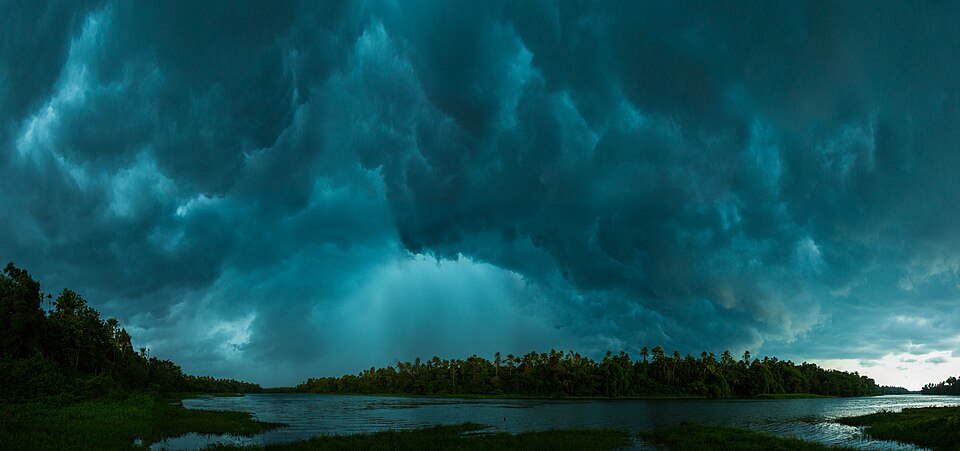
Folklore studies have a simple and provocative answer to the question of why ghost stories persist: because they work. Not as factual reports of supernatural encounters — but as cultural technologies for managing fear, negotiating social obligations, processing collective trauma, and transmitting moral codes. In Kerala, where one of the world's most sophisticated oral traditions meets one of India's richest supernatural imaginaries, this function is uniquely visible. Kerala's ghost stories are not pre-modern superstition awaiting the corrective light of modernity. They are a living intellectual and emotional system — and understanding why they exist is understanding something fundamental about the human mind.
Why Ghost Stories Exist — The Universal Question
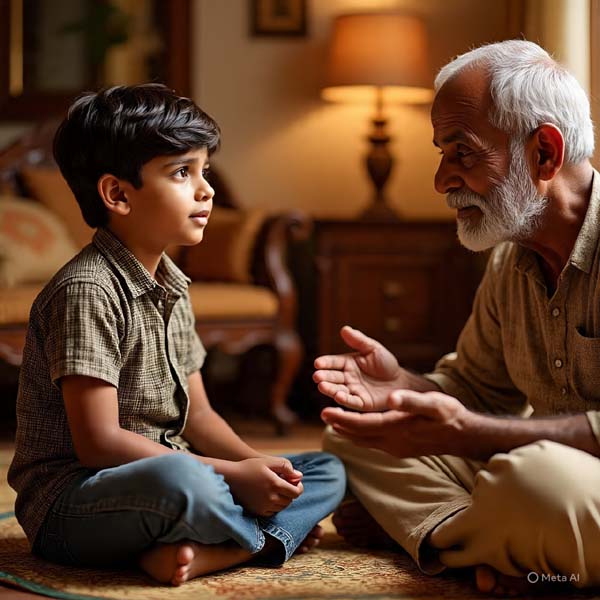
The question "are ghost stories true?" is the wrong question. The more revealing question — the question folklore studies has been asking for over a century — is: "Why does every human culture, in every historical period, in every geography, tell ghost stories?"
No society has ever been without them. Ancient Mesopotamia had ghost tablets documenting the protocols for appeasing restless dead. The Romans wrote haunted house narratives still recognisable in the genre today. Medieval European folklore was saturated with revenants. Chinese, Japanese, Indian, African, Indigenous American, and Australian Aboriginal traditions all developed rich and structurally similar supernatural narrative systems independently. When a behaviour appears in every human culture without direct cultural contact, the explanation must be universal to human experience — not specific to any single tradition.
Folklorist William Bascom's foundational taxonomy identified four core functions of folklore in any society: education (transmitting knowledge and survival skills), validation of culture (reinforcing beliefs and values), maintenance of conformity (discouraging deviance through narrative consequence), and release from social pressure (providing sanctioned spaces to express otherwise prohibited fears and desires). Ghost stories accomplish all four functions simultaneously — which is why they are among the most persistent of all narrative forms.
"A ghost story may be factually unverifiable yet culturally true — revealing how individuals and communities interpret experiences that fall outside ordinary explanation. When narrators insist a story is real, they are asserting sincerity rather than scientific certainty. This insistence is itself a meaningful cultural act, signalling trust, shared belief, and emotional authenticity."
— KeralaFolklore.com, on the folklore framework of supernatural narrativeThe Functions of Ghost Stories — What They Actually Do
Breaking down the specific work that ghost stories perform clarifies why they are not merely entertainment and why attempts to eliminate them through rational education consistently fail. Each function addresses a genuine human need that purely rational discourse cannot meet.
| Function | What It Does | Kerala Example |
|---|---|---|
| Safety Education | Teaches avoidance of genuinely dangerous situations through narrative consequence — water bodies at night, lonely roads, strangers after dark — without requiring direct experience of the danger | Yakshi near rivers and isolated trees at night; Kuttichathan at crossroads; warnings about entering forests alone during specific seasonal periods |
| Moral Enforcement | Creates consequences for moral failures (betrayal, neglect, injustice, cruelty) that may not exist in the visible social world — the wronged dead return to demand accountability | Kalliyankattu Neeli pursuing those who deceive or betray; ancestors returning when funeral rites are neglected; the Yakshi as the spirit of a murdered or betrayed woman |
| Grief Processing | Provides culturally sanctioned narrative frameworks for the persistence of the dead in the emotional lives of the living — the felt presence of the deceased is given a comprehensible form | Ancestral spirits lingering in the family home (tharavadu); the Muthappan tradition of deceased devotees continuing to communicate; spirits of those who died young appearing in protective roles |
| Community Cohesion | Creates shared experience and shared emotional intensity — the collective acknowledgement of invisible threat bonds communities more powerfully than the acknowledgement of visible threat | Village-specific ghost narratives that reinforce the uniqueness and sacred history of a particular location; shared ritual responses to haunting creating community action |
| Social Critique | Allows communities to express moral judgements about powerful individuals and institutions indirectly, through the metaphor of supernatural retribution, without direct confrontation | Brahmarakshasa (the spirit of a Brahmin who misused knowledge and power); Odiyaan narratives targeting feared individuals in communities; stories of colonial-era spirits in British-built structures |
| Ecological Knowledge | Encodes knowledge about dangerous environments — bodies of water, forest edges, monsoon conditions, disease-prone areas — in supernatural narrative that ensures the knowledge is remembered and transmitted | Spirits specifically associated with the Bavali River during flood season; Yakshi at specific trees known to harbour snakes or spiders; warnings about specific paths that become genuinely dangerous in monsoon |
Note that these functions are not mutually exclusive — a single ghost story typically performs multiple functions simultaneously. The Yakshi narrative, for instance, simultaneously provides safety education (avoid lonely paths at night), moral critique (this woman was betrayed), community cohesion (shared fear of a local spirit), and ecological knowledge (the specific tree or water body near which she appears is genuinely hazardous). This multi-functionality is exactly why ghost stories are so persistent — they are extraordinarily efficient cultural information carriers.
Kerala's Supernatural Figures — Profiles and Deeper Meanings
Kerala's supernatural tradition features a sophisticated pantheon of spirit figures, each with distinct characteristics, ecological associations, and social functions. Understanding them as a system — rather than as a collection of individual scary stories — reveals a coherent moral and cosmological framework.
Explore the scholarly and popular literature on ghost stories, spirit traditions, and supernatural folklore — from William Bascom's foundational folklore theory to cross-cultural studies of ghostlore and the psychology of fear narratives. These are the books that inform the ideas in this article.
Browse on Amazon →Affiliate link — we earn a small commission at no extra cost to you. Note: this link leads to a general selection; titles may not be specific to Kerala.
Liminal Spaces — Where Ghost Stories Happen
Anthropologist Victor Turner described liminality as "a state of ambiguity where conventional rules are suspended" — transitional zones that exist between established social categories. Threshold states. In-between places. Neither here nor there, neither this nor that.
This concept precisely explains one of the most consistent patterns in ghost stories across all cultures: supernatural encounters cluster at liminal locations and liminal times. Crossroads (between two paths). Riverbanks and shorelines (between water and land). Forest edges (between cultivation and wilderness). Twilight (between day and night). Midnight (the turning point between one day and the next). Doorways (between inside and outside). Graveyards (between the living and the dead).
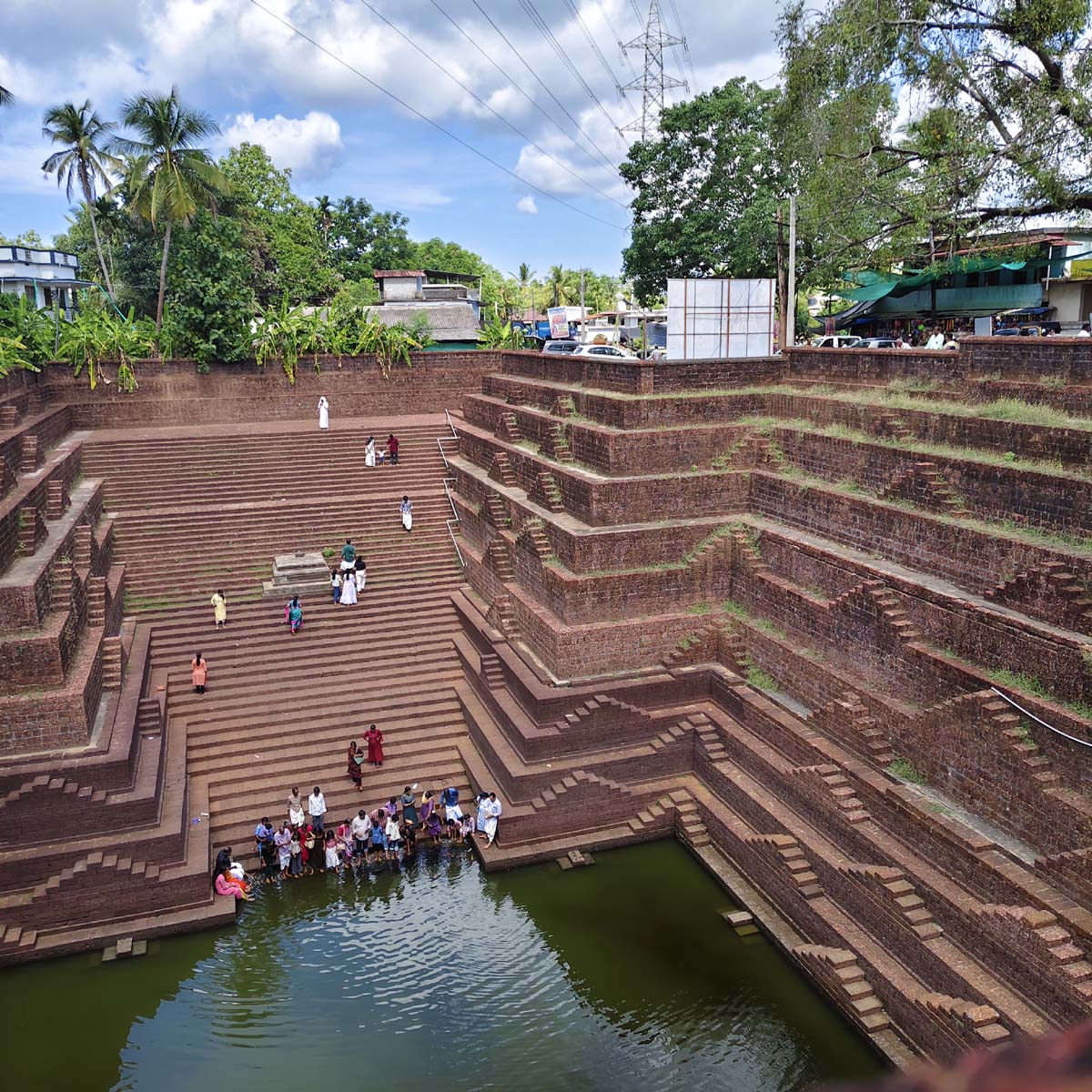
In Kerala, this pattern is especially pronounced. The Yakshi appears at specific trees — the Ezhilam Pala is not simply a tree but a tree known to stand at the boundary of habitation and forest, at the edge of human order. Temple ponds (the Peralassery pond and hundreds like it) are sites of ritual encounter because they are simultaneously sacred and dangerous — spaces of purification that require crossing a threshold of ordinary social behaviour. The monsoon forest, the rain-swollen river at night, the road between villages in the dark — all are consistently named as places where the supernatural becomes more accessible, and all are genuinely boundary spaces in Kerala's physical and social geography.
Kerala's monsoon — with its dramatic reduction of visibility, its transformation of familiar landscapes, its acoustic changes (rain masking sounds, thunder substituting for them), and its historical association with disease and isolation — creates the perfect physical conditions for the psychological experiences that ghost stories narrate and explain. The convergence of monsoon season with many of Kerala's major ritual festivals (Kottiyoor, Theyyam preparations) is not coincidental. Seasonal liminality amplifies the experience of spiritual presence.
Theyyam — Where Ghost Stories Become Sacred Reality
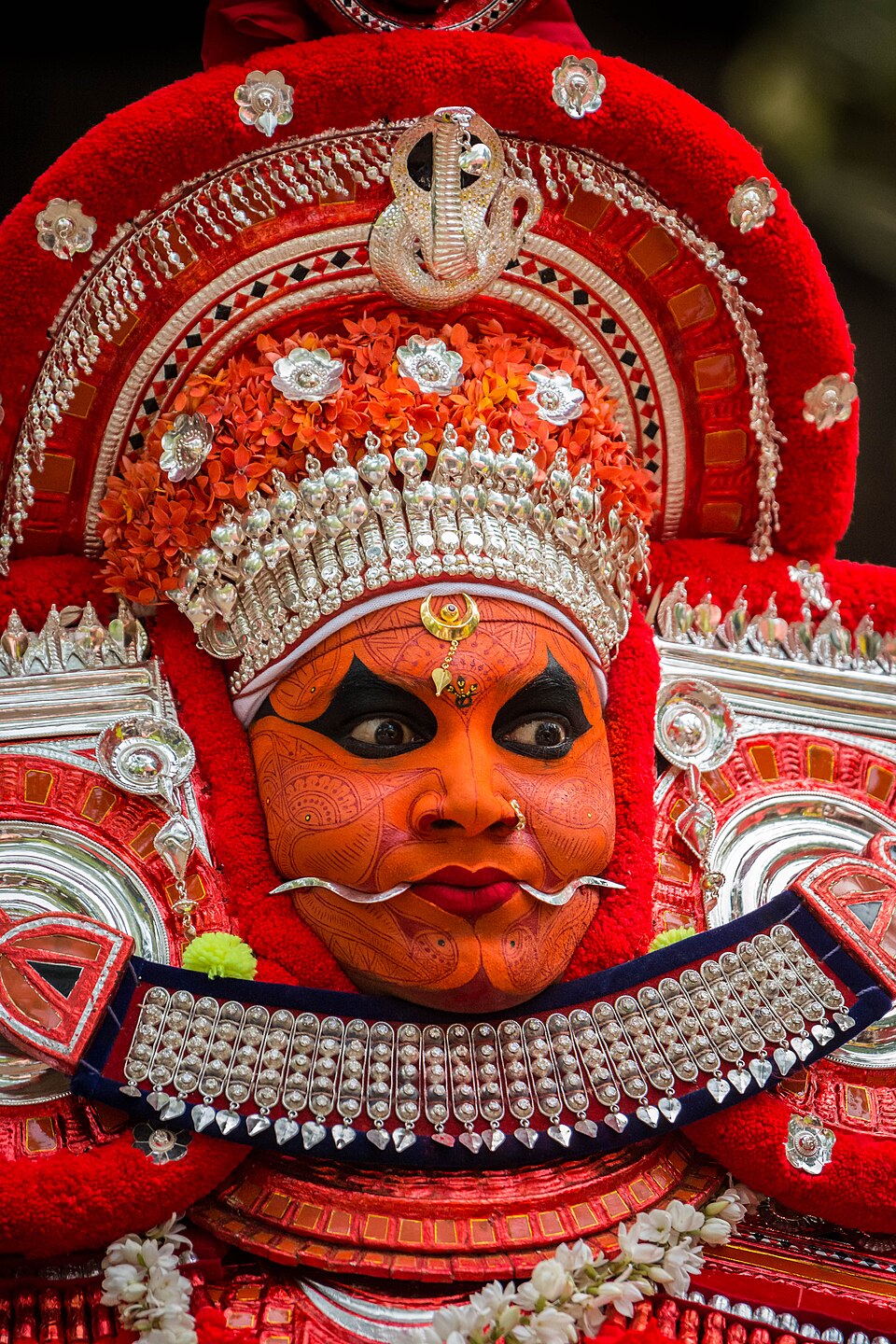
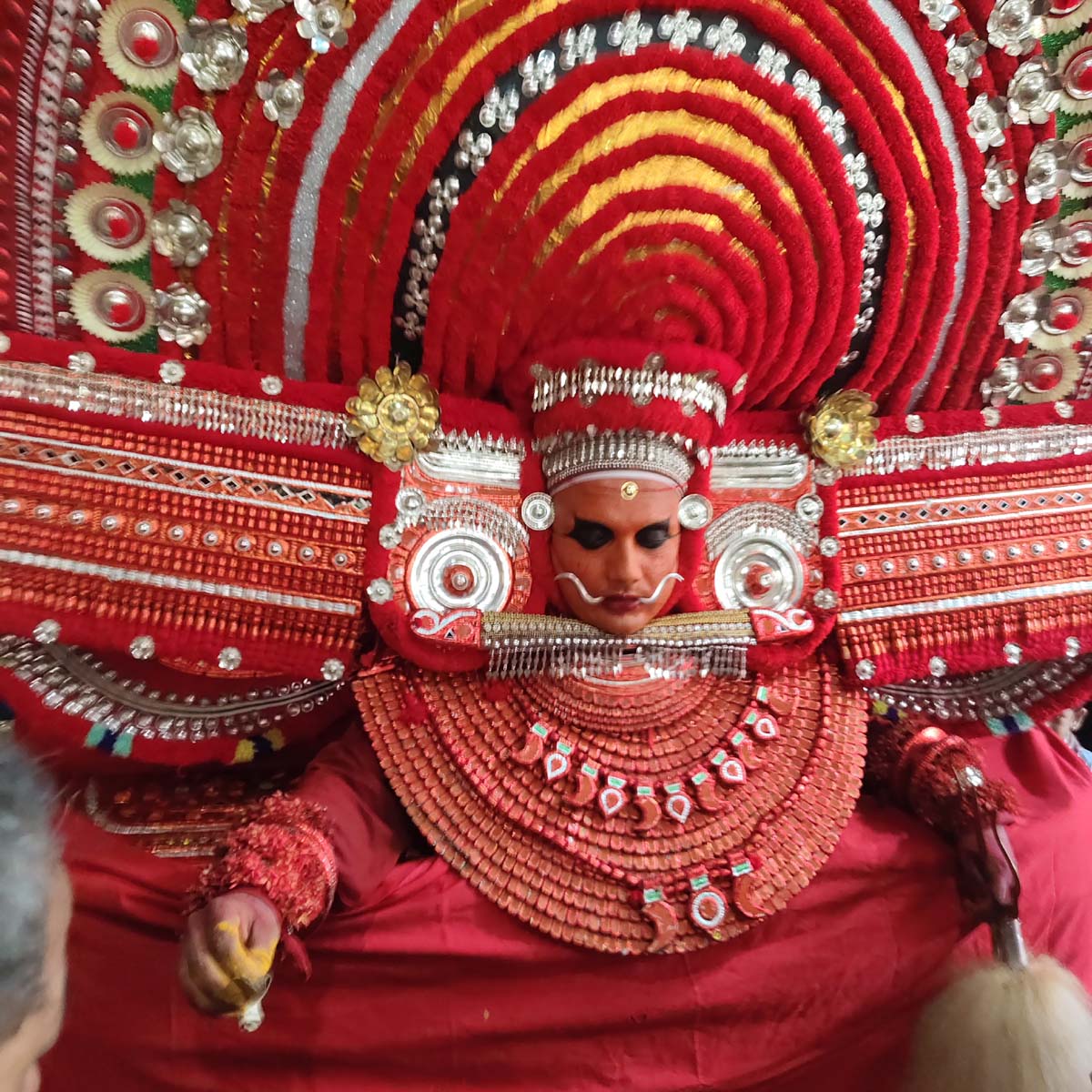
Kerala's most extraordinary contribution to the global study of ghost stories is Theyyam — the ritual art form of North Kerala that represents the institutionalised, community-sanctioned form of the same impulse that drives informal ghost narratives.
Where ghost stories circulate as informal oral texts — told in homes, passed between generations, adjusted for local context — Theyyam encodes the same beliefs in formal ritual, elaborate visual language, and communal ceremony. Many Theyyam deities are precisely the kind of figures that ghost stories describe: historical individuals who died through violence, betrayal, or injustice, and who were subsequently deified as protective spirits of their communities.
The Theyyam performer enters a trance state through which the spirit is believed to return and speak — directly, to the community that gathers to receive them. This is ghost story logic taken to its highest cultural expression: not just narrating the belief that the dead return, but ritually enacting it, creating a space within which the community can interact with those who have been lost, receive guidance, and process unresolved grief and obligation in a structured, sacred context.
"Theyyam does not argue for or against the existence of ghosts. It simply proceeds from the assumption that the relationship between the living and the dead is ongoing — and creates a formal, beautiful, terrifying space within which that relationship can be maintained."
This connection between informal ghost narratives and formal ritual systems is not unique to Kerala — similar relationships exist between folk ghost stories and Day of the Dead ceremonies in Mexico, between Scottish ghostlore and clan ancestral practices, between Japanese ghost narratives (obake, yūrei) and the Obon festival. In Kerala, however, the connection is unusually visible and unusually sophisticated, because Theyyam has preserved it in such extraordinary ritual detail across hundreds of forms.
The Psychology of Ghost Stories — Why Fear Is the Point
The experience of fear during a ghost story is not an unfortunate side effect to be avoided — it is the mechanism through which the story's functional content is transmitted most effectively. Fear creates a state of heightened attention and emotional arousal that is associated with superior memory encoding. A lesson delivered through fear is remembered longer and more vividly than a lesson delivered through abstract instruction.
This is why ghost stories are one of the most efficient educational technologies ever developed. The Yakshi story does not merely say "avoid lonely roads at night" in the way that a safety announcement does. It makes you feel what could happen with a visceral specificity — the sound of ankle bells approaching, the beautiful face turning monstrous — that encodes the warning at an emotional depth that rational instruction cannot reach. The fear IS the education.
Contemporary psychological research supports this: terror management theory (Greenberg, Pyszczynski, and Solomon) identifies the management of death-awareness as one of the central preoccupations of human psychology. Ghost stories provide a culturally specific mechanism for engaging with death-awareness — they bring the dead into the social world in controlled, narratable forms, making death-anxiety manageable rather than overwhelming. Communities that regularly tell ghost stories are not exhibiting irrational fear. They are practising a form of cultural therapy that processes the most universal human fear in a collectively supported framework.