Kandakarnan Theyyam: The Fiery Guardian of North Malabar and the Ritual of Divine Protection
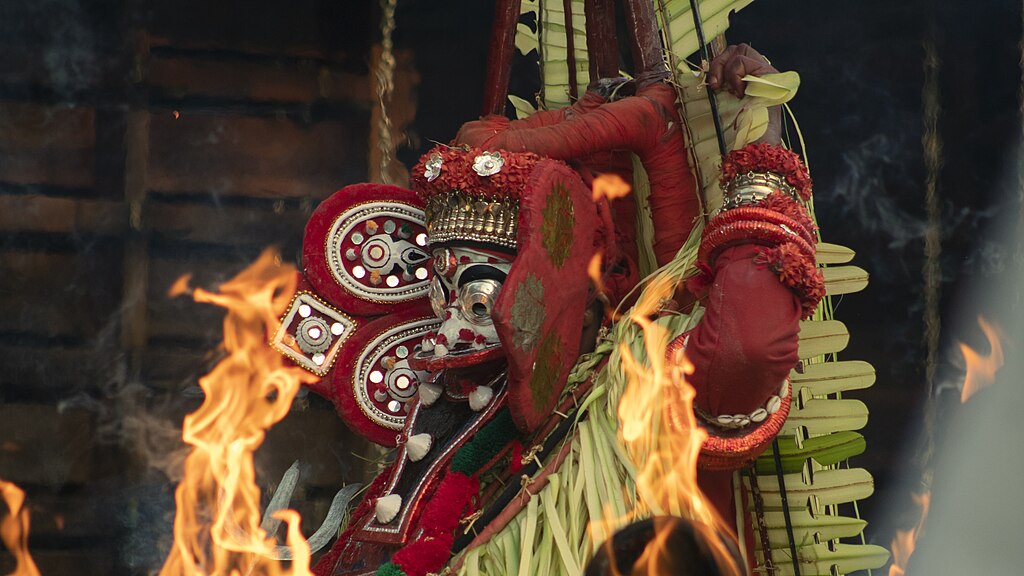
Credit: Vishnu Rema Jayaram, CC BY-SA 4.0 , via Wikimedia Commons
I. Introduction: Defining the Divine Fury and Function of Khandakarnan
Theyyam, often referred to as Kaliyattam or the "Dance of the Gods," is a mesmerizing ritual dance form deeply embedded in the cultural landscape of northern Kerala, specifically concentrating in the districts of Kannur and Kasaragod in the North Malabar region.1 This vibrant tradition is far more than mere artistic expression; it is a profound form of worship where a skilled performer, known as the Koladhari, embodies the spirit of a deity, ancestor, or hero, allowing the divine to manifest temporarily in the human world.1 Among the hundreds of distinct Theyyam types, Kandakarnan Theyyam occupies a uniquely powerful position. This deity is strongly associated with Lord Shiva, symbolizing immense power, fury, and ultimate protection.6 Kandakarnan is revered as a guardian deity in numerous sacred groves (Kavus) throughout Malabar, transforming into a mystical protector.6 The defining characteristic of this Kolam is its intensity, often presenting aggressive movements and profound fire rituals.6 This fiery nature has led to the common designation, Agnikandakarnan Theyyam.7 The performance serves a crucial, specific function within the community: Kandakarnan is primarily invoked to ward off diseases and epidemics, such as smallpox, acting as a divine cleanser and protecting the community from illness.3 This protective mandate ensures the Theyyam’s enduring significance, reinforcing the community’s faith and providing psychological reassurance against external threats to well-being.6
II. Mythology and Lineage: The Cosmic Battle Against Disease
The legend of Kandakarnan situates him firmly within the greater Hindu mythological framework while adapting local spiritual requirements. Kandakarnan is presented as a deity completely devoted to Lord Shiva.6 The aggressive dance movements and the curation of powerful elements, particularly fire, within the ritual reflect a deep affirmation and dedication to Lord Shiva's wrathful form, often linked to the fierce deity Bhairava.6 This fierce manifestation is considered necessary for the deity’s primary protective role.
The Nexus of Plague and Protection: Kandakarnan and Vasoorimala
A critical element in understanding the ritualistic purpose of Kandakarnan is his direct mythological and performance relationship with Vasoorimala Bhagwati.7 Vasoorimala is the goddess associated with Vasuri, or smallpox, and her origin story, like Kandakarnan’s, is often connected to the death of the demon Darikasura.7 The frequent joint performance of Khandakarnan Theyyam and Vasoorimala Theyyam at the same sacred sites—such as the Pinarayi Sree Kadanrayaroth Khandakarnan Kshethram5 or the Thalasseri Kadavathur Sree Kuroolikkavu9—is not incidental. This pairing is a codified ritualistic representation of disease management and divine intervention. Vasoorimala represents the destructive force of the epidemic, while Kandakarnan, acting as the fierce protector derived from Shiva’s wrath, embodies the power required to neutralize, contain, or consume that disease.3 The public witnessing of both these deities manifesting simultaneously provides a profound narrative framework for confronting and ultimately overcoming communal affliction.
Kandakarnan as a Mandramoorthi Theyyam
Within the established pantheon of Theyyams, Kandakarnan is classified among the Mandramoorthi Theyyams.10 This category signifies deities associated with potent elemental control, often bordering on magic or occult power. This classification is consistent with Kandakarnan’s mastery over fire (Agni) and his functional ability to counter epidemics (Vasuri). This dual role—as a Shiva manifestation and a Mandramoorthi deity—explains the blending of high-tradition devotion with the fiercely indigenous, localized protective cults prevalent in North Malabar.
III. The Aesthetics of Transformation: Mukhamezhuthu and the Kolam
Purification and the Initial Rituals
Before the manifestation begins, the performer undergoes extensive ritualistic preparation. This includes strict fasting and deep prayers intended to purify the body and mind.6 Blessings are sought from the temple priest and community elders before the performer assumes the sacred role.6 The transformation process starts with the Thottam, or Vellattam, a preliminary ritual where the deity's story is narrated through song, setting the mythological stage for the full manifestation.1
The Art of Mukhamezhuthu (Face Painting)
Face painting (Mukhamezhuthu) holds immense spiritual significance, equivalent in importance to the Thottam Pattu.5 This process is vital for elevating the human performer beyond his personal consciousness and filling him with the divine consciousness of the devatha.2 The intricate Mukhamezhuthu can take at least four hours to complete and utilizes purely natural substances, such as turmeric, manayola, and lamp soot (black charcoal).1 The color palette selected for Kandakarnan is deliberately aggressive yet symbolic: shades of red, black, and white are predominantly used.6 Red signifies divine fury and power; black represents mystery and the destructive aspect of the deity; and white often denotes purity and knowledge.6 Sacred marks and symbols of power are meticulously drawn onto the body, further enhancing the performer's supernatural appearance.6 The skill involved is considered extraordinary, often executed by artists sitting opposite the performer, using only a piece of green coconut midrib (pacha eerkkil) as a brush.5
The Majestic Kolam and the Symbolism of Sound
The costume (Kolam) of Kandakarnan is majestic and highly detailed, culminating in a grand headdress (Mudi).1 A unique structural requirement for the Kandakarnan Kolam is the use of fire-resistant materials, which are necessary because the performer must intentionally and connectively interact with fire during the climax of the ritual.6 Perhaps the most evocative element tied directly to the deity’s name is the use of sound. Large bells are attached to the performer's ears and body.6 The Sanskrit root Karna relates to the ear, and the bells symbolize the deity's name and his connection to the continuous, powerful sound they generate.6 This acoustic element is not merely decorative; it is an active component of the spiritual warfare. The aggressive dance movements, amplified by the bells, create a continuous, high-intensity spiritual frequency believed to drive away negative energies and purify the ritual space.
IV. The Ritual Performance: Agni Kandakarnan, The Fiery Dance
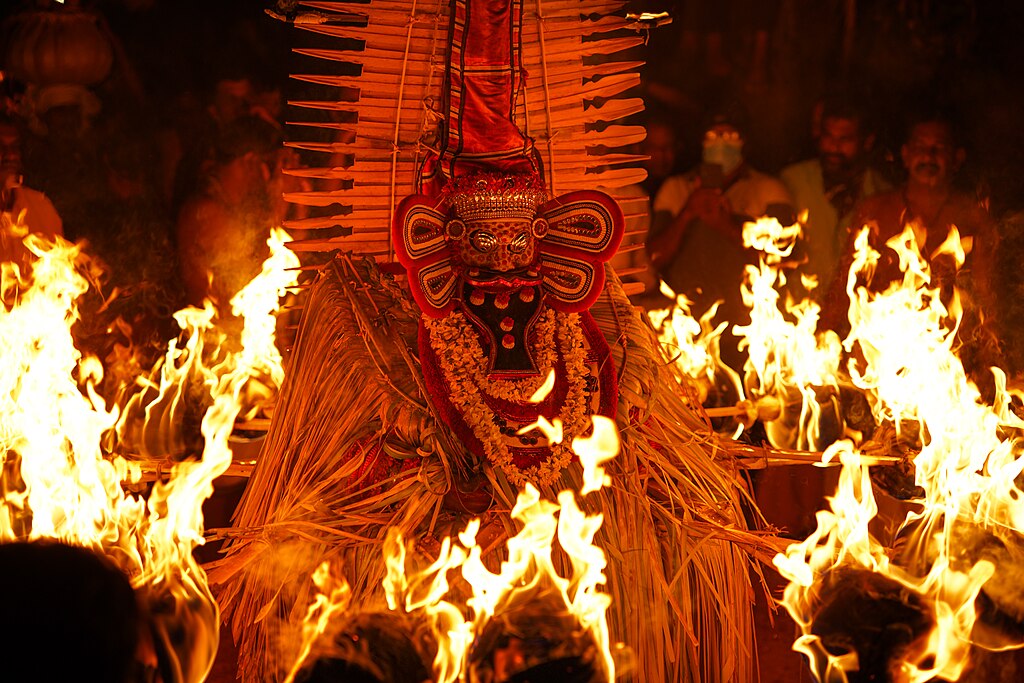
Credit: Lightframer007, CC BY-SA 4.0 , via Wikimedia Commons
The manifestation of Kandakarnan Theyyam, particularly in its Agni Kandakarnan Fire Dance form, offers a truly unforgettable ritualistic spectacle characterized by high energy, profound drama, and a powerful interaction with the element of fire.
The Setting and Atmosphere
Performances are typically held at the Kavu (shrine) or ancestral courtyards (Tharavadu).1 The ambiance is intensely mystical, often set at night where flickering flames from lamps and torches create a dramatic, ritualistic mood.6 The performance is dynamically propelled by traditional percussion instruments, prominently the Chenda and Maddalam, providing the rhythmic backdrop for the deity's fierce dance.1
The Fiery Climax and Symbolic Destruction
The climax of the Kandakarnan performance involves aggressive, fearless dance maneuvers and direct interaction with fire.6 This ritualistic consumption and destruction of fire symbolize the deity's ability to destroy negative energies and eliminate evil, reflecting a complete dedication to the purification through Shiva's wrath.6 In a specialized variant known as Agi Kandakaran, the fire connection is made even more direct, where lighted torches (Rag wrapped flaming torch) are attached around the performer’s waist, creating the visual impression of a deity engulfed in purifying flame.11
While many performances are intensely focused in the mystical night settings 6, certain rituals of Agni Kandakarnan are cited as occurring in the early hours of the morning.8 This timing variation is understood not as a contradiction, but as a reflection of diverse regional anushthanas (customs). The early morning timing supports the deity's function as a cleanser: the purification ritual, having combatted the forces of evil and disease throughout the night, concludes successfully before sunrise, symbolizing the return of peace and good health to the community.
Devotee Interaction and The Dispensing of Blessings
The performance culminates in a direct, unmediated interaction between the deity and the gathered devotees.3 This engagement is central to the ritual's social function. Devotees offer prayers, light lamps, and seek spiritual enlightenment and divine integration for communal well-being.6
The performer, believed to be fully possessed by Kandakarnan, listens to the grievances, worries, and problems of individuals and offers spiritual guidance, advice, and blessings.3 This direct engagement provides profound spiritual and emotional solace, acting as a crucial source of hope and psychological resilience within the community.3 Offerings (Nivedyam) presented to the deity often follow indigenous customs, sometimes including fish, toddy (madhyam), and other non-Vedic items, further emphasizing the cult’s foundational links to local traditions.2
V. Sociological and Therapeutic Dimensions of Kandakarnan Theyyam
Ritualistic Inversion and Social Empowerment
The performance of Theyyam is historically tied to and conducted by members of historically marginalized communities, specifically the Vannan and Malayar castes.2 In a traditional society previously dominated by the rigid caste system, where temple entry and mainstream worship were restricted, Theyyam provided an alternative, powerful spiritual space.5
By allowing individuals from lower castes to embody divine power (parakāya praveśanam) and receive deep reverence from the entire community, the ritual functions as a profound act of social subversion.5 The embodied deity speaks in the local dialect, often addressing social grievances and historical injustices, contrasting sharply with the Sanskritized language of traditional Vedic rituals.5 This institutionalized inversion provides empowerment and acts as a testament to the resilience of North Kerala’s marginalized communities.13
Theyyam as a Therapeutic and Healing Ritual
Kandakarnan’s specific role as a deity invoked to ward off diseases makes the performance fundamentally therapeutic.3 The ritual creates a powerful shared space for catharsis and collective healing, particularly important when dealing with generalized threats like epidemics.13
The fierce, rhythmic elements of the dance, combined with the trance-induced states of the performer and the collective participation of the audience, create a psychological release.13 Witnessing Kandakarnan—the embodiment of strength and destructive purity—fearlessly confront and consume fire symbolizes the destruction of the community's worries and the elimination of disease and negative energy. This dramatic resolution provides tangible reassurance and restores psychological balance to the collective.6 The belief that the manifested deity promises to cure all diseases and shower fortune strengthens community identity and fosters deep social cohesion, transcending other societal divisions.5
VI. Experiential Guide: Locating Kandakarnan Festivals (Kaliyattam)
Kandakarnan Theyyam is a seasonal ritual, performed predominantly during the dry months that span roughly from November (Vrischikam) to April (Medam).14 These performances occur primarily in the sacred groves (Kavu) and ancestral homes across the North Malabar region.
Cultural enthusiasts seeking to witness the authentic Kandakarnan Theyyam disease cure ritual must consult specialized Theyyam calendars, as dates and locations vary annually. The following table highlights some of the established locations renowned for staging the performance:
Key Performance Locations for Agni Kandakarnan Theyyam in North Malabar
| District | Notable Kavu/Kshethram | Specific Variant/Context | Approx. Month |
|---|---|---|---|
| Kannur (Thalasseri) | Kadavathur Sree Kuroolikkavu Bhagavathy Kshethram15 | Performed alongside Vasoorimala, Bhairavan9 | February (Kumbam)16 |
| Kannur (Pinarayi) | Sree Kadanrayaroth Khandakarnan Kshethram5 | Khandakarnan (Fire Theyyam)5 | January (Makaram)5 |
| Kasaragod (Thrikkarippur) | Kunnuveedu Kadappuram Sree Swami Madam15 | Agi Kandakaran (Torches attached to waist)11 | Varies (Peak Nov–Apr)14 |
| Kannur (Ezhimala) | Ezhimala Sree Kavu17 | Performed alongside Chamundi Theyyam17 | December17 |
Visitors are advised to observe the sacred nature of the event. The preparation rituals, including the extensive Mukhamezhuthu process, often begin hours before the main dance. Witnessing these preparatory stages provides a deeper appreciation for the spiritual transformation of the Koladhari into the divine entity.
VII. Conclusion: The Enduring Flame of Tradition
Kandakarnan Theyyam stands as a powerful testament to the spiritual and cultural depth of North Malabar. This fierce manifestation of the divine, rooted in Shiva’s protective fury and associated with the essential human need for protection from disease, continues to be an integral part of community life.
The sophisticated blend of artistic expression—seen in the meticulous Mukhamezhuthu Kandakarnan iconography and the symbolic Agnikandakarnan Fire Dance—with profound sociological utility ensures the ritual’s enduring relevance. By providing spiritual guidance, dispensing communal healing, and serving as a critical platform for social articulation by marginalized groups, Kandakarnan Theyyam is far more than an ancient dance; it is a living, breathing mechanism of cultural preservation, identity formation, and collective resilience in modern Kerala. The continuous performance of this Kolam preserves history, offers spiritual security, and asserts the powerful indigenous traditions of the region.
References
- Menon, A. Sreedhara. A Survey of Kerala History. D.C. Books.
- K.K.N. Kurup. Kerala: The Land and the People. National Book Trust.
- Panikkar, K.N. Culture, Ideology and Hegemony: Intellectuals and Social Consciousness in Colonial India. Tulika Books.
- Samuel, Geoffrey. The Origins of Yoga and Tantra. Cambridge University Press.
- Achaya, K.T. Indian Food: A Historical Companion. Oxford University Press.
- Poti, Pavithran K. “Ritual, Identity and Collective Memory in Kerala.” Journal of South Asian Studies, Vol. 38.
- Devika, J. “Food, Gender, and Ritual in Kerala Communities.” Indian Journal of Cultural Studies.
- Pillai, R. “Culinary Traditions of Kerala: A Socio-Cultural Study.” International Journal of Gastronomy & Food Science.
- Kerala Tourism – Official Website
- National Portal of India – Culture & Heritage
- UNESCO – Intangible Cultural Heritage
- JSTOR – Folklore & Anthropology Collections
- PubMed Central – Food & Nutrition Research