The Art of the Feast: A Culinary Folklore Journey Through the Kerala Sadya
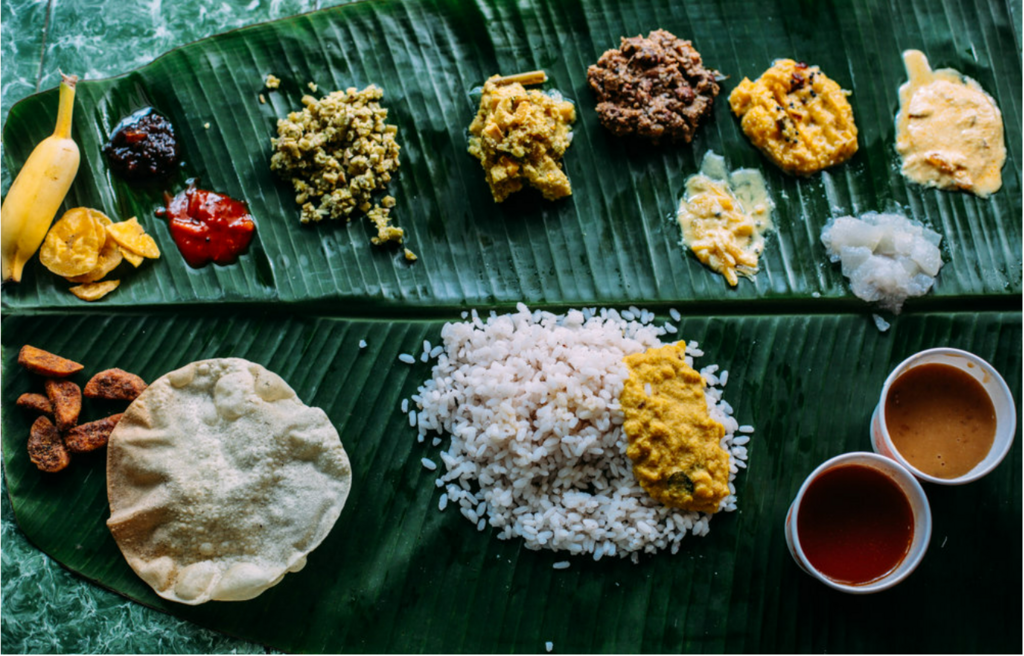
Courtesy: aaronshenny, CC BY-SA 4.0
The Kerala Sadya is a grand culinary ceremony, far exceeding the function of a simple meal. It serves as a profound articulation of Kerala’s cultural, spiritual, and ecological philosophy, meticulously encoded in its preparation, presentation, and consumption. This report provides an exhaustive, expert-level analysis of the Sadya, tracing its etymological and mythical origins, decoding its ritualistic structure rooted in Ayurvedic science, examining the contested biographies of its signature dishes, and positioning the feast within the broader dynamics of Indian food culture and globalization.
I. The Sadya as a Cultural Palimpsest: Origins, Etymology, and Mythology
The historical context of the Sadya is multilayered, revealing its origins in both sacred ritual and royal opulence, solidified by foundational myths that emphasize community and abundance.
I.A. The Semantics of the Feast: Tracing the Linguistic Roots
The very nomenclature of the meal suggests its communal intent. The Malayalam word Sadya (സദ്യ), sometimes transcribed as sadhya, translates simply to "banquet" or "feast".1 However, its deeper etymology confirms its socio-religious purpose. The word derives directly from the Sanskrit term ságdhi- (सग्धि), which specifically denotes the concept of a 'communal feast,' or the act of eating together.3 This ancient Sanskrit derivation underscores that the Sadya was never intended as a private or individual meal, but rather as an institution intrinsically linked to shared experience and community bonding.
The Sadya maintains central importance to all Malayalis, serving as the traditional, large vegetarian lunch for major religious and seasonal festivals, particularly Onam and Vishu.2 Beyond these seasonal milestones, the feast is indispensable at life-cycle events, including weddings, birthdays, and temple festivals, reinforcing its role as the definitive marker of a grand celebration.3
I.B. Royal and Ritual Foundations of Feasting
The structural foundations of the Sadya are traceable to two primary historical streams that defined the social and religious life of Kerala.
The first stream originates from temple culture and rituals.5 Historians note that temple feasts, where food was served generously to devotees as prasadam (a blessed offering), laid the early groundwork for the Sadya’s meticulous structure and sheer scale.6 This practice ingrained the ethos of serving food to nourish and honor guests as an integral component of upholding shared spiritual values.5
The second stream flows from the royal courts of the pre-colonial kingdoms, notably Travancore and Kochi.7 These royal functions and state festivals necessitated lavish banquets and demanded “generous offerings of food,” transitioning the Sadya from a purely religious ritual into a symbol of state prosperity, hospitality, and culinary grandeur.7 This historical trajectory, from sacred offering to secular celebration, established the expectation that a Sadya must be an elaborate spread, often comprising anywhere from 16 to 30 components, and sometimes swelling to over 64 items, such as the monumental feast served during the Aranmula Vallam Kali (Aranmula Vallasadya) boat race.3
I.C. The Sadya as an Echo of Agrarian Idealism
The significance of the Sadya is profoundly intertwined with the foundational folklore of Onam, the harvest festival it traditionally marks. Onam celebrates the annual return of the mythical King Mahabali, whose reign is idealized as a golden era characterized by perfect socio-economic equality and agricultural abundance.8 The people of Kerala believe that Mahabali returns annually to inspect the prosperity of his people, and the Sadya is the community’s demonstrative answer to that inspection.10
The sheer variety and calculated opulence of the feast—containing multiple curries, savories, and desserts—are a ritualistic performance designed to mirror and honor that mythical, boundless era of plenty.3 The use of seasonal ingredients, harvested immediately after the monsoon, such as pumpkin, yam, ash gourd, banana, and cucumber, reinforces the intrinsic link between the feast and the rhythms of the soil and sky.11 Every dish reflects the nutritional peak and abundance of the land.11
This convergence of folklore and cuisine suggests that the Sadya operates as a culinary manifesto. It is not merely a commemoration of a past event but an active, seasonal affirmation. By serving a meal that is simultaneously abundant, diverse, and derived directly from the local ecosystem, the community ritually articulates its core values: hospitality, sustainability, and the fundamental belief that the ideal state of equality and prosperity established by Mahabali is still achievable and present, realized through the bounty of the harvest.
II. Decoding the Sadya Code: Protocol, Geometry, and Ayurvedic Science
The defining characteristic of the Kerala Sadya is its non-negotiable ritual structure. The meal is highly codified, transforming the act of eating into a highly specific cultural and health-oriented practice that adheres to principles of sacred geometry and ancient Indian medicine.
II.A. The Architecture of the Feast: The Plantain Leaf (Ela)
The medium upon which the Sadya is served is as significant as the food itself: the banana leaf (ela). This practice is deeply rooted in tradition and ecology.2 The leaf symbolizes respect for nature and the environment, aligning with Kerala’s commitment to sustainable food practices as it is entirely biodegradable.2 Functionally, the leaf also adds a subtle, desirable earthy aroma and flavor to the food, enhancing the sensory experience, a characteristic lost when using modern utensils.12
Crucially, the placement of the leaf is mandatory and directional. The tapering end of the banana leaf must always point toward the diner’s left side.13 This specific orientation is integral to the Sadya Code, ensuring that the dishes are arranged correctly along the top and bottom halves of the leaf, facilitating easy consumption primarily with the right hand.15
II.B. The Ritual Geometry and Sequential Arrangement
Dishes are arranged according to a precise geometry, adhering to a cultural code that dictates harmony of flavor and optimal etiquette.2 The meal begins with a specific ritual: once the Sadya is prepared, the first serving is ritually set aside as an offering, sometimes dedicated to Ganapathy and Mahabali, or in remembrance of ancestors.16
The layout divides the leaf functionally:
- Top Half: This section houses the accompaniments, savories, and dry side dishes. Items like pickles (mango, lime), chips (Upperi), jaggery-coated chips (Sharkara Varatti), and vegetable stir-fries (Thoran, Avial, Olan) are arranged here.2
- Bottom Half: This area is reserved for the main staple and the primary liquid curries.10
The serving sequence is equally rigid, designed to guide the diner through a progressive journey of tastes:5
- The Starter: Small portions of salt and jaggery are traditionally placed on the leaf.17 Injipuli (ginger pickle) is often the first prepared dish served, preceding the staple.2
- The Staple: Plain boiled Matta rice, a native Kerala rice known for its nutty flavor, is placed on the lower half.5 Servers typically add rice multiple times throughout the feast.13
- The Primary Curries: These are poured over the rice in an established order: Parippu (cooked lentils) often served first with a generous spoon of ghee, followed by Sambar (lentil and vegetable stew).2
- The Cleanser: After the main curries, Rasam (a tangy, spicy soup) is consumed, acting as a crucial palate cleanser and further aiding digestion.2
- The Finale: The meal concludes with the dessert course, Payasam (or Pradhaman), which is sometimes served directly on the leaf or in small cups. Traditionally, three or more varieties are presented.3
II.C. The Ayurvedic Imperative: Harmony of the Six Tastes
The Sadya’s complex structure is not merely ceremonial; it is explicitly engineered based on the principles of Ayurveda, ensuring the meal supports both digestion and overall well-being. This structure demands the inclusion and proper sequencing of the six essential tastes, known as Shadrasa: sweet, sour, salty, bitter, pungent, and astringent.
The systematic serving progression reflects an internal digestive engineering:
- Activation of Agni: The meal strategically begins with dishes like Injipuli, which features pungent ginger, tamarind (sour), and jaggery (sweet). This sharp appetizer serves to “wake up the appetite” and activate Agni, the digestive fire.
- Digestive Harmony: The combination of various curries—from the mild, coconut-milk-based Olan to the thick, yogurt-based Kaalan—ensures no single taste overpowers another. Curd-based dishes such as Pachadi and Kichadi introduce probiotics to soothe the gut.
- Cooling Conclusion: The consumption of Sambharam (spiced buttermilk) near the end of the meal cools the body and settles the system, achieving holistic balance.
II.D. Structural Analysis: The Antiquity of Protocol over Menu
The stringent adherence to the serving order—Parippu first, then Sambar, then Rasam—demonstrates that the algorithmic structure of the Sadya is its most resilient and ancient feature. The protocol, rooted in the sequence of tastes required by Ayurvedic thought, is more fundamental than the specific curries filling those functional slots.
This means the Sadya is defined less by immutable ingredients and more by its functional template. For instance, the role of the primary lentil base must be filled by a rich, savory dish poured over rice. Even when dishes originating outside Kerala were incorporated (as discussed in Section III), they were absorbed only if they adhered precisely to the pre-existing ceremonial slot dictated by the ancient protocol. Thus, the Sadya operates as a philosophical template for ideal dining—highly resistant to changes in sequence, even while remaining flexible enough to assimilate new, high-quality components.
II.E. The Communicative Finale: Folding the Leaf
The dining experience concludes with a highly specific ritual gesture that communicates the guest’s experience to the host. Diners are expected to fold the banana leaf upon finishing. The direction of the fold is deeply symbolic and functions as a cultural feedback mechanism:
- Folding towards oneself (inwards): Signifies satisfaction, gratitude, and appreciation for the meal.
- Folding away from oneself (outwards): Traditionally interpreted as a gesture of dissatisfaction or disrespect, though modern interpretations may vary regionally.
The handling and disposal of the leaf form the guest’s final ritualistic acknowledgement, encapsulating the cultural emphasis on respect for food, community, and hospitality—the essence of the Grand Feast of Onam.
Table 1: The Sadya Architecture — Layout, Function, and Ayurvedic Logic
| Item Group | Position (on Leaf, Tapering Left) | Key Dishes (Examples) | Ayurvedic/Functional Role |
|---|---|---|---|
| Appetizers & Aids | Top Left Edge | Injipuli, Mango/Lime Pickle, Salt, Chips | Activating Agni; providing pungent and sour start; palate preparation |
| Core Side Dishes | Top Middle/Right | Avial, Thoran, Olan, Kaalan, Kootu Curry | Bulk, texture, seasonal nutrition; balancing bitter, astringent, and sour tastes |
| Staple & Pour-Overs (Savory) | Bottom Center/Left | Matta Rice, Parippu with Ghee, Sambar, Rasam | Main carbohydrate source; primary protein and rich liquid curries3 |
| Digestive Finishers | Added Last (Center/Bottom) | Payasam (Pradhaman), Curd/Buttermilk (Sambharam) | Auspicious sweet completion; cooling and probiotic final element |
III. Culinary Biographies: Folklore and Contested Dishes
The unique identity of the Sadya is shaped by its iconic dishes, many of which carry mythological backstories that glorify agrarian values or explain the assimilation of historically recent external influences.
III.A. Avial: The Mythology of Resourcefulness
Avial, a slow-cooked medley of vegetables, coconut, and curd, is one of the Sadya’s signature elements. Its origin is rooted in folklore that highlights innovation in moments of scarcity.
The most popular legend attributes Avial to the Mahabharata era, claiming it was invented by Bhima during the Pandavas’ exile. Forced to cook without adequate ingredients, Bhima allegedly chopped whatever vegetables were available into long strips and combined them with coconut and curd.
A more practical legend narrates that a king, distressed by kitchen waste, ordered his cook to use all leftover vegetables—resulting in Avial. Regardless of the version, the folklore performs a distinct cultural function: it codifies Avial as a dish born from necessity and ingenuity, reinforcing the agrarian value of zero waste. In the vast scale of Sadya preparation, vegetable scraps are inevitable, and Avial transforms this potential waste into a celebrated dish that is hearty and easy to digest.
II.B. Erissery: The Symbolism of Prosperity and Ritual Abundance
Erissery—typically made from pumpkin or yam cooked with cowpeas, coconut, and mild spices—is one of the most ritualistically significant dishes on the Sadya leaf. Its cultural presence is especially prominent in temple festivals and harvest celebrations.
Folklore associates Erissery with agrarian prosperity: pumpkin, a crop that thrives even in difficult seasons, came to symbolize resilience and abundance. A common belief in rural households recounts that Erissery was first prepared as an offering to village deities seeking steady harvests and protection from famine.
In the context of the Sadya, Erissery functions as a grounding, auspicious dish. Its creamy texture and mild sweetness balance the stronger flavours on the leaf, while the roasted coconut topping adds depth and festive aroma. Beyond taste, Erissery reinforces the agrarian worldview of Kerala—one where food is inseparable from seasonal cycles and ritual well-being.
III.C. Kalan: The Philosophy of Controlled Fermentation
Kalan, made with raw banana or yam cooked in a thick sour curd and black pepper–coconut paste, represents Kerala’s mastery over controlled fermentation and preservation.
Traditional accounts trace Kalan to the monsoon months, when curd naturally turned sour and households developed dishes that leveraged this tartness. Culinary folklore claims that early Brahmin kitchens perfected Kalan as a stable dish that could last several days even in humid weather, especially during temple festivities.
Within the Sadya, Kalan is placed among the first semi-liquid items, symbolizing purification and digestive readiness. Its sharp sourness, mellowed by coconut, prepares the palate for richer dishes and marks a transition from appetisers to core curries. In cultural symbolism, Kalan embodies discipline, balance, and Kerala’s intimate relationship with monsoon rhythms.
III.D. Olan: The Quietness of Flavor and the Ideal of Restraint
Olan—featuring white ash gourd, cowpeas, coconut milk, and green chilies—is celebrated as one of the most subtle dishes in the Sadya.
Unlike most Kerala foods that emphasize spice, Olan is guided by restraint. Oral traditions suggest that Namboothiri households introduced the dish as a mark of purity and meditative simplicity. Its emphasis on clarity rather than complexity gave it a special place in rituals connected to calmness, auspicious beginnings, and ancestral offerings.
In the Sadya, Olan cleanses the palate and creates a gentle pause amid bolder preparations. Its delicate scent of coconut milk and minimal seasoning function as a reminder that refinement is achieved not through excess but through mindful reduction. Olan thus stands as a culinary philosophy—quiet, balanced, and deeply contemplative.
III.E. Thoran: The Folklore of Everyday Labour
Thoran, a dry stir-fry of finely chopped vegetables with grated coconut, is rooted in the rhythms of Kerala’s daily life.
Unlike festival dishes with mythic origins, Thoran is tied to the social history of women’s labour. Folklore portrays Thoran as the product of communal cooking—especially during harvests—where women gathered to process vegetables collectively. The act of chopping, mixing, and lightly seasoning came to represent cooperation and household harmony.
In the Sadya, Thoran provides texture and freshness. Whether made from beans, cabbage, or carrot, its lightness offsets the heaviness of richer gravies. Symbolically, Thoran acknowledges the invisible everyday work that sustains agrarian families, subtly honouring domestic labour within a festive meal.
III.F. Kootu Curry: The Memory of Temple Kitchens
Kootu Curry, combining yam or raw banana with black chickpeas in a mildly sweet-spicy coconut base, is believed to have emerged from large temple kitchens of central Kerala.
Stories narrate that cooks devised Kootu Curry to feed large crowds during festivals because the mixture of vegetables and legumes was filling, affordable, and nutritionally balanced. Over time, the dish became woven into temple folklore as a symbol of hospitality and generosity.
In the Sadya, Kootu Curry provides a sturdy, grounding counterpoint to delicate dishes like Olan. Its combination of sweetness (from jaggery) and spice mirrors the dual nature of festival life itself—celebration and discipline, devotion and indulgence.
III.G. Pachadi: The Aesthetics of Sweet–Sour Balance
Pachadi is a sweet-sour preparation made from fruits or vegetables—such as pineapple, beetroot, or bitter gourd—cooked in curd or coconut and tempered lightly.
Folklore links Pachadi to royal kitchens, where cooks experimented with contrasting flavours to please kings who sought novelty in taste. The blending of sweetness, sourness, and mild bitterness symbolised emotional balance, leading to Pachadi’s inclusion in ritual meals connected to new beginnings.
On the Sadya leaf, Pachadi introduces vibrancy—both in colour and flavour. It softens the monotony of savoury dishes and nudges the palate toward a more celebratory mood. In cultural terms, Pachadi reflects Kerala’s appreciation for harmony in dualities.
III.H. Kichadi: The Grammar of Precision and Coolness
Kichadi—often made with cucumber or bitter gourd in a curd-and-coconut base—is the sharper, more sour cousin of Pachadi.
Its origins are tied to Ayurveda-informed household practices that used curd and mildly bitter vegetables to cool the body during hot seasons. Folkloric traditions also suggest that Kichadi was considered a “corrective dish,” balancing heat-inducing items consumed during feasts.
In the Sadya sequence, Kichadi acts as a palate refresher. Its crisp sourness cuts through heavier gravies and fried items. Symbolically, Kichadi reinforces the underlying Ayurvedic principle of pacifying excess, keeping the meal harmonious.
III.I. Pulissery: The Sweet-Tang of Ritual Refreshment
Pulissery is a thin, sweet-tangy curry made with ripe fruits—most famously mango—combined with sour curd and coconut. Folklore links Pulissery to summer temple festivals, when ripe mangoes were abundant. Villagers brought offerings of these fruits, and temple cooks created a dish that combined seasonal produce with the cooling properties of curd.
In the Sadya, Pulissery functions as a refreshing interlude. Its light sweetness provides emotional comfort, while its sourness ensures appetite continuity. Culturally, Pulissery represents seasonality, renewal, and the gratitude associated with harvest gifts.
III.J. Parippu (Dal) and Ghee: The Blessing of Beginnings
Parippu—usually made with moong dal cooked with coconut and spiced ghee—is the first main dish consumed with rice in a Sadya. Its primacy is not accidental: agricultural folklore presents dal as the “seed of sustenance.” The first harvest ceremonies of Kerala involved offering lentils to ancestral spirits, believing that the meal must begin with the simplest and most fundamental food.
During a Sadya, Parippu mixed with ghee forms the gastronomic foundation that readies the stomach for heavier dishes. Symbolically, it embodies humility, nourishment, and the essential simplicity from which abundance emerges.
III.K. Rasam: The Digestive Logic of the Sadya
Rasam—a pepper-tamarind broth enriched with tomatoes, cumin, and herbs—originated from Siddha and Ayurvedic medicinal traditions. Early healers created Rasam as a therapeutic drink to aid digestion, especially after heavy meals. Over centuries, it transitioned from medicine to cuisine but retained its physiological purpose.
In the Sadya, Rasam prepares the stomach for the final stages of the meal. Its heat and spiced aroma rejuvenate the senses while aiding metabolism. Rasam symbolizes Kerala’s seamless blending of health wisdom with culinary practice.
III.L. Payasam: The Sweet Ritual of Closure
Payasam, whether made with rice (Palada), vermicelli, green gram, or jaggery-rich ingredients like ada, is the ceremonial finale of the Sadya. Mythology associates Payasam with divine offerings—particularly in Vaishnavite and Bhadrakali temples—where sweet puddings were considered food fit for the gods. Village legends also describe Payasam as a marker of community celebration, made in large urulis during weddings and harvest festivals.
In the Sadya, Payasam offers emotional closure: warmth, sweetness, and fulfilment. More than dessert, it is symbolic gratitude—a reminder that every feast is both a communal act and a sacred offering.
III.M. The Injipuli Catalyst: The 101 Curry
Injipuli, also known as Puli inji, is a crucial accompaniment, characterized as a dark brown, intensely sweet-sour and spicy pickle or chutney made from ginger, tamarind, green chilies, and jaggery. Its preparation often begins first in the process of cooking the Sadya.
Its significance is magnified by its practical and symbolic roles. Functionally, it is an essential digestive aid, featuring ginger and tamarind to activate the digestive system before the main course. Symbolically, Kerala folklore maintains that a Sadya prepared without Injipuli is considered deficient—lacking the equivalent of 101 curries. This metaphor underscores the dish’s indispensability as the fundamental savory, pungent anchor of the entire feast.
III.N. The Sambar Paradox: External Infusion into the Sadya Canon
While Sambar—a thick lentil and vegetable stew—is universally central to the modern Sadya, compelling historical analysis indicates that it is not indigenous to Kerala. Historical evidence suggests Sambar originated in the royal kitchens of Thanjavur during the reign of the Maratha King Shahuji I (1684–1712). Legend states that Shahuji, attempting to recreate the Maharashtrian sour lentil soup amti, substituted moong dal with arhar dal and kokum with tamarind, naming the resulting curry after his guest, Sambhaji.
The assimilation of Sambar into Kerala cuisine, likely facilitated by migrant communities such as the Palakkad Iyers, exemplifies Kerala’s long history of culinary exchange. Earlier chronicles explicitly note that Sambar was “totally alien to Kerala cooking,” indicating that indigenous coconut- or curd-based curries must once have held the place now occupied by tamarind-heavy Sambar.
Despite its non-native origins, Sambar became integral to the Sadya due to its functional fit within the strict flavour-sequencing logic of the feast. As a rich, savory lentil-based pour-over for rice, it fulfilled the required role so effectively that practicality outweighed the question of regional purity—making the Sadya a testament to cultural dynamism and assimilation.
IV. Sadya in Context: Socio-Cultural Dynamics and Regional Divergence
To fully understand the Kerala Sadya, it must be analyzed in comparison to other South Indian feasting traditions and through the lens of Kerala’s unique geographic and socio-historical landscape.
IV.A. The Coconut Axiom and Culinary Differentiators
The flavour profile of the Kerala Sadya is fundamentally defined by its bio-regional dependency on the coconut. Kerala—known poetically as Kera-la (The Land of Coconuts)—utilizes this ingredient pervasively. Coconut oil is the primary cooking medium, even for frying chips; coconut milk and grated coconut form the bases of numerous curries, including Olan and Avial.
This heavy reliance on coconut gives the cuisine its earthy, nutty, and creamy textures, setting it apart from neighbouring traditions. The Sadya’s traditional plant-based nature is not a recent ethical shift but a natural extension of Kerala’s ecological landscape.
Table 2: Comparative Culinary Signatures of South Indian Feasts
| Feature | Kerala Sadya | Tamil Virundhu | Andhra Bhojanam (Traditional) |
|---|---|---|---|
| Primary Cooking Fat | Coconut Oil, Ghee | Sesame/Groundnut Oil | Groundnut/Sesame/Mustard Oil |
| Defining Staple | Red Matta Rice (Parboiled) | White Boiled Rice | White Steamed Rice |
| Unique Core Curries | Avial, Olan, Kaalan | Poriyal, Kootu, Kuzhambu | Pulusu (Tangy/Sour), Highly Spiced |
| Defining Flavor Profile | Creamy (Coconut Milk), Earthy (Coconut Oil), Balanced | Tangy (Tamarind), Nutty (Oil), Spicy-Sour | Highly Spicy (Chili), Extremely Tangy (Tamarind) |
| Pickles Base | Ginger, Lime, Mango | Oil-based (Sesame/Groundnut) | Mustard Oil-based, High Chili Content |
The differences illustrate that while all South Indian feasting traditions use rice, lentils, and the banana leaf, the Kerala Sadya’s extensive use of coconut produces a milder, richer, and more balanced flavour compared to the oil-forward Tamil Virundhu or the intensely spicy, tangy Andhra Bhojanam.
IV.B. The Evolution of Communal Dining
In the contemporary cultural landscape, the Sadya is celebrated as a powerful "symbol of unity," characterized by communal dining where individuals across all social strata—regardless of caste, class, or religion—sit together and partake in the identical feast.7 This act is widely promoted as embodying the values of equality and togetherness, echoing the idealized governance of King Mahabali.32
However, this modern egalitarian ideal contrasts with earlier ethnographic accounts of Kerala's historical social structures. Evidence suggests that traditional feasting practices were historically governed by strict caste hierarchies. These rules dictated not only who could cook for whom but also manifested in subtle yet explicit social markers during the meal itself; historical texts reveal that even the size of items like the pappadam served could be regulated based on the diner’s caste.27 Furthermore, the dining hall itself was a venue where "pride and power were exhibited, based on caste".27
The contemporary Sadya, therefore, represents a conscious cultural declaration. By insisting that everyone shares the exact same elaborate spread, it actively rejects the restrictive social structures of the past. The modern communal Sadya is, in part, a post-colonial effort to solidify a shared Malayali identity, translating the political ideal of equality into a concrete, gastronomic experience.
IV.C. Geographic Splits and Adaptation
While the core Sadya framework is recognized throughout Kerala, regional differences exist, reflecting localized customs, trade histories, and distinct culinary influences.1
- South Kerala (Travancore and Cochin): These regions tend to maintain a stricter adherence to the traditional, exclusively vegetarian, and highly ritualized format, largely defining the pan-Kerala perception of the Sadya.34
- North Kerala (Malabar/Kozhikode): This area, historically connected to extensive maritime trade networks, especially with Arab communities, exhibits a greater culinary absorption of external flavors, reflected in its unique Mappila cuisine.1 The Malabar Sadya often breaks the pan-Kerala vegetarian ideal by including non-vegetarian side dishes, such as Kozhi Curry (chicken curry), alongside the core vegetarian spread.10 Furthermore, the dessert course expands beyond the traditional Payasam (Pradhaman) to include regional delicacies such as halwa (a jelly-textured delicacy of Kozhikode) and coin jalebis.1 The prominence of jalebis (zulabiya in Arabic) reflects the region's strong Arabic ties through trade.1
These variations demonstrate that the expression of the Sadya is dictated by centuries of regional economic and religious interaction. While the name Sadya implies the grand feast, its precise execution is highly contextual.
IV.D. The Hierarchy of Sweetness
The auspicious conclusion of the Sadya mandates the service of Payasam or Pradhaman.3 This is not merely a single dessert, but often involves a lavish display of three or more varieties, emphasizing the climax of the feast.3 The tradition differentiates between milk-based Payasam (e.g., Paal Payasam, Paalada Pradhaman) and richer, plant-based Pradhaman made using jaggery and coconut milk (e.g., Ada Pradhaman, Parippu Pradhaman, Chakka Pradhaman).3
This "hierarchy of sweetness" signifies that the ending of the meal must be an abundant, layered demonstration of prosperity and generosity.3 By serving multiple, distinctly rich desserts, the host reinforces the Sadya’s core theme of boundless abundance, solidifying the celebratory mood and the honor bestowed upon the guests.6
V. Modernity, Migration, and the Global Sadya
The Sadya, while deeply rooted in ancient custom, is not static. It continues to evolve under pressures from globalization, historical assimilation, and the dispersal of the Malayali diaspora.
V.A. Colonial Culinary Residue and Ingredient Assimilation
Kerala’s historical role as a crucial port in the spice trade ensured centuries of culinary interaction with diverse populations, including Arabs, Portuguese, Dutch, and British settlers.28 European colonial rule profoundly influenced the urban cuisine of places like Kochi, introducing new culinary practices and New World crops.35
The Sadya, however, served as a resilient repository of pre-colonial food practices, resisting massive structural modification. While ingredients like chili, tomato, and cashew were introduced by the Portuguese 28, the Sadya selectively and subtly integrated only those ingredients that could replace or supplement existing functions. For instance, the traditional Sadya avoids onion and garlic, maintaining its ritual purity.3 Similarly, the incorporation of ingredients like carrots and pineapples in modern or commercial Sadyas, though becoming common practice, represents a deviation from the traditional use of only seasonal, indigenous vegetables.3
The overall resilience of the core structure—the reliance on coconut, the Ayurvedic sequencing, and the use of indigenous vegetables—demonstrates a strong commitment to maintaining a core culinary identity. This resistance, contrasted with other regional cuisines that embraced fusion, positions the Sadya as an artifact of post-colonial gastronomy, choosing selective absorption over structural transformation.
V.B. The Diaspora Sadya: Adaptation and Globalization
The Sadya has transcended its regional confines, migrating with the Malayali diaspora to become a recognizable global cultural phenomenon, celebrated in cities across the world, including New York, London, Singapore, and Dubai.36
This globalization has necessitated significant structural and contextual adaptations:
- Commercialization and Simplification: Due to the complexity and labor involved in preparing 25 to 64 dishes 3, the Sadya has moved out of individual kitchens and into commercial settings. It is served in luxury hotel buffets, restaurant celebrations, or delivered as pre-packaged feast boxes.16 Diaspora celebrations often result in "simplified versions" adapted to local resource availability and lifestyle constraints.37
- Rebranding: In upscale international markets, the Sadya is reinterpreted as a plated fine-dining experience or celebrated as an example of sustainable, plant-based cuisine, aligning perfectly with modern global wellness trends.36
The internationalization of the Sadya allows Malayali communities to maintain and share their heritage globally, transforming a local feast into a multinational food festival.36
V.C. Preservation vs. Commercialization: Challenges to Purity
The shift towards modernization presents a significant cultural challenge. Urbanization, the engagement of women in the paid workforce, and globalization have contributed to a sedentary lifestyle and a corresponding erosion of traditional culinary skills and knowledge.38 The massive time and organizational commitment required for a traditional Sadya (up to 3-4 hours of cooking alone, often requiring a day of preparation) 16 is difficult to sustain within modern, fast-paced life.38 This has led to a growing reliance on commercial caterers for festive meals.7
However, the analysis suggests that commercialization acts as an unexpected preservation tool. While individual home cooking skills decline, professional caterers and specialized restaurants become the custodians of the traditional Sadya Code.16 These experts maintain the strict ritualistic protocol, ingredient lists, and sequential presentation, ensuring that the historical integrity of the feast survives even if the home practice diminishes. This institutionalization is vital, especially within the diaspora and busy urban centers, guaranteeing that the Sadya’s complex cultural geometry remains accessible and accurately replicated for future generations.
VI. Conclusion: The Enduring Ethos of the Sadya
The Kerala Sadya is a masterpiece of Indian gastronomy, its cultural weight derived from an intricate balance between rigid protocol and pragmatic flexibility. It is not merely a collection of dishes but a performance of cultural history.
Its uniqueness in the Indian culinary landscape stems from its definitive reliance on the Coconut Axiom, which yields a creamy, earthy, and highly nuanced flavor profile distinct from the oil- and spice-heavy cuisines of its neighbors. Furthermore, its complexity is fundamentally structural, dictated by ancient Ayurvedic principles that prioritize digestive harmony through the meticulous sequencing of the six essential tastes. The persistence of this algorithmic structure, demonstrated by the assimilation of non-native elements like Sambar, highlights the primacy of function over origin within its culinary canon.
Ultimately, the Sadya serves as an edible link to Kerala’s foundational ideals. It ritualistically performs the prosperity of King Mahabali’s era through a demonstration of agricultural abundance and consciously reinforces modern values of equality and community unity by requiring all participants to share the same feast. As the Sadya continues its global migration, the challenge for its custodians will be to ensure that its inherent logic—the complex code of arrangement, sequence, and ritual—is preserved, allowing this grand feast to remain a profound articulation of Kerala’s unique heritage.
References
- Achaya, K. T. Indian Food: A Historical Companion. Oxford University Press, 1994.
- Namboodiri, K. P. Padmanabha Menon. History of Kerala (Vol. 1–4). Asian Educational Services.
- Ardur, R. The Flavours of Kerala. Penguin Books India.
- Kurup, K. K. N. Aspects of Kerala History and Culture. Kerala Historical Society.
- Varma, Adoor K. K. Cuisine and Culture of Kerala. DC Books.
- Zvelebil, Kamil. Kerala: India’s Enchanted Land. Chronicle Books.
- Menon, Sreedhara. A Survey of Kerala History. DC Books.
- Sharma, M. Ayurveda and Food Principles. Chaukhamba Publications.
-
Articles & Research Papers:
- "Food, Memory and Identity in Kerala" — Indian Anthropologist.
- "Culinary Rituals of Kerala: An Ethnographic Overview" — Journal of South Indian Studies.
- "Diaspora Food Cultures and Kerala Sadya in the Global City" — Food, Culture & Society.
- Web Resources: