The Enigma of Kuttichathan Theyyam: A Definitive Study of Sasthappan, The Benevolent Trickster of North Malabar
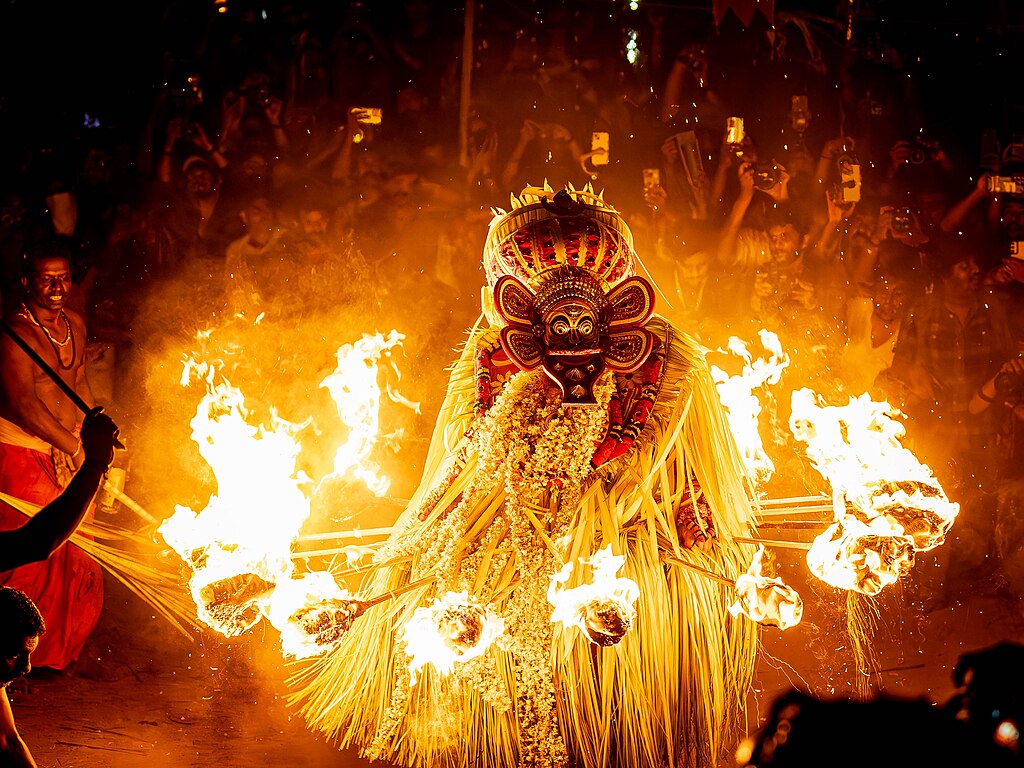
Kuttichathan (Shasthappan) Theyyam
Image credit: Lightframer007, CC BY-SA 4.0I. Introduction: Kuttichathan—The Defiant Divinity of the Malabar Coast
Theyyam stands as a formidable thousand-year-old ritual art form unique to the Malabar Coast of North Kerala, encompassing the districts of Kannur, Kasaragod, and Kozhikode.1 This tradition involves the ritualistic manifestation of divine or ancestral spirits, embodied by performers predominantly drawn from marginalized communities.2 Within this complex religious landscape, Kuttichathan Theyyam occupies a central and multifaceted position.
1.1 Kuttichathan’s Identity and Nomenclature
The deity revered in this ritual is most frequently identified as Kuttichathan, a name roughly translating to "Child Chathan." However, he is also widely known by the name Sasthappan Theyyam or Shasthappan Theyyam.3 This connection to Sasthappan (often equated with the Puranic deity Ayyappa, a son of Shiva and Vishnu) immediately places the folk deity within the broader Hindu pantheon, while simultaneously preserving his indigenous, localized character. Kuttichathan’s essence is defined by his profound duality: he is simultaneously a mischievous and playful spirit, a powerful protective deity, and a divine trickster known to confer fortune and general well-being upon his devotees.4 The deity is classified theologically as a Bhootha Gana, one of the primary attendants of Lord Shiva, who descended to the earthly realm specifically to carry out protective assignments.7
1.2 The Kalakattu Lineage and Historical Anchor
The Kuttichathan tradition is geographically and sociologically anchored to the region surrounding Payyanur in the Kannur district. This is due to the undeniable historical relationship between the deity and the Brahmin house known as the Kalakattu Illam.3 Because of this foundational association, the Theyyam is frequently referred to as Kalakattu Kuttichathan.3
The theological structure of Kuttichathan’s worship reveals a significant cultural phenomenon: the simultaneous reverence of a transgressive, marginalized figure alongside high-caste Puranic affiliations (Sasthappan, Shiva, Vishnu).7 The deity’s origin story is centered on his violent rejection by a high-caste family, yet the resulting ritual performance is widely accepted across various social strata. This suggests that the Theyyam tradition serves as a flexible repository, enabling regional indigenous lore to reinterpret and accommodate established pan-Indian religious frameworks within its performance structure. The figure of Kuttichathan acts as a spiritual guardian tied deeply to the indigenous traditions of Kerala while being recognized by centralized Hindu systems, demonstrating a successful historical blending of seemingly contradictory theological and social affiliations.
II. Mythology and Sacred Origins: The Narrative of Persecution and Divine Retribution
The origin stories of Kuttichathan are foundational to understanding his complex nature, detailing a history rooted in divine lineage, social transgression, and violent persecution. These myths are articulated and perpetuated through the Thottam Pattu (ritual ballads) preceding the performance.
2.1 The High Puranic Origin: The Shiva Putra Theory
One version of the sacred narrative asserts that Kuttichathan is a divine child born to Lord Shiva and Devi Parvati. When the divine couple adopted the guise of Valluvan and Valluvathi (a tribal or low-caste couple residing in a remote hill area), they bore two sons: Karuval and Kuttichathan.3 Kuttichathan was born distinctively, possessing a dark complexion, the auspicious third eye, and a flower adorning his forehead.3 The childless Namboothiri of Kalakatt Illam received Kuttichathan as a gift from the divine couple following prolonged prayers and fasting.3 This narrative establishes the child’s inherent divinity, albeit one concealed beneath a mortal adoption by a strict Brahmin family.
2.2 The Kalakattu Illam Conflict: The Charter Myth of Theyyam
The core conflict arises from Kuttichathan's immediate defiance of Brahmanical orthodoxy. Sent to a Guru for schooling, the child, endowed with extraordinary intelligence, refused to adhere to established teachings and customs. His intelligence often exceeded the Guru’s ability to respond to his questions.3 When the Guru, angered by the disobedience, rebuked and physically struck the boy, Kuttichathan retaliated by killing him and fleeing the school—his first act of powerful, violent revenge.3 The tension escalated at the Kalakattu Illam. Denied sustenance by his foster mother, Atholamma, upon his return—a rejection dictated by the Namboothiri—the hungry child acted out the ultimate transgression against Brahminical purity laws: he slaughtered a bull and drank its blood to quench his thirst.3
The horrified Namboothiri killed the child, but Kuttichathan was instantly reborn. In a drastic, ritualized attempt at annihilation, the Namboothiri summoned a large assembly of Brahmins. They killed Kuttichathan again, cut his body into 390 pieces, and attempted to destroy his essence by burning them in 21 sacred Homakundams (holy kilns or fire pits).3 However, this orthodox ritual, intended for sacred purification and destruction, was spectacularly subverted. Rather than destruction, the fires served as the catalyst for genesis: countless vengeful Kuttichathans emerged from the Homakundams.3 This army immediately performed a fire dance of retribution, burning the Kalakatt Illam and the houses of all nearby Brahmins, causing widespread disasters.3 Faced with uncontrollable divine fury, the community was compelled to recognize the persecuted spirit as a divine power and established the ritual of Theyyam worship to appease and contain the destructive force.10
2.3 The Subaltern Narrative and the Caste Dimension
An equally resonant, parallel myth addresses the issue of caste and marginalization directly. In this alternative version, Kuttichathan is the son born to the Namboothiri of Kalakattu Illam and a lower-caste Pana woman.3 Because of his illegitimate birth and low-caste lineage, the child was neglected and denied any inheritance or status within the father’s dominion.3 When the neglected child sought water, he was insulted and refused. His subsequent act of slaying the bull and drinking its blood is thus re-framed as a furious, desperate response to profound social exclusion and thirst.3 He subsequently wandered, reaching important cultural sites like Lokanarkavu via Vadakara Kuttoth.3 The co-existence of this narrative alongside the Divine Son myth is significant: the Divine narrative grants the deity theological authority, while the Subaltern narrative provides him with sociological legitimacy, positioning him as an eternal champion of those who suffer disenfranchisement and rejection by the social hierarchy.
2.4 The Linguistic and Historical Link to Buddhism
Adding another layer of historical complexity, there is a recognized link between the deity and Buddhism. The name "Chathan" is identified as a Malayalam translation derived from the Pali word for Buddha.3 Consequently, "Kuttichathan" means "Child Chathan" or "Child Buddha." A theory posits that when Hindu traditions incorporated early Buddhist temples in the region, many existing Buddhist customs and perhaps even deities were integrated and reinterpreted into the emergent Hindu framework, leading to the establishment of Chathan worship.3
III. Geography and Chronology of Performance
Kuttichathan Theyyam is fundamentally a phenomenon of North Kerala (Malabar), where its ritual geography closely follows the historical and mythological events tied to the Kalakattu Illam in the Kannur district 8.
3.1 Performance Geography and Theyyam Season
The Theyyam ritualistic season generally spans from mid-October to late May 1. Within this period, the Kuttichathan Theyyam is performed throughout the region, connecting the deity of persecution to the specific landscapes of the communities who now rely on his protection. The prevalence of the Kuttichathan Theyyam in the annual festival calendar alongside universally revered figures like Vishnumoorthi and Bhagavathi indicates that the deity, who originated from a place of intense social rejection, has achieved a status of widespread cultural legitimacy and is fully integrated into the regional religious life.
Performances are meticulously scheduled and take place in specific Kavus (sacred groves) and temple grounds across Kannur and surrounding areas. A partial summary of documented sites and timings includes:
Performance Sites and Timeline Highlights
| Location (Kavu/Temple) | Region/District | Key Associated Theyyams | Typical Season/Timeline Example |
|---|---|---|---|
| Kalakattu Illam (Payyanur) | Kannur | Kalakattu Kuttichathan Origin | Historically significant site of origin myth. |
| Kandachira Sree Kavu | Kannur | Gulikan Theyyam | Early November (e.g., Nov 9–11) 11 |
| Peringome Sree Kavu | Kannur | Vayanattu Kulavan Theyyam | Early December (e.g., Dec 1–3) 11 |
| Pariyaram Sree Kavu | Kannur | Vishnumoorthi Theyyam, Kandanar Kelan Theyyam | Mid-February (e.g., Feb 16–19) 11 |
| Chembilode Kavu | Kannur | Pottan Theyyam | Late March (e.g., Mar 20–23) 11 |
Kuttichathan Theyyam is frequently performed in conjunction with other major deities, such as Vishnumoorthi, Puthiya Bhagavathi, and Gulikan 11. This co-presence further validates the successful integration of Kuttichathan's worship across North Malabar. Although the focus is heavily on the Kannur region, the ritual has also been noted for performances in areas such as Wayanad district 3.
IV. Ritual Mechanics: The Embodiment of the Divine Kolam
The performance of Kuttichathan Theyyam is a sophisticated transformation where the performer (Koladhari) transitions from a mortal being to the manifest deity. This process is governed by stringent ritual stages, culminating in the creation of the elaborate Kolam (divine form).
4.1 The Precursor Ritual: The Thottam Pattu
The invocation of Kuttichathan begins with the chanting of the Thottam Pattu (invocative ballad) 13. These songs are crucial, acting as the socio-religious archive of the deity, elaborating Kuttichathan’s life, his persecution, his violent acts, and his eventual resurrection 13. The Thottam Pattu must be sung immediately before the Theyyam ritual begins, with the purpose of spiritually preparing the space and inducing divine possession in the performer 13.
The songs are accompanied by traditional percussion, primarily the Chenda and the Thudi 13. The tempo and rhythm are specific to the narrative of Kuttichathan, with the instrumental players reciting the Thottam lyrics in sync with the beats 14. While some Thottams may last only 20 to 30 minutes, the complete mythological narrative for certain powerful deities can extend over six or seven hours 15.
4.2 The Vellattam (Initial Manifestation)
The Vellattam is the preliminary ritual performance, usually conducted at night, serving as the transitional phase before the full divine manifestation 16. During the Vellattam, the performer wears a comparatively simpler costume and a smaller crown (Mudi) 16.
A specific variant, the Vellattam Kuttichathan Theyyam, is identified as a form intended to appease the deity in his playful, less formidable aspect. Performers in this ritual wear a white-colored costume and a crown adorned with white flowers 10. This simpler form precedes the full, visually intense Kolam performance, which is typically conducted during the day.
4.3 The Kolam: Headdress, Makeup, and Attire
The full Kuttichathan Kolam represents the peak of the ritual transformation. Once the elaborate headgear is placed upon the performer, the mortal is believed to fully transform into the divine being 16.
The Mudi (Headdress)
The Mudi, or crown, for the day performance is strikingly large and complex 16. It is constructed using materials sourced from the local environment, adhering to the indigenous roots of the tradition 17. The armature is primarily made from bamboo sticks, cane, and wood from the areca nut palm 16.
Key decorative elements include Mayilppeeli (peacock feathers) used to form the border of the headdress, and floral motifs crafted from Kuruthoola (tender coconut leaves) and small orange Chekkipoov 17.
A distinctive feature of the Kuttichathan Mudi is the use of two pieces of wood affixed prominently on either side of the cheeks 3. The extensive use of forest products like Kuruthoola and wood reinforces the deep connection to the regional, non-Brahmanical aesthetic that provided the primary framework for Kuttichathan’s worship, even though the deity was rejected by the Brahmin structure.
The Mukhezhuthu (Face Painting) and Costume
The Mukhezhuthu, or face painting, is a crucial element, dominated by a symbolic palette of red, black, and white 3. These colors are employed to represent the deity’s dual nature—the mischievous trickster aspect and the fierce protective power.
A unique feature is the metallic cap worn over the performer’s eyes, featuring a small hole in the center for visibility 3. This device is both practical and symbolic—suggesting the deity’s focused gaze, essential for exorcism and powerful blessings.
The costume is characterized by a long rectangular waist structure and striking peacock-like extensions on the back, aligning with the imagery of a Bhootha Gana 3. The primary overall color of the attire is red, symbolizing aggression, power, and the fiery aspect of his origin 3. Ornaments are hand-crafted, frequently made from wood or areca nut palm 16.
Symbolic Components of the Kuttichathan Kolam
| Component | Primary Material/Color | Symbolic Significance |
|---|---|---|
| Mudi (Headdress) | Bamboo, Areca Wood, Mayilppeeli (Peacock Feathers) | Divine embodiment, indigenous roots, elevated ritual status. |
| Mukhezhuthu (Face Painting) | Red, Black, White pigments | Dual nature, Fire–Earth symbolism, fierce divine power. |
| Eye Covering | Metallic cap with central opening | Focused divine gaze; protective tool for the performer. |
| Costume Base | Red cloth, Kuruthoola (Tender Coconut Leaves) | Fierce appearance; indigenous and non-Brahmanical aesthetic. |
V. Theological Variations: The Spectrum of Kuttichathan’s Power
Kuttichathan is often not viewed as a singular, monolithic entity but rather as a gaṇa—a clan or group of divine forms (murtis) sharing a common origin and name. [17] This theological segmentation allows devotees to interact with specialized aspects of his power for different needs. The development of these variations is key to managing the ambivalence inherent in the deity’s mythology, where he is both destructive and benevolent. By segmenting his power into distinct forms, the ritual system ensures that his potentially volatile power can be safely and functionally integrated into communal life.
5.1 The Dichotomy of Tamasa and Sattvika Forms
The major variations of Kuttichathan are often categorized by their Swarupam (nature or character).
Karim Kuttichathan (Dark Chathan) is often considered the primary, default form, sometimes referred to simply as chathan.
[18]
This form embodies the Tamasa Swarupam—the fierce, dark, and aggressive nature. Karim Kuttichathan is revered for his supreme protective capabilities, specifically warding off the most potent evil spirits and negative energies.
[19]
In contrast, Vishnumaya Kuttichathan (the Illusion of Vishnu) is considered the Sattvika Swarupa—the benevolent, pure, and controlled form. [20] Vishnumaya, often regarded as an incarnation of Kuttichathan, emphasizes ultimate protection, the removal of obstacles, and the bestowal of prosperity and material riches upon the worshipper. [21] This distinction allows worshippers to seek either controlled, stable blessings or raw, protective force through different ritual approaches. [22]
5.2 Elemental and Familial Connections
Other notable forms relate Kuttichathan to essential elements or specific parental deities:
- Thee Kuttichathan (Agni Chathan) is explicitly linked to the element of fire and is sometimes considered a part of Lord Shiva. [23] Reflecting the fiery genesis in the Homakundams, this form is invoked for purification, cleansing, and the removal of sins and internal negative energies. [24]
- Poothan Kuttichathan is associated with the Mother Goddess, Bhagavathy, and is revered for securing maternal blessings, nurturing, and general success. [25]
- Kandakarnan Kuttichathan is a ritual dedicated to appeasing Kandakarnan, a legendary hero believed to have conquered Kuttichathan in battle. [26] This performance may serve as a ritual mechanism to mitigate Kuttichathan’s more volatile powers by honoring an entity capable of reigning him in.
Major Theological Variations of Kuttichathan Theyyam
| Type of Kuttichathan | Primary Affiliation / Element | Swarupam (Nature) | Ritual Function / Blessings Sought |
|---|---|---|---|
| Karim Kuttichathan (Dark) | Lord Vishnu / Lord Shiva (Karinkutti) | Tamasa Swarupam (Fierce, Aggressive) | Protection against potent evil spirits and negative energies. |
| Thee Kuttichathan (Agni) | Lord Shiva (Part of Siva) | — | Purification, cleansing of sins, and removal of internal negative energies. |
| Poothan Kuttichathan (Poothan) | Goddess Bhagavathy (The Mother) | — | Seeking maternal blessings, nurturing, and success. |
| Vishnumaya Kuttichathan | Lord Vishnu (Incarnation) | Sattvika Swarupa (Benevolent, Pure) | Ultimate protection, removal of obstacles, bestowal of prosperity and wealth. |
| Kandakarnan Kuttichathan | Legendary Hero | — | Ritual dedicated to appeasing the hero who conquered Kuttichathan. |
VI. Social and Spiritual Significance: The Oracle, the Protector, and the Voice of Justice
6.1 Function as Oracle and Protector
The primary significance of Kuttichathan Theyyam is rooted in his function as a powerful protective deity. Devotees believe that praying to him ensures the removal of obstacles, guarantees protection (kaval) from malevolent spirits, and brings general prosperity and success in life endeavors. [27]
During the Kolam performance, the divine essence fully possesses the performer. Once transformed, the deity acts as a divine oracle, offering direct communication to the assembled community and individual devotees. [28] The possessed Koladhari dispenses blessings, provides diagnoses for illnesses, and issues divine commands or prescriptions for resolving personal challenges and communal issues. The rhythmic drumming and the invocative songs facilitate this state of possession, allowing the divine and mortal realms to intertwine.
6.2 The Power of Transgression and Social Validation
Kuttichathan’s mythology, particularly the narrative detailing his rebellion against his Guru, the violation of Brahminical taboos (drinking bull's blood), and his violent retribution against the Kalakattu Illam, establishes him as a unique figure of validated transgression. [29] His most destructive acts—which should have led to his permanent downfall according to social norms—instead resulted in his forced elevation to divinity by the very society he attacked.
This narrative structure holds profound meaning for marginalized communities. It suggests that resistance and non-conformity, especially when driven by cosmic injustice or divine will, are not merely rebellious acts but necessary, sanctified pathways to achieving ultimate power and status. Kuttichathan’s story thus provides strong mythological validation for social inversion through ritual. This resonance places Kuttichathan within a theological context shared with other justice-oriented Theyyams, such as Pottan Theyyam, which uses its ritual to explicitly critique the caste system and promote egalitarian teachings. [30] Kuttichathan, the persecuted child who was elevated to a powerful guardian deity, embodies the ultimate triumph over caste-based discrimination and authority.
VII. Conclusion: Preserving a Legacy of Defiance and Divinity
Kuttichathan Theyyam, known also by the names Sasthappan Theyyam and Kalakattu Kuttichathan, represents a crucial intersection of indigenous folklore and established Hindu tradition in North Malabar. The ritualistic performance is a dynamic and complex socio-religious archive that narrates a definitive charter myth of transgression, persecution, and divine retribution.
The tradition is sustained by the detailed ritual sequence, from the invocation through the Thottam Pattu and the preliminary Vellattam, culminating in the intricate Kolam where the deity's power is manifested. The careful use of natural materials in the Mudi and the precise application of symbolic colors in the Mukhezhuthu are integral to embodying a deity whose origins lie outside of established orthodox control. Furthermore, the theological differentiation into various Swarupams—such as the fierce Karim and the benevolent Vishnumaya—allows the community to safely manage and access the full, multifaceted power of this defiant divinity.
As a protector, fortune-giver, and oracle, Kuttichathan Theyyam continues to fulfill a vital role in community life, offering direct divine connection and safeguarding cultural heritage. The continuous performance of this ritual across numerous sacred groves and temples ensures the perpetuation of a powerful message: that spiritual authority and justice can be born from the fires of oppression, cementing Kuttichathan’s status as the beloved and respected benevolent trickster of the Malabar Coast.
References
- Freeman, James. Performing Possession: Ritual, Culture, and Community in North Kerala. New Delhi: Oxford University Press, 1993.
- Kurup, K.K.N. Aspects of Kerala Culture. Calicut: University of Calicut Publications, 1977.
- Tarabout, Gilles. Le Culte des Divinités Possédées au Kerala. Paris: École Française d’Extrême-Orient, 1986.
- Panikkar, K.N. Culture, Ideology and Hegemony: Intellectuals and Social Consciousness in Colonial India. New Delhi: Tulika, 1995.
- Walker, Margaret. India’s Kathak Dance in Historical Perspective. Farnham: Ashgate Publishing, 2014. (Chapters discussing ritual performance structures relevant to Theyyam.)
- Nambiar, K.V. The Theyyam: A Ritual Art of Malabar. Kannur: Malabar Studies & Publications, 2011.
- Varrier, U.P. "Oral Traditions and Ritual Practices of North Malabar." Indian Folklore Research Journal, Vol. 12, 2008.
- Pavithran, C. “Possession and Transformation in North Malabar Ritual Theatre.” Folkloristics Review 22, no. 2 (2016).
- Menon, A. Sreedhara. Cultural Heritage of Kerala. New Delhi: East-West Publications, 1999.
- Dube, Saurabh. Untouchable Pasts: Religion, Identity, and Power among a Central Indian Community. New Delhi: Vistaar Publications, 1998. (Referenced for caste-inversion theory relevant to Theyyam’s social commentary.)
- Kerala Folklore Academy. "Theyyam Documentation and Research Articles." https://keralafolklore.ac.in
- Department of Kerala Tourism. "Theyyam – Ritual Art Form of Malabar." https://www.keralatourism.org/theyyam
- Indira Gandhi National Centre for the Arts (IGNCA). "North Malabar Rituals and Possession Traditions." https://ignca.gov.in
- Sahapedia. “Kuttichathan Theyyam: Ritual, Myth, and Performance.” https://www.sahapedia.org
- Academia.edu. "Research Papers on Theyyam, Possession Rituals, and North Kerala Folk Religion." https://www.academia.edu