Pottan Theyyam (also called Pottan Daivam) stands apart even within Kerala's extraordinarily rich Theyyam tradition. While many Theyyam forms embody warrior heroes, ancestral spirits, or fierce mother goddesses, Pottan Theyyam embodies something rarer: a philosophical argument. In Pottan Theyyam, Lord Shiva manifests not as a king or a conqueror but as a Pottan — a word that means “fool” or “madman” in everyday Malayalam, but which the ritual transforms into divine fool: one who reveals ultimate truth precisely by appearing foolish, ash-smeared, and socially worthless.
Performed primarily in the Kannur and Kasaragod districts of North Malabar, Pottan Theyyam re-enacts a confrontation between this ash-smeared figure and a Brahmin — in the most widely told version, the great philosopher Adi Shankaracharya himself — in which the apparent outcast asks a question that exposes the entire logic of caste as illusion. It is, in the words of scholars who have studied it, one of Kerala's earliest enacted arguments for human equality — performed centuries before the social reform movements that would later transform the state.
What is Pottan Theyyam?

Pottan Theyyam belongs to the oldest layer of the Theyyam tradition — a layer in which ancestral hero worship merges with philosophical allegory. Within the broader landscape of Kerala Theyyam, where most forms commemorate warriors, founders, or protective deities, Pottan Theyyam stands out for its overtly ethical and philosophical content. It is less a story about a hero and more a staged argument — a piece of moral theatre performed annually in village shrines (kavus) across Kannur and Kasaragod.
The performance is traditionally undertaken by the Vannan or Velan communities — hereditary custodians who carry, across generations, the specific knowledge of rhythm, dialogue, costume, and the precise sequence of the ritual. As with all Theyyam, the performer is understood not to represent the deity but to become the deity for the duration of the performance — a transformation marked by fasting, ritual preparation, and the application of the Mukhathezhuthu face art.
Region: Kannur and Kasaragod districts, North Malabar · Performing communities: Vannan, Velan · Associated deity: Lord Shiva (as Pottan / divine fool) · Core theme: caste critique, social equality, fire as revelation (Jnana Agni) · Linked legend: Adi Shankaracharya and the Manisha Panchakam · Distinctive ritual: the performer lies on burning embers, ashes distributed as prasadam
The Legend — Shankaracharya, the Ash-Smeared Man, and Manisha Panchakam
The most widely told legend behind Pottan Theyyam connects directly to Adi Shankaracharya, the founding philosopher of Advaita Vedanta, who was born at Kalady in present-day Kerala. According to the story, Shankara was walking with his disciples when he encountered a man covered in ashes, laughing wildly, near a cremation ground — a place considered ritually impure and a person considered of the lowest social standing.
When Shankara's party ordered the man to move aside — as social custom demanded of someone of his presumed status — the man refused. Instead, he asked a question that has become one of the most quoted lines in Kerala's folk philosophy: “Whom do you ask to move — the body made of five elements, or the soul beyond caste?”
The question struck at the foundation of Shankara's own Advaita philosophy — the doctrine that the individual soul (atman) is identical with the universal reality (Brahman), beyond all distinctions of body, caste, or social position. If this is true, the ash-smeared man asked, then on what basis does caste hierarchy claim any reality at all? Angered — or perhaps tested — Shankara struck the man. And the man transformed before him into Lord Shiva.
This encounter is said to have inspired Shankara's Manisha Panchakam — a set of five verses in which he acknowledges that true wisdom recognises no distinction of caste, and that the same divine consciousness pervades every being, regardless of birth. The philosopher who had, in that moment, acted from social conditioning rather than his own stated philosophy, was corrected by the very god he worshipped — appearing in the body of someone his society had taught him to dismiss.
“In Pottan Theyyam, Kerala's folk society found a moral vocabulary to resist caste-based discrimination. The ritual did not wait for philosophy to descend from Sanskrit texts — it staged the argument itself, in the village shrine, for everyone to see.”
— M. P. Bhaskaran Nair, Kerala Folklore: History and Meaning, State Institute of Languages, 2008Over time, this philosophical encounter transformed into ritual theatre. Pottan Daivam became both a spiritual ideal and a representative of the socially marginalised, worshipped in shrines including those associated with Vayanattu Kulavan — itself part of a broader complex of North Malabar deities whose myths intersect and reinforce one another. The continuity of this performance across centuries suggests that folk spirituality in North Malabar developed, in effect, a parallel theology of resistance — distinct from Sanskritic ritualism, performed in village kavus rather than elite temples, yet carrying philosophical weight equal to anything written in formal treatises.
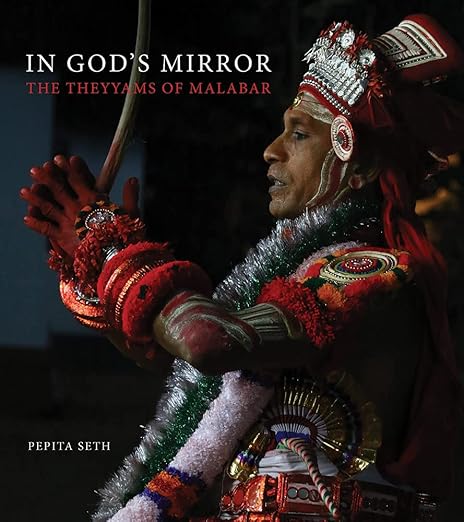
Pottan Theyyam is one of hundreds of Theyyam forms across North Malabar, but few carry its explicit philosophical and social content. These scholarly and photographic books explore Theyyam's myths, performing communities, and its role as a living vehicle for ideas about caste, equality, and the divine — essential reading for anyone moved by Pottan's question.
Browse Theyyam Books →Affiliate link — we earn a small commission at no extra cost to you.
The Fire Ritual — Jnana Agni, the Fire of Knowledge
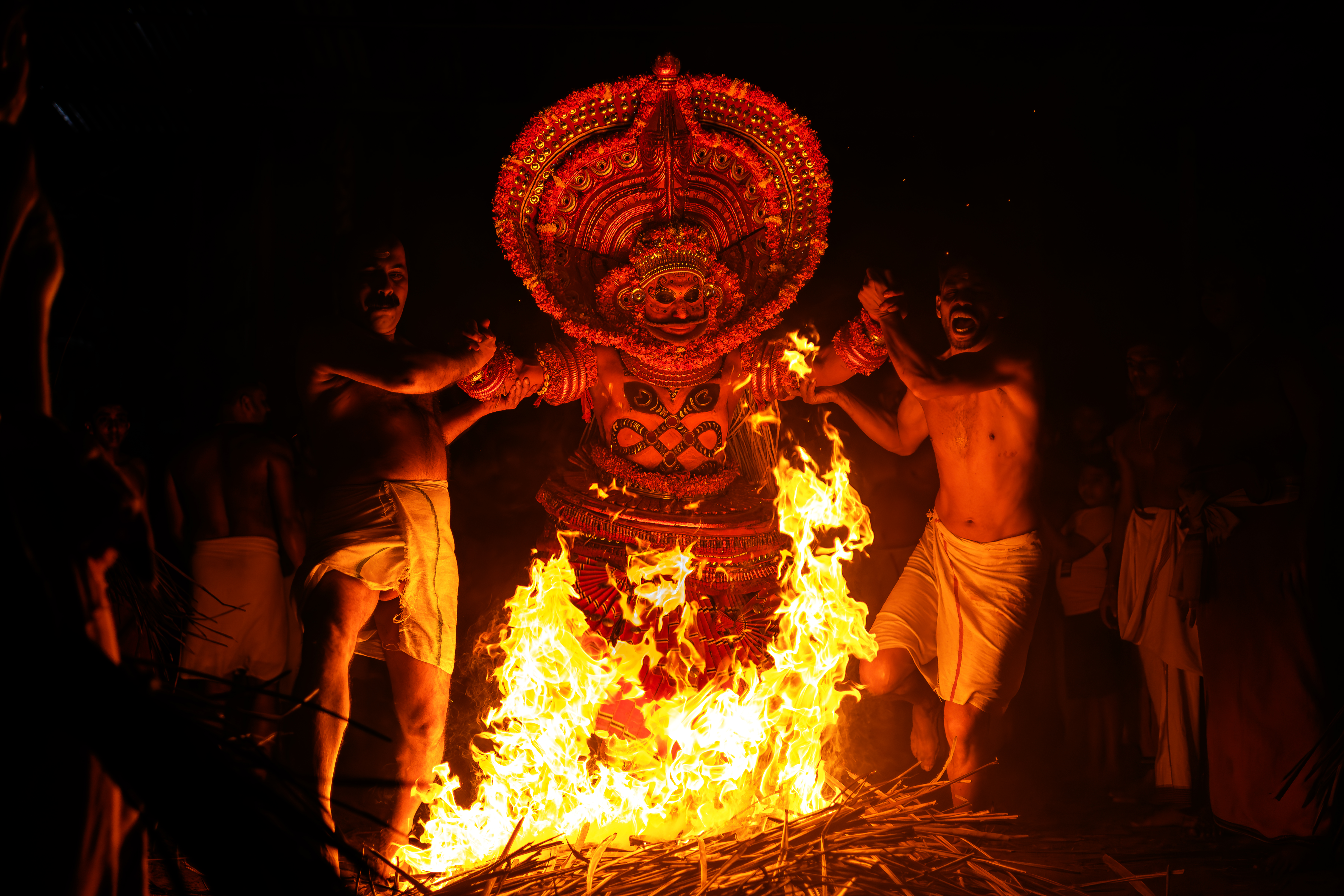
The most visually and physically intense moment of Pottan Theyyam is the performer lying on a bed of burning embers — an act that re-enacts the founding legend's central image of fire as revelation rather than punishment. In Theyyam philosophy, this is called Jnana Agni — the “fire of knowledge.”
The performance usually begins after midnight and continues until dawn, the shrine courtyard filling with drumbeats and the smell of burning coconut husk. As the ritual builds toward its climax, the performer — now fully transformed into Pottan Daivam — lies upon the embers while the gathered devotees chant “Harahara Mahadeva.” The performer's endurance of the heat becomes, in the tradition's understanding, a trial by truth: a demonstration that the body's apparent vulnerability is not the deepest reality.
As folklorist K. V. Krishna Iyer observed, fire in Theyyam “is not punitive but revelatory; it exposes ignorance and reclaims dignity.” After the ritual, the ashes are distributed to the gathered crowd as sacred prasadam — an act of profound symbolic equality. Every person present, regardless of caste, receives the same ash from the same fire. The cremation ground — in ordinary Kerala society the ultimate space of ritual impurity — becomes, for the duration of this ritual, the great equaliser: dust returns to dust, without distinction.
Vattakali — The Circular Dance
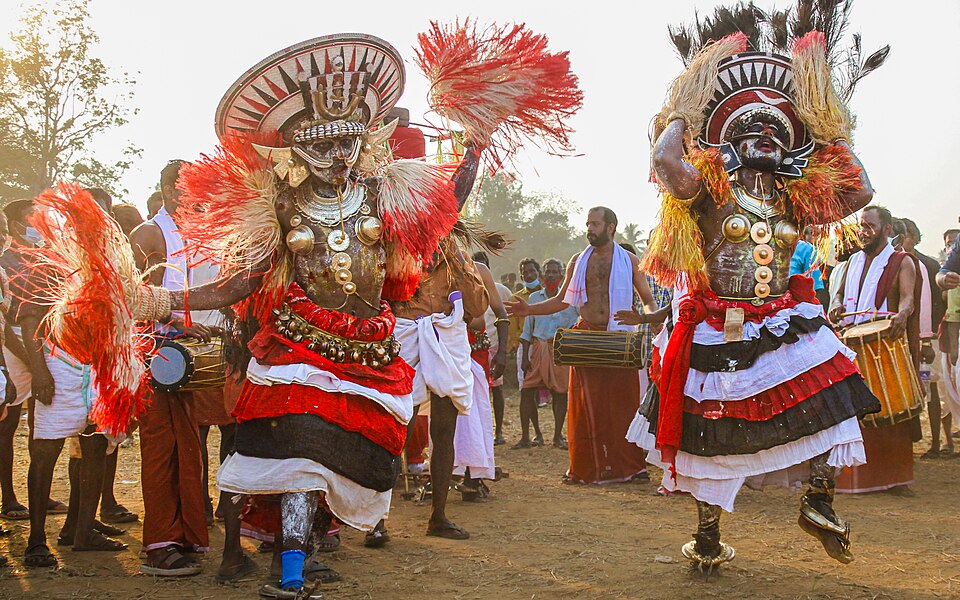
The performance's choreography centres on vattakali — a circular dance representing the eternal cycle of creation and dissolution. The movements are rapid, circular, and trembling, alternating between what observers describe as divine frenzy and the visible tremor of human suffering. Every spin and jump re-enacts, on the level of the body, the metaphysical tension between knowledge and illusion that the legend establishes in words. The shrine courtyard, for these hours, becomes what one scholar called a “cosmic arena” — the village's ordinary ground transformed into the stage on which the universe's fundamental drama is performed.
Mukhathezhuthu — The Face Art and Its Codified Colours
Every visual element of Pottan Theyyam's costume and makeup encodes the same philosophical content as the legend and the fire ritual. The Mukhathezhuthu (face art) is painted in concentric lines using natural pigments — turmeric, rice paste, and laterite — and follows a precise colour grammar:
In contrast to the elaborate, towering headgear of many other Theyyam forms, Pottan Theyyam's headdress (mudi) is comparatively small — made of palm leaves painted with red and white dyes. This restraint is itself meaningful: the deity who appears as the lowest of the low does not announce himself with grandeur. The humility of the costume is part of the argument the performance makes.
The percussion accompanying the ritual — chenda, veekkan chenda, and ilathalam — alternates between slow, philosophical recitation and explosive bursts that mirror the rhythm of debate itself: statement, challenge, response, revelation. Ethnomusicologists have described this rhythmic cycle as “a sonic metaphor for conflict between ignorance and enlightenment” — the drums themselves arguing the legend's case alongside the performer's body and voice.
The Vaakku — When the God Speaks
At the heart of Pottan Theyyam is direct speech — the vaakku, spoken lines delivered by the performer in rustic Malayalam, addressing the gathered crowd. These lines vary slightly from village to village, but their central theme is consistent: the rejection of false superiority and the insistence that dignity has nothing to do with birth.
One widely recorded line — “Ninte kulam ariyaan njaan agniyil kidakkunnu” (“I lie on fire to know your caste”) — turns the entire logic of caste inspection inward. The deity, lying on embers that test his own endurance, claims to be testing the audience’s caste through his own suffering — an inversion that exposes the absurdity of using suffering or purity tests to determine someone's worth.
Pottan Theyyam's characteristic laughter — often interpreted as mockery of social hypocrisy — echoes a wider tradition of devotional poets across India, from Basavanna in Karnataka to Kabir in North India, who used verse and performance to puncture religious pretension. In Kerala's folk imagination, it is precisely through such laughter that divine knowledge reclaims its human face — wisdom delivered not as solemn doctrine but as the laugh of someone who has seen through the joke that society takes so seriously.
“Man is ashes before wisdom.”
Offerings (Nivedyam) — The Humility of What Is Given
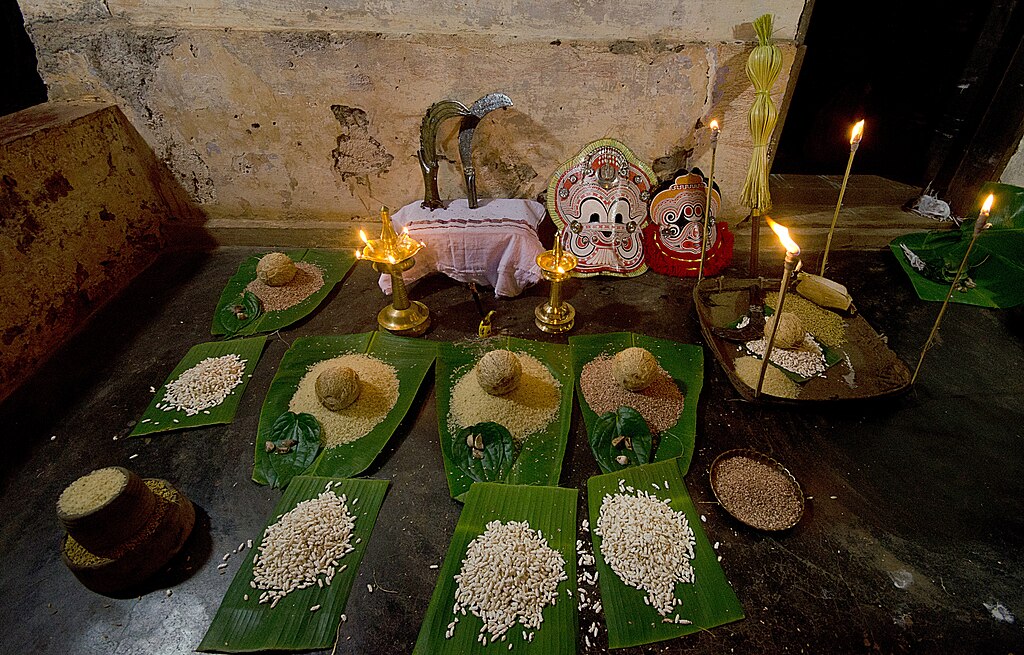
The offerings (nivedyam) made to Pottan Theyyam continue the same philosophical thread in material form. Unlike the elaborate offerings of grand temple deities, Pottan Theyyam — who embodies the voice of the oppressed and the seeker of truth — receives offerings that are deliberately humble: tender coconut, puffed rice (malar), jaggery, and roasted rice powder (poothari), prepared by the local community with heartfelt reverence rather than ceremonial expense.
In many shrines and household performances, betel leaf and arecanut (vettila and adakka) are also included — not consumed, but serving as traditional symbols of respect, dialogue, and hospitality, echoing the everyday social customs through which Kerala's villagers extend goodwill to one another. Their inclusion in the ritual reinforces Pottan Theyyam's connection to ordinary life — the offerings are not separated from the daily customs of the community but are continuous with them.
Together, these offerings express what might be called ritual equality through humility. Pottan Theyyam's nivedyam is not about material grandeur but about sincerity and shared emotion — embodying the belief, central to the entire tradition, that divine grace responds to truth and humility rather than to status or wealth.
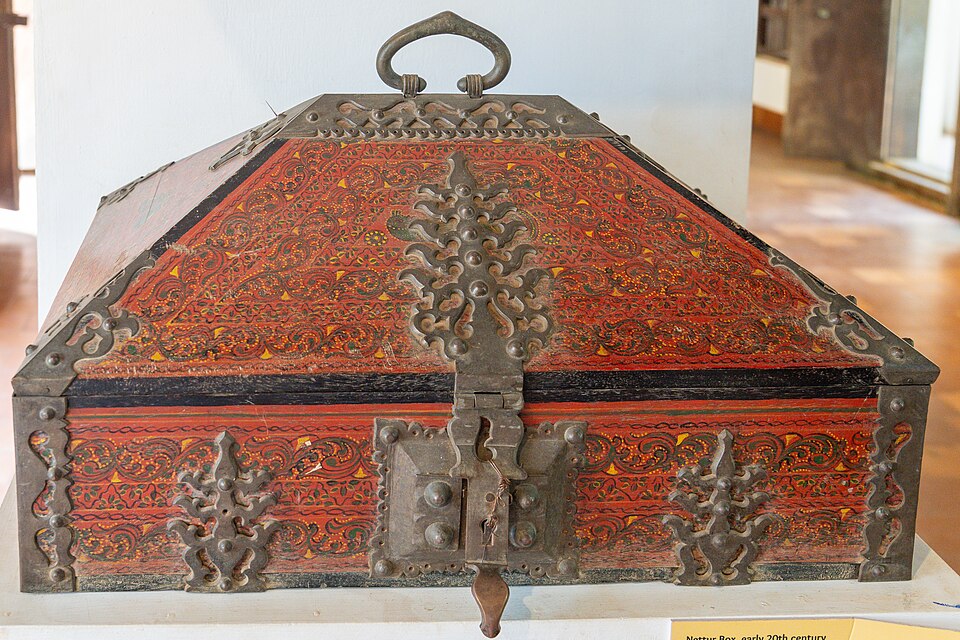
The natural pigments and palm-leaf headdress of Pottan Theyyam reflect the same artisan tradition that produces Kerala's celebrated heritage crafts — objects made by hand, from natural materials, carrying knowledge passed down across generations. Explore authentic Kerala craft objects, from Nettur Petti jewellery boxes to bronze ritual items and woodwork, available on Amazon.
Browse Kerala Crafts →Affiliate link — we earn a small commission at no extra cost to you.
Social and Philosophical Significance
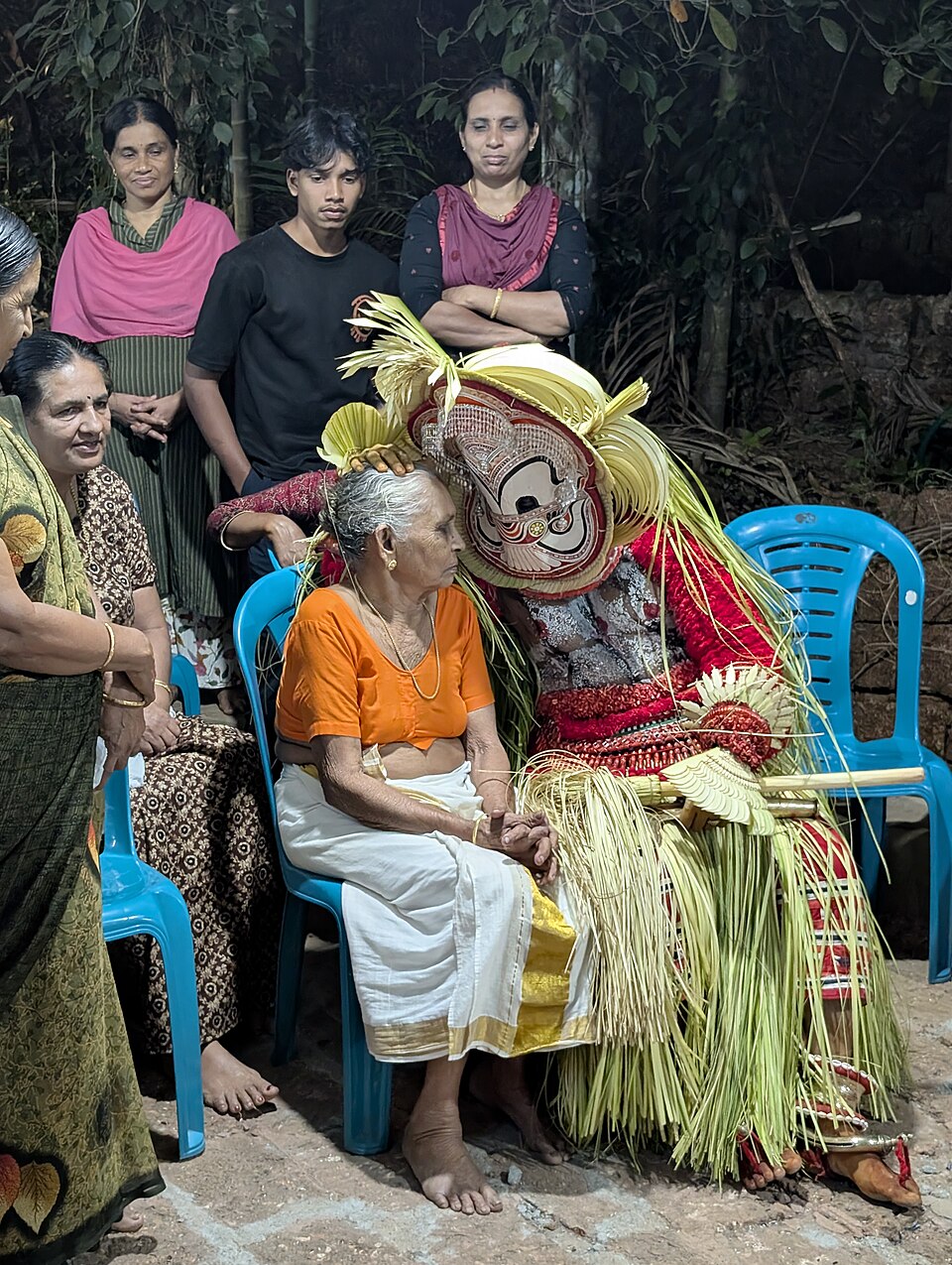
Beyond its visual and ritual power, Pottan Theyyam functions as what one folklorist called “Kerala's earliest democratic dialogue enacted through ritual.” During the performance, Pottan addresses the gathered crowd directly — questioning their deeds, their pride, their neglect of moral duty. This is not a passive spectacle: it is a direct address, and the audience — comprising people of all castes, gathered in the same courtyard — receives it as such.
The ritual's spatial arrangement carries its own social meaning. The performer begins outside the shrine's inner sanctum — symbolising exclusion — and only later enters after proving divine identity through the fire ordeal. This sequence dramatises, in physical movement through space, the historical struggle of marginalised communities for ritual visibility and inclusion. Anthropologists studying South Indian folk religion have described such rituals as “cosmological protests” against hierarchical closure — the sacred geography of the shrine itself enacting a story of inclusion.
Philosophically, Pottan Theyyam dramatises the Advaita idea that all beings share the same divine essence — but rather than leaving this as abstract metaphysics, the ritual makes it sensory and participatory: bodily endurance, rhythmic exhaustion, shared ash. Philosophy becomes something the whole village can feel, together, once a year.
Many observers note that Pottan Theyyam — along with related forms performed at Muchilottu Bhagavathy and Vayanattu Kulavan shrines — anticipated, by centuries, the language of social equality that would later shape Kerala's modern reform movements under figures such as Sree Narayana Guru and Ayyankali. Before these movements had names, the question Pottan Daivam asked — whom do you order to move? — was already being asked, every year, in village courtyards across North Malabar.

The Aranmula Kannadi — the world's only metal-alloy first-surface mirror — is, like Pottan Theyyam, a sacred tradition whose knowledge is held within specific hereditary families across generations. GI-protected and one of Kerala's eight Ashtamangalyam objects, it is a meaningful keepsake connecting visitors to North Malabar's living heritage of sacred craft and ritual.
View Aranmula Kannadi →Affiliate link — we earn a small commission at no extra cost to you.
A Living Tradition — Pottan Theyyam Today
Pottan Theyyam remains both a living ritual and a subject of scholarly interest. The performance continues at village kavus and household shrines across Kannur, Kasaragod, and parts of North Malabar, drawing villagers who seek moral counsel as much as divine blessing — the ritual functions, for many who attend, as an annual occasion for ethical reflection rather than mere spectacle.
In contemporary Kerala, Pottan Theyyam has become a subject for art films, documentaries, and academic theses. Photographers are drawn to its haunting imagery — the ash-covered body illuminated by flame — as a visual metaphor for enlightenment through suffering. Yet in the rural shrines of Kandoth and the wider Kolathunadu region, the ritual continues with the same sincerity it has carried for generations: villagers gather not primarily for spectacle, but because they believe the god who once corrected a philosopher still has something to say to them, each year, again.
Comparatively, Pottan Theyyam shares thematic affinities with other folk-religious protest traditions across India — the Basava Purana narratives of Karnataka and the poetry of Kabir in North India both reinterpret divine truth as a social equaliser rather than a privilege of birth. What makes Pottan Theyyam distinctive within this wider landscape is its fusion of explicit philosophical dialogue with embodied ritual — the argument is not merely told, but performed, endured, and shared as ash among everyone present.