Real and Legendary Ghost Stories of Kerala: A Folklore Perspective
AI Generated image
Ghost stories occupy a peculiar yet persistent space in Kerala’s cultural imagination. Despite high literacy, scientific education, and strong rationalist movements, narratives of spirits, apparitions, and haunted spaces continue to circulate in villages, towns, and urban neighbourhoods alike. These stories are not merely remnants of a pre-modern belief system; they are living narratives that adapt themselves to changing social realities.
In the context of Folklore studies, ghost stories—whether narrated as ancient legends or as personal experiences—are valuable cultural texts. They reveal how communities interpret fear, memory, morality, death, and the unknown. This article examines both so-called “real” ghost stories narrated in Kerala and the older legendary spirit figures that continue to shape such narrations.
Rather than asking whether these stories are factually true or false, this study approaches them as Folklore: narratives that are believed, retold, reshaped, and preserved within specific cultural contexts.
What Is a “Real” Ghost Story in Folklore?
In popular usage, a “real” ghost story refers to an incident claimed to have been personally experienced or directly witnessed by someone known to the narrator. Such stories are often narrated without dramatic flourish, presented as ordinary recollections rather than deliberate attempts to frighten the listener.
Folklore scholarship recognises these narratives as a distinct form of oral tradition. They are typically grounded in specific locations—roads, houses, ponds, schools, temples— and anchored in everyday life. The teller often insists on authenticity using phrases such as “this happened to someone I know” or “this is not a story, it really happened.”
These narratives differ from fairy tales or myths because they demand belief. They function as contemporary legends, reflecting present-day anxieties while drawing unconsciously from older symbolic patterns embedded in Kerala’s traditional spirit lore.
Real Ghost Stories from Kerala: Narrated Experiences and Places
AI Generated image
The following narratives are commonly told in Kerala as real experiences. What gives these stories credibility in local memory is not proof, but precision: named places, ordinary circumstances, and narrators who insist that the events were neither imagined nor invented.
The Estate Road at Bonacaud, Thiruvananthapuram
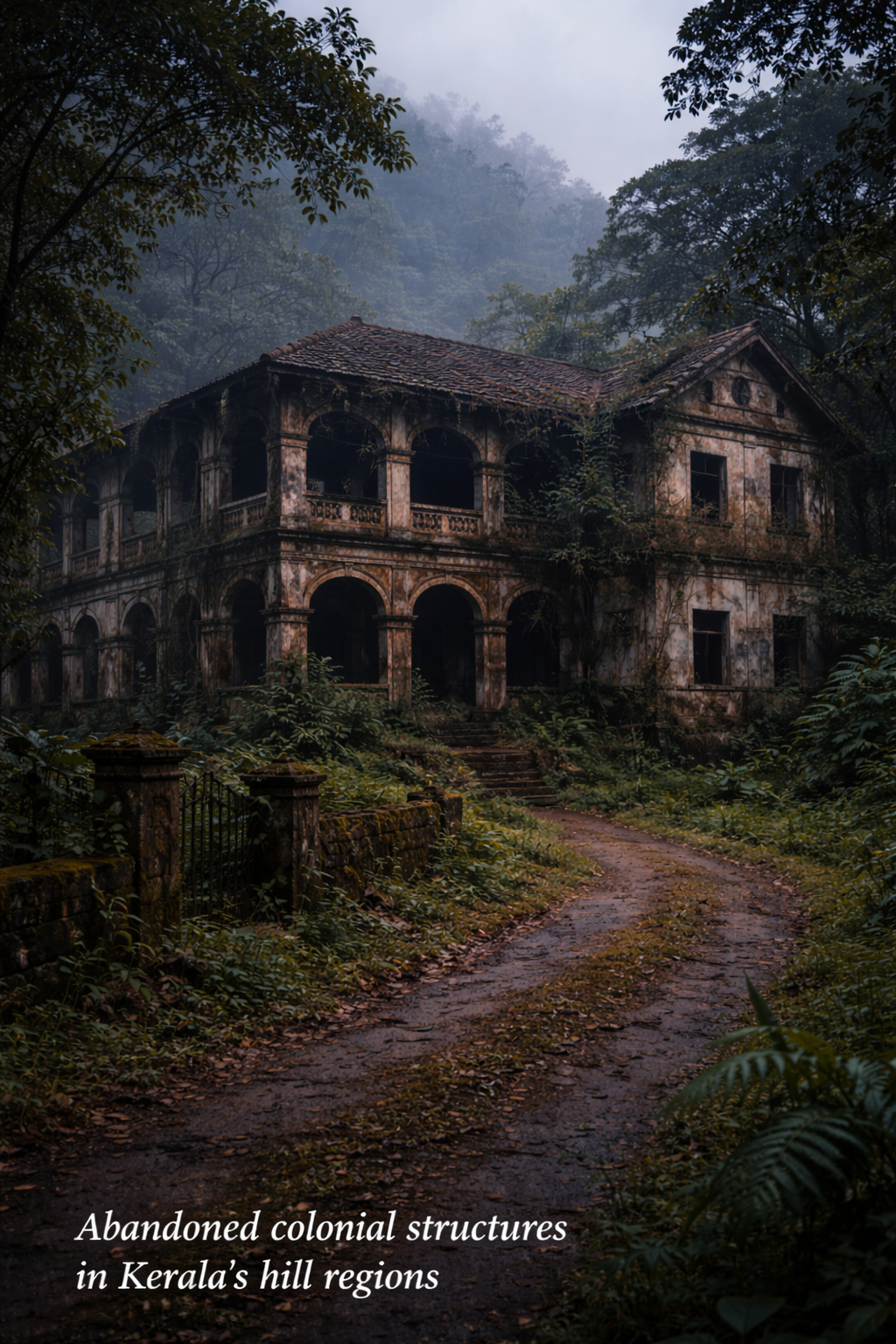
Bonacaud Estate, located at the foothills of the Western Ghats near Thiruvananthapuram, has long been associated with stories of strange encounters narrated as real experiences. The estate road, particularly the stretches leading toward the abandoned factory buildings, is frequently mentioned in such accounts.
Locals, forest workers, and occasional night travellers describe seeing a solitary figure walking ahead of them on the road during late evening hours. The figure is usually reported as male, dressed in old-fashioned clothing, and walking at an unhurried pace. Those who attempt to overtake or call out claim that the figure vanishes suddenly near bends or dense tree cover.
In some versions, the encounter is accompanied by the sound of footsteps even after the road appears empty. The experience is often narrated without dramatic elements, described instead as deeply unsettling because of its ordinariness.
Elder residents associate the story with the colonial history of the estate—particularly with former European supervisors or workers who are believed to have died in isolation. Younger narrators, however, often avoid specific explanations, emphasising only that the experience occurred at Bonacaud and that it felt unmistakably real.
From a folklore perspective, the Bonacaud narratives reflect how abandoned industrial landscapes, colonial memory, and forested terrain combine to produce powerful modern ghost stories. The estate, identifiable and historically layered, provides the spatial and emotional conditions necessary for such narratives to endure.
Hymavathi — The Karyavattom (Kariavattom) Pond Legend, Thiruvananthapuram
AI Generated image
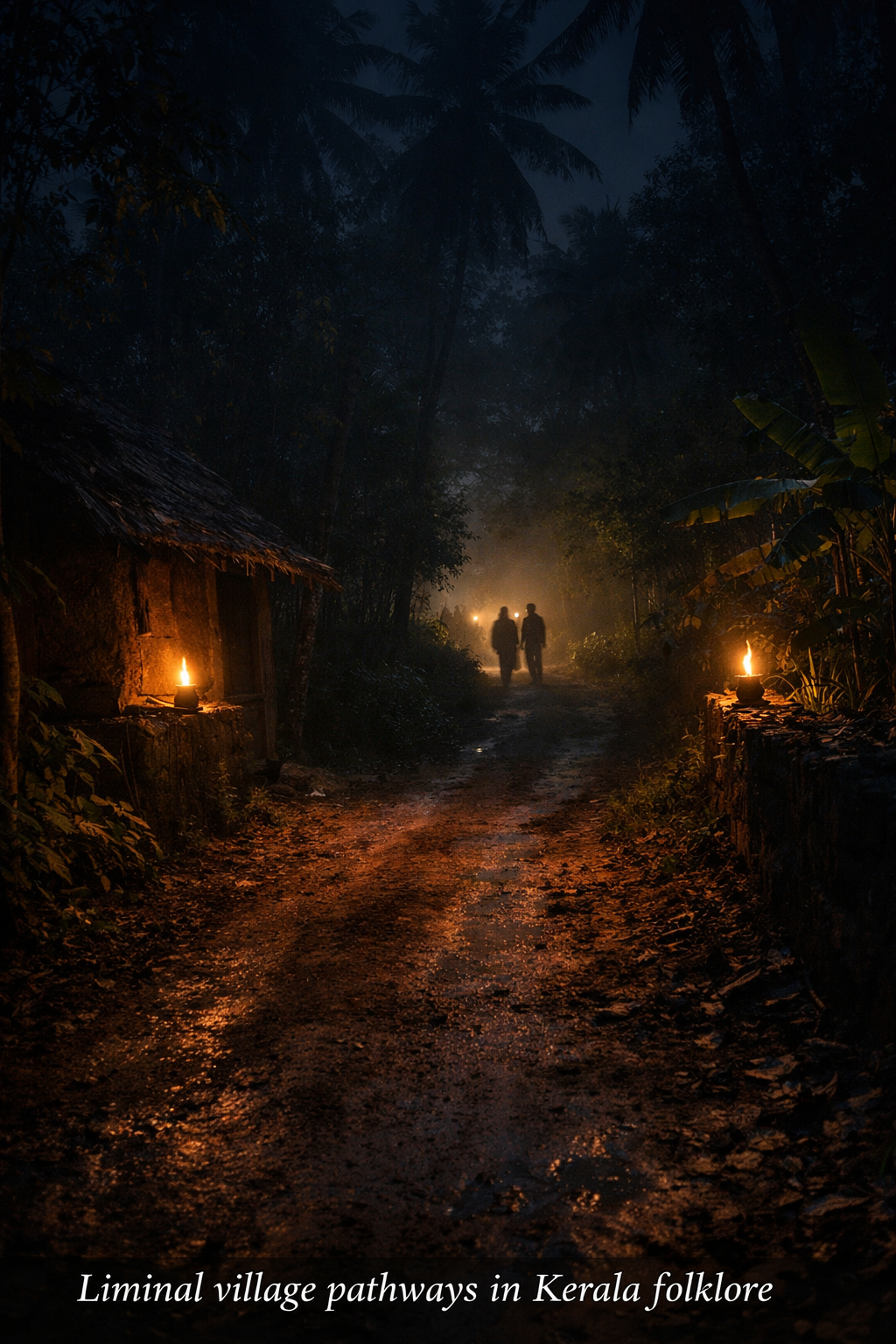
The name Hymavathi (also spelled Haimavathi) in Kerala’s popular imagination is most commonly tied to an abandoned pond on the Karyavattom/Kariavattom campus area of the University of Kerala in Thiruvananthapuram (near Technopark). Local press and long-running campus stories place the legend at this site rather than in Silent Valley or the Attappady forest belt.
The widely repeated version tells of a young woman named Hymavathi who took her life by drowning after a tragic love affair—often described as involving a lover from a lower caste who was murdered or forcibly separated by her family. Over decades the pond acquired a reputation for ghostly sightings; students and nearby residents reported eerie experiences and the site became a staple of campus folklore. Variations in details and spelling are common in oral retellings.
Important note: the available sources are journalistic reports, blogs and social media recollections, not archival legal records or academic ethnography. Present the Hymavathi account as **campus/urban legend**—a piece of modern folklore shaped by local memory, rumour, and retelling—rather than an established historical event.
Ghost of Perumbavoor MC Road
The legend of the Perumbavoor MC Road ghost is a quintessential roadside myth centered on a stretch of the Main Central Road in Kerala. It typically involves sightings of a woman in a white saree who appears at night near an abandoned colonial-era tea bungalow. While local folklore suggests she is the spirit of a woman who met a tragic end decades ago, the story is more likely rooted in the high frequency of road accidents on this dangerous stretch. The "eerie" reputation of the area has been further amplified by paranormal vloggers and reports of miscreants using white clothing to scare drivers into stopping, facilitating robberies. Ultimately, the story persists as a warning about the treacherous nature of the road and the isolation of the surrounding abandoned industrial sites.
Ghost story at College Hostel Thrissur
The Thrissur College hostel ghost story is a staple of campus culture, often whispered among students at the Government Engineering or Medical Colleges. The legend usually revolves around a specific room where a student is said to have committed suicide, leading to claims of phantom footsteps, the sound of anklets in the hallways, and the sensation of being watched while studying late at night. In reality, these stories are often passed down from seniors to juniors as a form of initiation or "legend tripping." The psychological stress of high-stakes exams, combined with sleep deprivation and the architectural acoustics of old, wind-swept buildings, frequently causes students to misinterpret natural sounds as supernatural events. The presence of large, flowering trees like the Pala tree near these hostels also adds a traditional layer of folklore to these modern student anxieties.
Sumathi Valavu: The Sumathi Ghost Narrative
AI Generated image
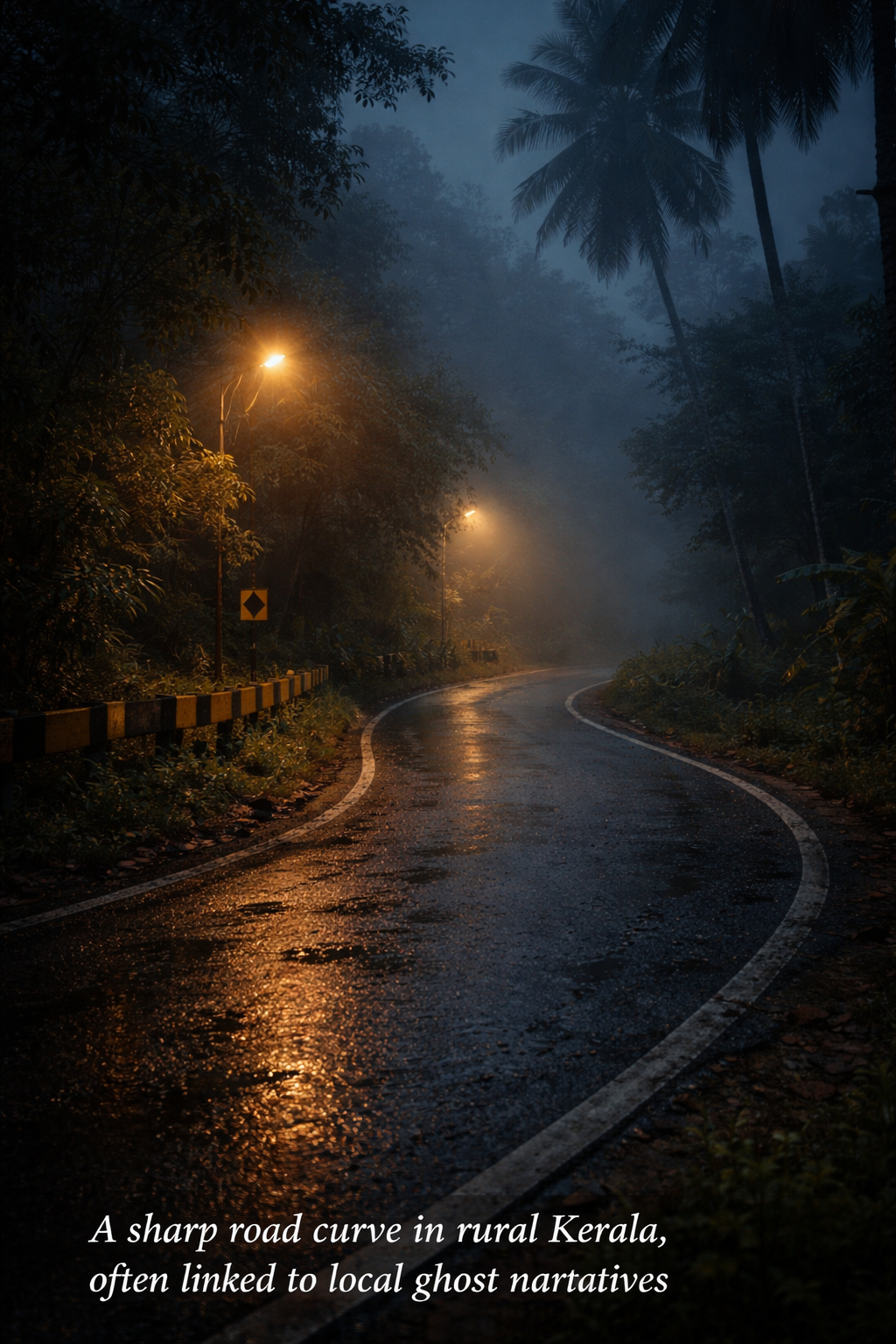
Among Kerala’s modern ghost stories that circulate as “real” accounts, the legend of Sumathi Valavu is widely known in the Thiruvananthapuram region. The tale centres on a road bend locally called Sumathi Valavu, believed by some to be haunted by the spirit of a young woman named Sumathi. This story is rooted in a tragic event said to have occurred decades ago, and it continues to shape local memory of the place. :contentReference
According to local folklore, Sumathi was a young woman who became pregnant and was murdered by her lover, Rathnakaran, who wanted to avoid responsibility and wed another. The incident, variously dated to the early 1950s in regional accounts, marked the beginning of eerie rumors around the nearby road. Witnesses claimed sightings of a female figure in white near the bend, accompanied by unexplained vehicle malfunctions and mysterious sounds at night.
Over time, this narrative became embedded in local lore. However, in later years there were reports that criminal elements exploited the fear surrounding Sumathi’s ghost to intimidate and rob travellers after dark. Individuals dressed in white would stage frightening appearances, while a sharp, poorly lit curve in the road may have contributed to real accidents and incidents that reinforced the legend.
The story has entered popular culture and was the inspiration for the 2025 Malayalam film Sumathi Valavu, which blends horror and comedy around this legendary bend. While the movie uses the haunting tale as a backdrop, it fictionalises many elements for narrative effect rather than presenting a strict historical account.
Today, Sumathi Valavu remains a roadside myth interwoven with both tragedy and human exploitation. Whether interpreted as a haunting spirit, a cautionary tale, or a legend amplified by community fear and folklore, it illustrates how personal tragedy can evolve into enduring supernatural narrative in Kerala’s cultural imagination.
Karinthandan at Lakkidi, Wayanad
The story of Karinthandan is inseparably tied to Lakkidi in Wayanad, where the old ghat road was laid through difficult terrain. According to local memory, Karinthandan, an indigenous guide, was instrumental in revealing the route through the hills but was later betrayed and killed.
Even today, travellers and workers speak of disturbances near the old route—strange sounds, sudden fear, and a feeling of obstruction. Early colonial accounts describe rituals performed to bind Karinthandan’s spirit, suggesting that the fear was once considered real and disruptive.
In folklore terms, Karinthandan represents a powerful convergence of history, injustice, and belief. His story survives not merely as legend but as a moral memory embedded in the landscape of Wayanad.
Apparitions at Varkala Cliff
Varkala Cliff, unique in Kerala for rising directly from the sea, is associated with several ghost narratives narrated as real experiences. Night walkers and residents speak of hearing footsteps, whispers, or sudden calls along less crowded stretches of the cliff after dark.
Some accounts describe seeing figures standing close to the edge, disappearing when approached. These stories are often linked to the cliff’s long association with death rites and memorial practices.
Unlike forest or road-based ghost stories, Varkala’s narratives are shaped by the presence of the sea, height, and ritual memory. The cliff itself functions as a liminal space between land and ocean, life and death, making it fertile ground for such experiences.
Morris Bungalow near Bonacaud
Morris Bungalow, located in the forested Bonacaud region, is one of the most frequently referenced haunted colonial structures in southern Kerala. The abandoned bungalow, once occupied by a British official, is said to be the site of unexplained sounds and sightings.
Forest staff and local residents recount hearing furniture being moved, footsteps on empty verandas, and doors opening without human presence. These experiences are usually narrated in a matter-of-fact manner, emphasising familiarity with the building rather than fear.
The Morris Bungalow narrative reflects a broader pattern in Kerala’s folklore, where abandoned colonial buildings become repositories of unresolved history. The structure’s isolation and continued visibility allow the story to persist as a lived belief rather than a distant legend.
Why Place Matters in “Real” Ghost Stories
These stories derive their strength from specificity. Named roads, houses, hostels, forests, and riverbanks transform vague fear into believable experience. Whether or not the events occurred as narrated is less important than the fact that they are remembered and retold as real within the community.
In folklore terms, such narratives occupy the space between personal memory and collective legend, demonstrating how belief becomes anchored in place.
Legendary Ghosts and Spirit Figures of Kerala
Long before ghost stories were narrated as individual experiences, Kerala’s folklore had already developed a dense and sophisticated world of spirits. These beings were not vague abstractions; they were socially located, morally charged, and closely tied to specific landscapes. Even today, when people speak of “real” ghost encounters, the vocabulary, imagery, and emotional tone often emerge from these older legendary frameworks.
Traditional spirit figures in Kerala were rarely imagined only to frighten. They explained sudden or unjust death, sexual violence, betrayal, caste and gender oppression, ecological danger, and moral imbalance. Understanding these legendary forms is essential for interpreting contemporary ghost narratives, which frequently reproduce the same symbolic structures under the guise of modern experience.
Yakshi: Desire, Deception, and Fear
The Yakshi is perhaps the most enduring and recognisable female spirit in Kerala folklore. Traditionally described as a beautiful woman who attracts men only to destroy them, the Yakshi represents a deeply ambivalent figure where desire and danger coexist. She is often encountered near trees, riverbanks, crossroads, forests, and lonely paths—spaces already marked as liminal and unsafe.
In many narratives, the Yakshi is not born evil. She is frequently portrayed as a woman betrayed by lovers, murdered for wealth, or subjected to extreme injustice. Her transformation into a spirit is shown as the result of social cruelty rather than inherent wickedness. The Yakshi thus becomes a moral reminder of unresolved violence and denied justice.
Modern ghost stories of female apparitions on highways, bridges, or near water bodies often unconsciously echo Yakshi imagery. Even when the name “Yakshi” is not used, the cultural memory of this figure continues to shape how fear is narrated and understood.
Kalliyankattu Neeli: The Wandering Spirit of Vengeance
AI Generated image
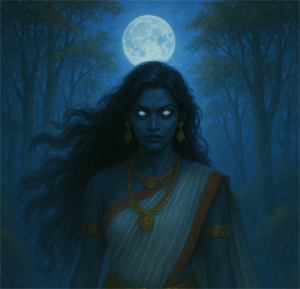
Among the most powerful Yakshi-like figures in Kerala folklore is Kalliyankattu Neeli. According to legend, Neeli was a woman who suffered extreme injustice and betrayal in life, often linked to sexual violence or deceit by men of authority. After her death, her spirit is said to wander relentlessly, haunting those who exploit or deceive others.
Unlike many Yakshi figures who rely on seduction, Kalliyankattu Neeli is remembered for her relentless pursuit of vengeance. She appears on lonely roads, near abandoned houses, and forest edges, often revealing her terrifying form only after gaining the victim’s trust. Her story reflects a deep cultural anxiety about unpunished crimes and moral hypocrisy.
Kalliyankattu Neeli occupies a space between ghost and moral force. She is feared not merely as a supernatural being but as a reminder that injustice, especially against women, does not disappear with death. Many contemporary ghost sightings involving aggressive female spirits closely resemble Neeli’s narrative structure.
Other Yakshi and Female Spirit Legends
Kerala folklore records several regional Yakshi figures that follow similar narrative patterns. Kanjirottu Yakshi, for instance, is associated with betrayal and violent death, her spirit bound to a specific locality and tree. Such stories firmly root fear within geography, transforming ordinary landscapes into memory-laden spaces.
In some regions, Yakshi figures overlap with Odiyan legends, where fear is intensified through shape-shifting, deception, and night travel. These spirits often appear as women, animals, or familiar figures, blurring the boundary between the known and the unknown.
What unites these narratives is not spectacle but meaning. These spirits articulate social tensions surrounding gender, power, trust, and vulnerability. When modern storytellers describe encounters with mysterious women or hostile female apparitions, they are often unknowingly reactivating these older folkloric templates.
Pretam: The Restless Dead
The Pretam occupies a different moral and emotional space in Kerala’s spirit lore. Unlike the Yakshi, the Pretam is usually described as incomplete rather than seductive. It is the spirit of someone who died suddenly, violently, or without proper rites.
Stories of Pretams frequently emphasise unresolved obligations—debts unpaid, rituals neglected, or duties left unfinished. The spirit’s unrest mirrors the community’s anxiety about disorder and discontinuity.
Many modern ghost stories involving strange sounds, disturbances in houses, or repeated misfortune are framed locally as Pretam-related, even when narrated as recent and real experiences. This demonstrates how traditional categories continue to structure contemporary belief.
Brahmarakshassu: Knowledge Without Ethics
The Brahmarakshassu is a distinctive figure in Kerala folklore, combining intellectual power with moral failure. Traditionally associated with learned individuals who misused their knowledge, this spirit represents the fear of intellect divorced from ethical responsibility.
Often imagined as inhabiting old houses, ruins, or secluded scholarly spaces, the Brahmarakshassu stands apart from more primal spirit figures. Its terror arises not from physical violence but from the unsettling presence of corrupted wisdom.
In contemporary narratives, this figure subtly survives in stories about haunted ancestral homes or mysterious presences associated with former scholars or powerful individuals.
Bhuta and Maruta Spirits: Fear of the Natural World
Spirits associated with wind, forests, and untamed landscapes occupy a significant place in Kerala’s folklore. Often referred to as Bhuta or Maruta, these entities represent the unpredictable and dangerous aspects of nature.
Such spirits were traditionally believed to inhabit forests, hills, and open lands—spaces beyond human control. Encounters with them often serve as warnings against ecological transgression or reckless movement through dangerous terrain.
Modern ghost stories involving forests, deserted plantations, or remote hills echo these older beliefs, even when narrated in secular language. Fear of the unknown landscape remains a powerful narrative force.
From Legendary Spirits to Living Folklore

AI Generated image
These legendary figures have not disappeared; they have transformed. While ritual contexts and explicit belief systems may have weakened, the narrative structures remain active. Contemporary ghost stories often draw unconsciously from these older archetypes.
This continuity explains why “real” ghost stories in Kerala feel familiar even when they are new. They are shaped by a deep reservoir of shared symbols, fears, and moral expectations.
Understanding legendary spirit figures allows us to see contemporary ghost narratives not as isolated experiences but as part of a long, evolving folklore tradition.
When “Real” Experiences Become Legends
A striking feature of ghost narratives in Kerala is how easily a personal experience transforms into a shared legend. What begins as an individual encounter—real or perceived— gradually detaches itself from the original narrator and enters collective memory.
In the earliest stage, the story is anchored to a specific person and moment. As it is retold, personal details fade while location becomes more prominent. The name of the road, house, pond, or grove remains, even as the identity of the witness disappears.
Over time, repetition standardises the narrative. Certain motifs are retained, others are discarded, and the story begins to function independently of its origin. At this point, the narrative is no longer a personal account but a local legend.
The Power of Place in Ghost Narratives
Place plays a decisive role in the survival of ghost stories. In Kerala, narratives are rarely abstract; they are tied to named locations that listeners recognise or can locate on a map. This geographical anchoring lends credibility and durability to the story.
Certain spaces repeatedly attract ghost narratives: abandoned houses, temple boundaries, burial grounds, riverbanks, forest paths, and crossroads. These are liminal spaces—zones that exist between categories such as sacred and profane, habitation and wilderness, life and death.
Once a place acquires a reputation, subsequent experiences are interpreted through that lens. Ordinary sounds, shadows, or coincidences are reimagined as confirmation of the existing legend, reinforcing the narrative cycle.
Why Ghost Stories Flourish in Kerala
Kerala’s cultural landscape provides fertile ground for ghost narratives. A strong oral tradition ensures that stories circulate easily across generations, while dense settlement patterns allow narratives to spread rapidly within communities.
The coexistence of rationalist thought and ritual practice creates a unique environment where disbelief does not eliminate storytelling. Even those who reject supernatural explanations often participate in narrating such stories as cultural memory.
Ecological factors also play a role. Kerala’s geography—its rivers, forests, hills, and monsoon climate—has historically demanded respect and caution. Ghost stories articulate this relationship with a landscape that is both nurturing and unpredictable.
Fear, Memory, and Belief
From a psychological perspective, ghost stories operate at the intersection of fear and memory. Human perception is especially vulnerable under conditions of darkness, isolation, fatigue, and emotional stress—conditions frequently present in ghost narratives.
Once an experience is interpreted as supernatural, memory reshapes it to fit existing narrative patterns. Retelling further stabilises the story, gradually transforming a moment of uncertainty into a coherent narrative.
Belief, in this context, is not a fixed conviction but a spectrum. People may simultaneously doubt and narrate, question and repeat. This ambiguity allows ghost stories to survive without demanding absolute faith.
From Belief to Interpretation
By examining how personal experiences become legends and how legends persist within social and psychological frameworks, we begin to see ghost stories as cultural processes rather than isolated events.
The next section addresses a question often asked but rarely answered carefully: are these stories true? Approached through folklore methodology, the question itself takes on a new meaning.
Are Ghost Stories True? A Folklore Perspective
One of the most persistent questions surrounding ghost stories is whether they are true. From a folklore perspective, this question is not dismissed, but it is reframed. Folklore does not seek to verify supernatural claims through empirical proof; instead, it examines why stories are told, believed, and preserved.
In this framework, truth is not limited to factual accuracy. A ghost story may be factually unverifiable yet culturally true, revealing how individuals and communities interpret experiences that fall outside ordinary explanation.
When narrators insist that a story is real, they are asserting sincerity rather than scientific certainty. This insistence itself is a meaningful cultural act, signalling trust, shared belief, and emotional authenticity.
Belief, Experience, and Explanation
Folklore distinguishes between experience and explanation. An individual may experience fear, confusion, or a sense of presence, while the explanation offered for that experience is shaped by cultural memory and available narrative forms.
In Kerala, traditional spirit figures, ritual knowledge, and inherited stories provide a ready-made interpretive framework. Even when people do not explicitly believe in ghosts, these frameworks influence how experiences are remembered and narrated.
This layered process explains why similar experiences are narrated differently across cultures. The experience may be human and universal, but the explanation is culturally specific.
Ghost Stories in a Modern, Educated Society
The persistence of ghost stories in a modern, educated society like Kerala is often misunderstood as a contradiction. In reality, education does not erase narrative traditions; it coexists with them.
Ghost stories survive because they fulfil emotional and social needs that rational explanations do not always address. They allow people to articulate fear, uncertainty, and moral tension without requiring definitive answers.
In contemporary contexts, these stories circulate through new media—social networks, online forums, and digital storytelling—demonstrating their ability to adapt while retaining traditional structures.
Ghost Stories as Living Folklore
When viewed through the lens of folklore, ghost stories emerge as living cultural documents. They preserve collective memory, encode social values, and reflect changing relationships between people, place, and belief.
The distinction between “real” and legendary ghost stories becomes less significant than their shared function. Both are narrative responses to uncertainty, shaped by inherited symbols and contemporary experience.
By listening carefully to these stories—without ridicule or blind acceptance—we gain insight into how communities understand themselves and their world.
Conclusion: Fear, Memory, and Meaning
Ghost stories in Kerala are not merely tales of fear. They are expressions of memory, morality, and cultural continuity. Whether narrated as personal experiences or inherited legends, they reveal how the unseen is used to make sense of the visible world.
In the context of Kerala folklore, these narratives deserve careful attention—not because they prove the existence of ghosts, but because they illuminate the enduring human need to narrate, believe, and remember.
References
- Dégh, Linda. Legend and Belief: Dialectics of a Folklore Genre. Indiana University Press.
- Brunvand, Jan Harold. The Vanishing Hitchhiker: American Urban Legends and Their Meanings. W. W. Norton & Company.
- Blackburn, Stuart. Print, Folklore, and Nationalism in Colonial South India. Permanent Black.
- Nambiar, K. K. N. Kerala Folklore. National Book Trust.
- Thurston, Edgar. Omens and Superstitions of Southern India. Government Press.
The Social Functions of Ghost Stories
Ghost stories in Kerala perform several social functions beyond entertainment. They often act as informal moral narratives, warning against risky behaviour such as travelling alone at night, disrespecting boundaries, or neglecting social obligations.
These stories also provide a framework for discussing sensitive topics that may otherwise remain unspoken—sudden death, injustice, violence, or social transgression. By attributing such events to supernatural causes, communities create a symbolic language for collective anxiety.
Importantly, ghost narratives can reinforce social norms. Spirits frequently appear in response to violations of ethical or ritual expectations, reminding listeners of the consequences of moral imbalance.