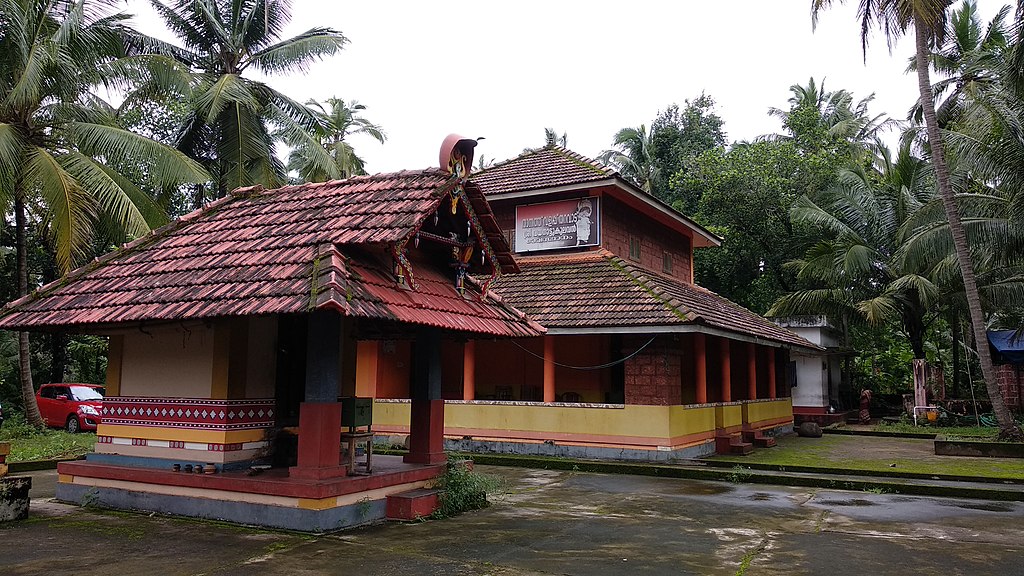
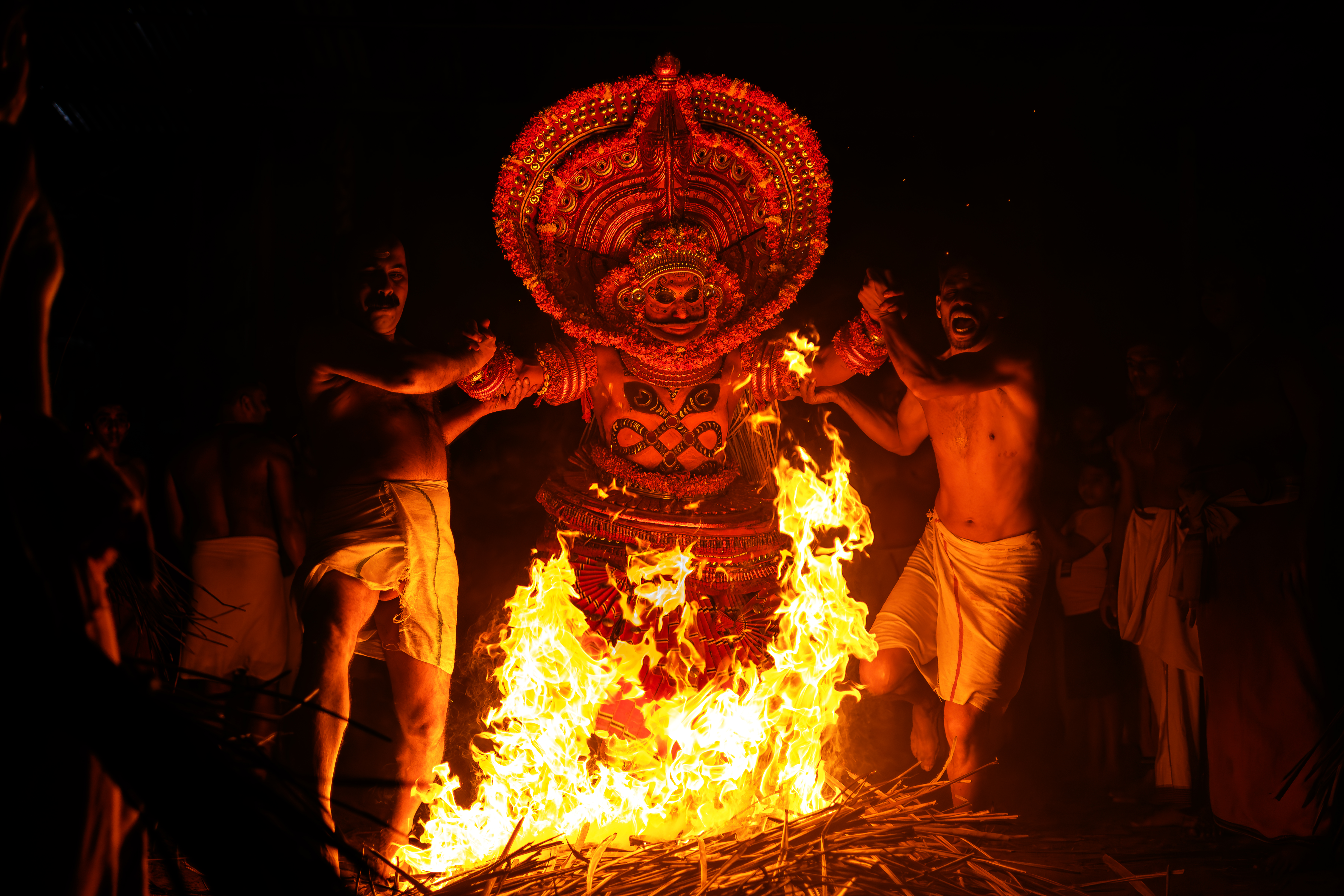
It is four in the morning at Muthachivalappil Tharvadu in Kannur. There is no electric light. Coconut leaves are set alight, and from that glow — sudden, amber, alive — Kandanar Kelan Theyyam appears. Silk garments. Metal anklets. Two serpents drawn across the chest in red and black. And then, without hesitation, the deity runs directly into the fire. This is not spectacle. This is the re-enactment of a death and resurrection that North Kerala has refused to forget for centuries.
A Deity Unlike Any Other — The God Who Conquered Fire by Dying in It
In the rich and complex pantheon of Theyyam — with its 400+ divine forms spanning the full spectrum of human experience and cosmic power — certain deities command a special kind of attention. Kandanar Kelan is one of them. Not the most famous, not the most frequently performed, but widely regarded among Theyyam practitioners, scholars, and the growing community of documentary photographers drawn to North Kerala as one of the most viscerally powerful performances the tradition has to offer.
The reason is elemental: this is the only major Theyyam form in which the divine performer literally, without any protective technology or theatrical illusion, runs through burning fire in full silk costume. The fire is real. The costume is real. The Theyyam is not performing a fire ritual — the Theyyam is, at that moment, the deity itself. And the deity was born in fire, died in fire, and was resurrected from fire's ashes. The Agni Pravesham is not spectacle. It is theology made physical.
Kandanar Kelan is one of Theyyam's most photographed forms globally — its combination of fire, silk, the serpent iconography, and the pre-dawn darkness in which it is typically performed makes it extraordinary visual content. But the visual power is inseparable from the mythological depth. Read our full Theyyam guide for the broader context of this extraordinary ritual tradition, and our North Kerala Cultural Tour guide for how to attend authentically.
The Legend of Kandanar Kelan — From Abandoned Child to Forest Fire to Divinity
Every Theyyam has its origin story — the Thottam Pattu (invocatory ballad) that recounts the deity's earthly history before the costume and the transformation begin. For Kandanar Kelan, this story is one of the most human, most unjust, and most ecologically charged in the entire Theyyam tradition. It begins not with cosmic drama but with an abandoned infant in a forest.
The Child of the Forest — Kelan's Origins
In the village of Ramanthali near Payyannur in Kannur district, a woman named Meladathu Chaki of the Thiyya community was going about her daily life when she came across an infant boy abandoned in the Poombunam forests of Wayanad — the same dense Western Ghats territory that later became the site of Kelan's death. She had no child of her own. She took the boy home, named him Kelan, and raised him as her son.
Kelan grew into a young man of extraordinary physical strength and industry. He was devoted to Chaki Amma, working the land she owned with a diligence that brought real prosperity to their household. The pair were, by all accounts in the oral tradition, genuinely happy — the foundling had found his family, the childless woman had found her child.
Kelan Clears the Forest — Labour, Love, and the Setting of a Stage
Chaki Amma had an ambition for her ancestral land in Poombunam: she wanted the dense forest cleared to make it suitable for cultivation. This was not a small task. The Poombunam forest was thick, wild, and difficult. Kelan accepted the work with characteristic determination and set about clearing, one after another, four named forests: Kelan Mukkuttikkad, Muvarukunnu, Nallathenga, and Karimpanakkad.
The naming of these four forests in the Thottam Pattu — their specific, real names, not generic descriptors — is a characteristic feature of Kerala's oral tradition. Folklore encodes geography. The Theyyam community that performs this ritual knows exactly where these forests were. The landscape is not abstract. It is the landscape of a specific historical community's ancestral memory.
"Four forests cleared. Four forests he carried on his back, tree by tree, through the strength of devotion to a woman who found him abandoned and chose to call him son. The fifth forest was the one that chose him."
— KeralaFolklore.com, drawing from oral tradition

The Fifth Forest — Death by Fire and the Serpents
When Kelan came to the fifth and final forest, the oral tradition offers two variant accounts that have coexisted in the community's memory. In the first — which appears in the Thottam Pattu of Meledath Tharavadu in Kunnaru, Ramanthali — Kelan had consumed kallu (toddy) before setting out to work that day. Intoxicated, he began burning the undergrowth to clear it, as was the slash-and-burn practice of the time. The fire, fuelled by the dry forest vegetation, spread faster than he could control it. He was surrounded before he could retreat.
In the second variant — reported from the Muthachivalappil Tharavadu tradition and referenced in several historical accounts of North Malabar — Kelan was a hunter in this forest when it unexpectedly caught fire around him. Both versions converge on what happened next: trapped by the advancing flames, Kelan climbed the nearest tree as a last resort.
The tree he climbed was already occupied. Two snakes — according to the oral tradition, a pair of forest cobras — were coiled in its branches. As the fire reached the tree, it began to burn. The tree collapsed. Kelan and the two snakes fell together into the burning forest. All three perished in the same fire. The forest burned to charcoal and ash, and in the ash, somewhere, was the form of a man who had cleared four forests in love for a woman who had found him abandoned in the fifth.
Vayanattu Kulavan — The Resurrection and the Renaming
It was Vayanattu Kulavan — the mighty hunter-deity of the Western Ghats, himself one of Theyyam's most celebrated forms — who was passing through this scorched landscape on his daily hunt when he noticed something in the ashes. The form of a man. Faint in the grey, but recognisably human. Vayanattu Kulavan bent down, took his hunting bow, and with its tip traced the outline of the form he could see in the ash.
What the oral tradition describes next is one of its most extraordinary moments: as Vayanattu Kulavan traced the form, it responded. The outline filled with life. Kelan breathed again. Not as the man he had been — that Kelan died in the fire — but as something new, something the fire had made. Vayanattu Kulavan named him Kandanar Kelan ("Kelan of Kandan") and blessed him with divine authority. The charcoal forest had just produced a god.
"The fire that killed him is the same fire he walks through every year. Death did not erase him — it defined him. Kandanar Kelan is what a man becomes when the worst thing that can happen turns out to be the most important thing that ever will."
Kandanar Kelan is one of hundreds of Theyyam forms across North Malabar, each with its own legend, costume, and ritual structure. These scholarly and photographic books on Theyyam open up the full tradition — its myths, its performing communities, its place in Kerala’s living cultural heritage — for readers who want to go beyond a single Theyyam’s story.
Browse Theyyam Books →Affiliate link — we earn a small commission at no extra cost to you.
Agni Pravesham — The Fire That Must Be Entered
Agni Pravesham — literally "entering into fire" — is the ritual act that distinguishes Kandanar Kelan from almost every other form in Theyyam's vast repertoire. It is the theological argument of the legend made viscerally, undeniably physical: the deity who died in fire is not afraid of fire. The deity who was born from fire's ashes returns to fire's embrace. Fire, which was the agent of Kelan's death, has become the proof of his divinity.
The Agni Pravesham typically happens in the hours before dawn — the performance will have been underway for hours already, the Thottam Pattu sung, the costume assembled layer by elaborate layer, the metal anklets fixed, the two serpents drawn across the chest. By the time the Theyyam moves toward the prepared fire — bundles of coconut leaves arranged in a path or a pyre on the open ground — the assembled devotees have been awake for most of the night. They know what is coming. The darkness holds a particular quality of suspended breath.
"There was no light in the space where the Theyyam was about to take place. Then, they set fire to coconut leaves — and from that glow, Kandanar Kelan Theyyam began. My heart was already pounding, even before it began."
— First-person account from Muthachivalappil Tharvadu, Kannur, 4 AM. KeralaFolklore community record.
The fire burns. The Theyyam performer — possessed, the deity now fully present in the body — runs directly through it. The silk catches the light and the heat simultaneously. The metal anklets ring. The two serpents on the chest pass through the flames that killed the serpents who died alongside Kelan. The fire does not stop the deity. The deity stops for no fire. This is Kandanar Kelan's primary spiritual declaration: that death is not the end of a story, only one of its turns.
The Agni Pravesham may be performed multiple times, depending on the specific tradition of the kavu or tharavadu hosting the performance. At some venues it is a single dramatic run. At others it is a series of increasingly intense encounters with the fire. The performer — in trance, understood in the tradition to be the deity rather than the man — is not considered to experience the fire as ordinary flesh would. This is not a claim to magic or invulnerability. It is a theological statement about what possession actually means: in Theyyam's understanding, when the deity is fully present, the human body is no longer operating according to ordinary physical rules.
The Ritual Process — From Penance to Possession
The Kandanar Kelan performance, like all major Theyyam forms, is not a single event but a layered ritual process that unfolds over many hours. Understanding this process is essential for anyone seeking to witness the Theyyam with genuine comprehension rather than as passive spectacle.
Long before the night of the performance, the Malayan community performer enters a period of rigorous ritual purity — Vrutham — lasting up to 41 days. Strict vegetarianism, abstinence from alcohol, sexual activity, and any contact with ritually polluting substances. The performer gradually withdraws from ordinary social life into the liminal space that the ritual requires. This is not theatrical preparation. It is an ontological transition — the slow dissolution of the man's personal identity as preparation for the deity's arrival.
The first stage of the performance itself. The Kolam Thullal (preliminary performance without full costume) begins after dark, and the performer sings the Thottam Pattu — the oral ballad encoding the complete story of Kelan's life, the clearing of the four forests, the death by fire, the serpents, the ash, and the resurrection by Vayanattu Kulavan. This can continue for many hours. The assembled community hears the full narrative before witnessing the divine embodiment. The story must be told before the god can appear.
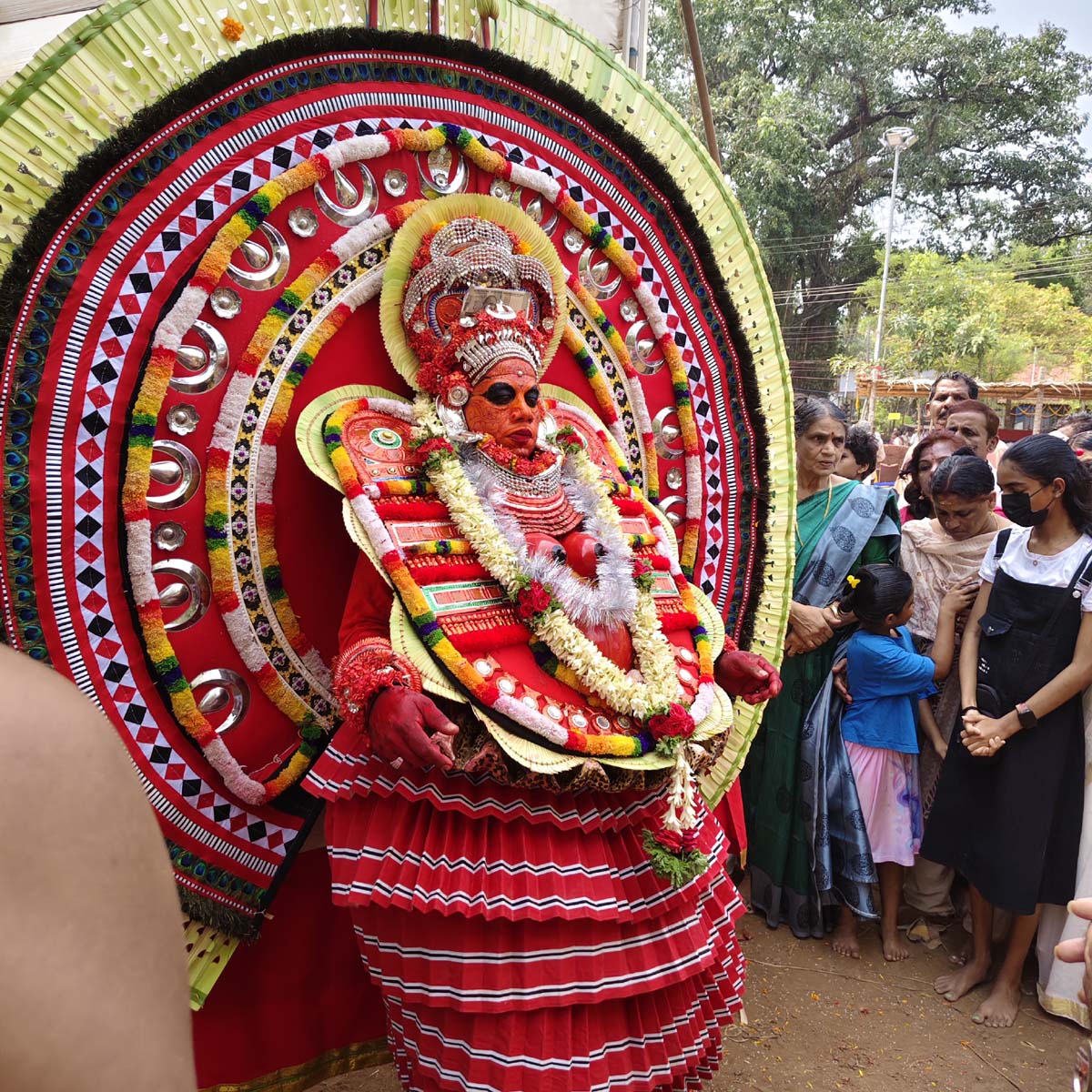
The sacred face painting — Mukhathezhuthu — using natural pigments applied by specialised practitioners. For Kandanar Kelan, the face paint is primarily red and black, reflecting the fire and the night through which the deity moves. The process can take three to four hours. The most significant additional element is the painting of two serpents in red and black on the performer's chest — the visual memory of the two snakes who died alongside Kelan in the forest fire, now permanently inscribed on the deity's body.
The ritual dressing of the deity: elaborate silk garments, which will carry extraordinary visual power when the Agni Pravesham fire illuminates them from below. The Chilambu — heavy metal anklets — are fixed to the performer's ankles. Their sound, as the deity walks, rings through the night air with a resonance that participants consistently describe as qualitatively different from the sound of metal on human feet. The costume assembly is itself a ritual, not merely a preparation.
The final and theologically crucial act: the Mudi (sacred headgear) is placed on the performer. In Theyyam's theology, this is the moment of possession — the deity enters the body. From this point, those who approach are approaching the god, not the man. Devotees prostrate. The priest of the kavu receives the deity formally. The social hierarchy of everyday life is, for this duration, completely inverted: the Malayan performer has become the divine authority before whom everyone kneels.
The ritual culmination: Agni Pravesham. Coconut leaves are arranged and set alight. The fully costumed, fully possessed Kandanar Kelan Theyyam runs directly through the burning fire — sometimes multiple times, sometimes with increasing intensity. The anguish that the deity expresses during this ritual is described in the oral tradition as Kelan's anger at the fire for burning him. He is not subduing the fire. He is confronting it. The fire did its worst to him already. It cannot do more. He has already died in it. What more can it do?
After the Agni Pravesham, Kandanar Kelan receives devotees — hearing petitions, pronouncing blessings, issuing oracles on community matters. This is the function that the Theyyam tradition was ultimately designed to serve: not the spectacle of fire-running but the sacred relationship between a deified ancestral spirit and the community that honours his memory. Devotees receive the deity's thiruvacha (divine words) as genuinely authoritative guidance, not theatrical utterance.
The Visual Language of Kandanar Kelan — Reading the Symbols
Theyyam's visual vocabulary is a carefully coded system of symbols developed over centuries that communicates the deity's specific mythological character, emotional register, and relationship to the community. Kandanar Kelan's costume is particularly rich in this regard.
| Ritual Element | Physical Description | Symbolic Meaning |
|---|---|---|
| Two Serpents on Chest | Two cobras drawn in red and black across the performer's chest | The two snakes who died alongside Kelan in the forest fire — a permanent commemoration of the shared death from which only Kelan was resurrected. Also connects to Kerala's deep veneration of serpents as sacred, protective beings associated with ancestral power. |
| Silk Costume | Elaborate layered silk garments, typically in deep red and gold tones | The dignity of the divine — silk given to a man who was a simple farmer and forest worker, signifying the radical elevation of status that deification represents. The silk also responds dramatically to firelight during the Agni Pravesham. |
| Metal Anklets (Chilambu) | Heavy cast-metal ankle rings producing a distinctive resonant sound with movement | The sound of divine presence — the Chilambu announces the deity's arrival and departure, marking the boundary between ordinary space and sacred space. In Kerala's ritual tradition, specific sounds are understood as divine signatures. |
| Red and Black Face Paint | Dominant fire-red base with black detailing; fierce expression emphasised | Red = fire, blood, Shakti, and the divine anger that Kelan expresses during the Agni Pravesham. Black = the charred forest, the night, the boundary between death and life through which Kelan passed and from which he emerged transformed. |
| Fire (Coconut Leaves) | Bundles of dried coconut leaves arranged in a path or pyre, lit immediately before the Agni Pravesham | The forest fire that was Kelan's agent of death and the medium of his transformation into divinity. Running through it is the theological statement of the ritual: death transformed into power, the worst outcome transformed into the defining identity. |
| Pre-Dawn Darkness | Performances typically begin around midnight; Agni Pravesham occurs before dawn | The forest was dark when Kelan died. The ritual is performed in the same darkness. The fire's light is the only illumination — exactly as the burning forest was the only light available to Kelan in his final moments. The darkness is not incidental. It is the correct atmosphere for this mythology. |
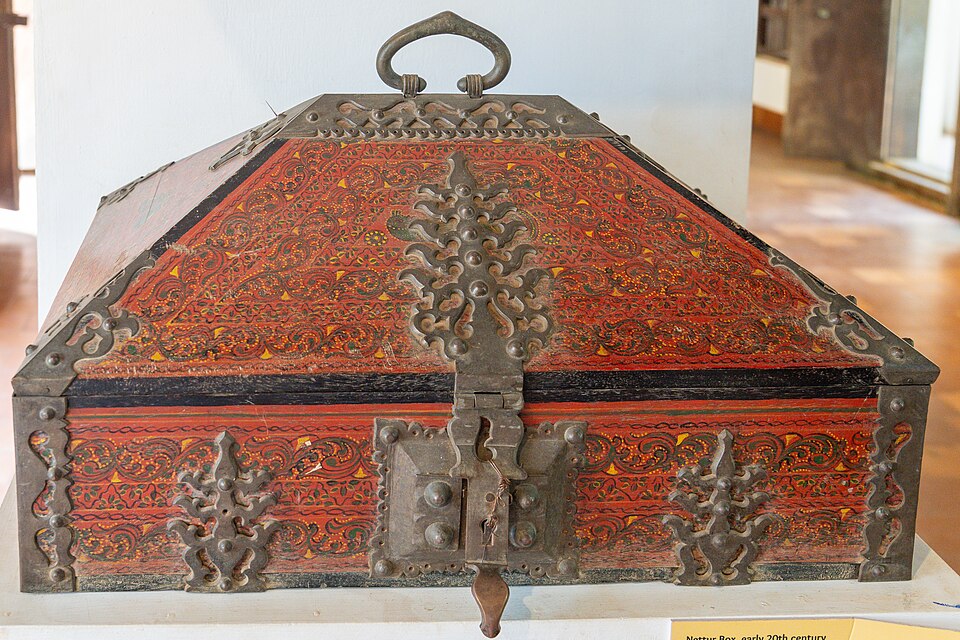
The visual world of Kandanar Kelan — the painted snakes, the silk costume, the silver anklets, the towering Mudi headgear — is the product of Kerala’s hereditary artisan craft traditions. Explore authentic Kerala craft objects, from Nettur Petti jewellery boxes to bronze ritual items and woodwork, available on Amazon.
Browse Kerala Crafts →Affiliate link — we earn a small commission at no extra cost to you.
Caste, Community, and the Social Architecture of Kandanar Kelan
Like all Theyyam forms, Kandanar Kelan is embedded within a specific social architecture that reflects the caste structure of historical North Malabar — and simultaneously subverts it. Understanding this architecture is essential for understanding why Theyyam matters beyond its extraordinary visual power.
The deity Kelan is identified with the Thiyya community — the community that Meladathu Chaki belonged to and into which Kelan was effectively adopted. The Thiyya are a numerically significant agricultural community of North Malabar, historically classified as Other Backward Class in Kerala's social hierarchy. The origin story, rooted in Thiyya social geography — the tharavadus, the forest-clearing farming practices, the specific topography of Ramanthali and Poombunam — gives Kandanar Kelan a specific social identity that is preserved in the ritual's community memory.
The performance right, however, belongs to the Malayan community — a Scheduled Caste community whose hereditary role as Theyyam performers represents the same ritual inversion that characterises the broader tradition. The Malayan performer, through the Theyyam, temporarily transcends the social position that caste has assigned him. During the hours of Kandanar Kelan's manifestation, the community that has historically occupied the lowest rungs of the local social hierarchy becomes the deity that everyone must approach, kneel before, and receive blessings from.
This inversion is not permanently transformative — as scholars like Rajesh Komath have documented, the Theyyam performer returns to his assigned social position when the ritual ends. But the inversion is real, annual, and publicly witnessed. The community that cleared the forests — as Kelan cleared his — has been burning and being reborn in this ritual space every year for centuries. The fire is both literal and metaphorical.
The Vayanattu Kulavan Connection — When One God Resurrects Another
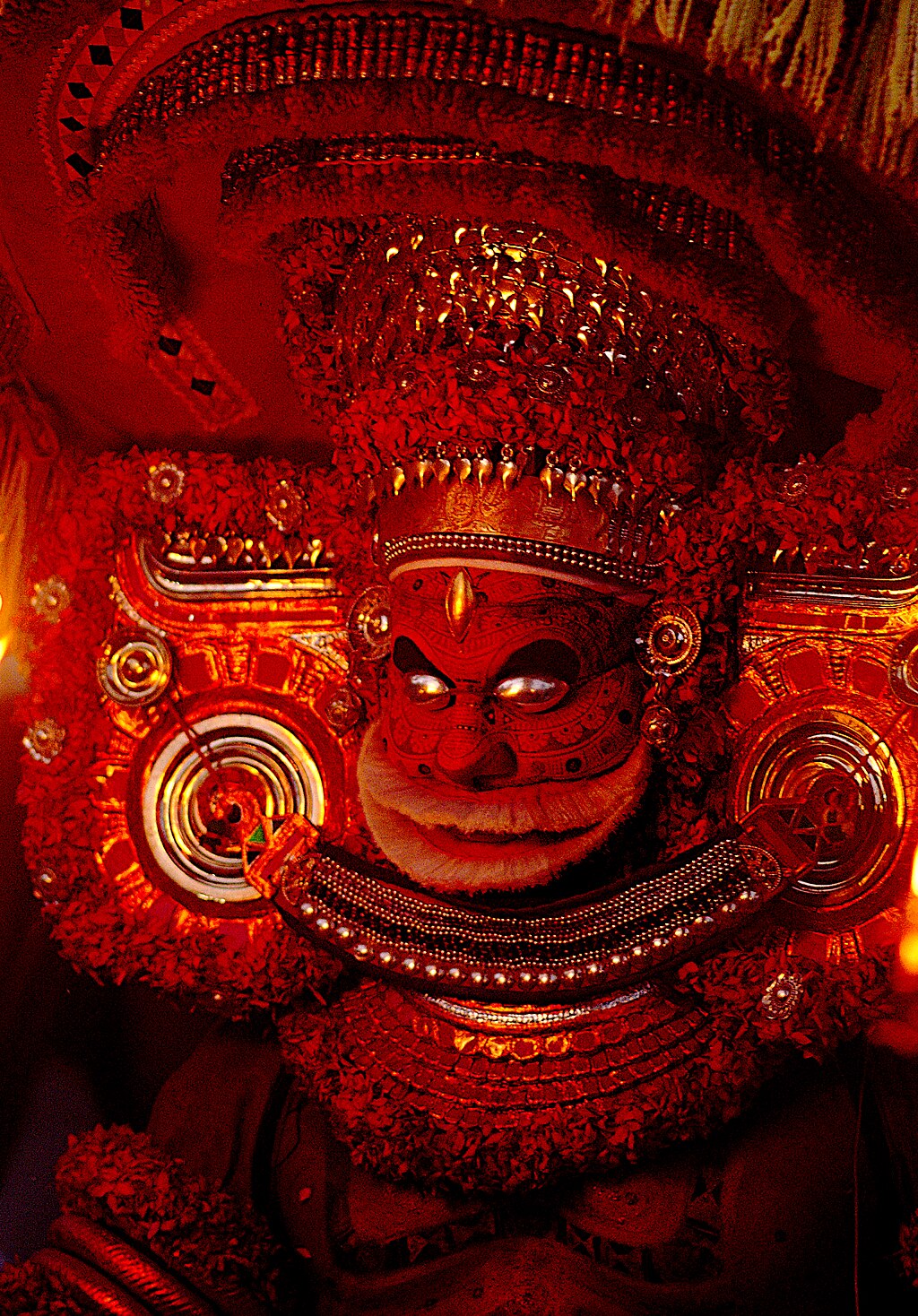
The role of Vayanattu Kulavan in Kelan's story is theologically significant beyond the immediate narrative of resurrection. Vayanattu Kulavan is himself one of Theyyam's most celebrated deities — the divine hunter of the Western Ghats, a figure deeply associated with the forest ecology of North Malabar and with the indigenous tribal communities of Wayanad.
The fact that it is a hunter-deity — not a Brahmin scholar, not a royal patron, not a powerful feudal lord — who recognises Kelan's divine potential in the ashes is consistent with Theyyam's social theology. The forest communities recognise what the social hierarchy missed: that this man, this ordinary farmer's son from the Thiyya community, who died doing the work his mother asked of him, carried something sacred. Vayanattu Kulavan's bow, pressed into the ashes, drew out that sacred form.
The bow is a recurring instrument of divine action in North Kerala mythology — Vadakkan Pattukal's warrior ballads celebrate the bow as the martial-spiritual instrument of the Chekavar. Vayanattu Kulavan's use of his hunting bow to trace the form of resurrection echoes this tradition: the bow is not merely a weapon but a precision instrument, capable of the most delicate and significant acts.
Kandanar Kelan in the Landscape of Kerala Folklore
Placed in the broader context of Kerala's folk tradition, Kandanar Kelan occupies a specific and important position. He is one of a category of Theyyam deities — alongside Pottan Theyyam, Muchilottu Bhagavathy, and Vayanattu Kulavan — that were once ordinary mortals and became divine through a specific, historically located experience of suffering, injustice, or extraordinary trial.
What distinguishes Kandanar Kelan from most of this category is that his story is not primarily one of social injustice. No feudal lord killed him. No caste system murdered him. He was killed by a natural force that he himself had set in motion — the fire he started, uncontrolled, consuming him. This gives Kandanar Kelan a different mythological register: he is the deity of ecological recklessness and its consequences, of the moment when human intervention in the natural world exceeds its own control, and of the redemption that can emerge from even the most irreversible of errors.
There is also a deeply ecological dimension to the story that resonates with contemporary environmental consciousness. Kelan was a forest-clearer — his entire life was the work of removing trees to make land cultivatable. The fifth forest took its reckoning. The tradition does not make this explicit as an ecological lesson, but the oral memory preserves the cause-and-effect with sufficient clarity that the connection cannot be missed: the man who cleared forests died in a forest fire. What was preserved and deified was not the clearing but the man — and the deity that emerged is associated with the forest's power, not the farmer's dominion over it.
Kandanar Kelan is widely considered one of the most rewarding Theyyam forms for documentary photography — the combination of firelight, pre-dawn darkness, the silk costume, the serpent iconography, and the extraordinary drama of the Agni Pravesham produces images of singular visual power. For ethical guidance on photographing Theyyam, see our North Kerala Cultural Tour guide's section on responsible cultural engagement.
Where and When to Experience Kandanar Kelan Theyyam
Kandanar Kelan Theyyam is performed during the main Theyyam season, which runs from November to May in North Kerala, with the peak being December through March. The primary venues are kavus and tharavadus in Kannur district — particularly in the Ramanthali, Payyannur, and broader North Malabar region — that hold hereditary rights to the Kandanar Kelan form within their specific Malayan performer lineages.
- Muthachivalappil Tharvadu, Kannur: One of the most frequently cited venues in contemporary accounts of Kandanar Kelan. The pre-dawn performance with coconut-leaf fire illumination and no electric lighting is particularly atmospheric here.
- Meledath Tharavadu, Kunnaru, Ramanthali, Payyannur: The origin-site of the legend — the ancestral home of the Meladathu family from which Kelan's story emerges. Performances here carry particular mythological resonance.
- Various kavus across Kannur and Kasaragod: The Theyyam calendar published annually by the Kannur Folklore Academy and the Kannur District Tourism Office lists specific dates and venues. These calendars are the most reliable source of current performance information.
The performance typically begins after dark — often around 10 PM or midnight — and the Agni Pravesham occurs in the pre-dawn hours, usually between 3 and 5 AM. Anyone planning to attend should be prepared for a full night. The experience of arriving in darkness, watching the Thottam Pattu singing through the night hours, and then witnessing the Agni Pravesham as the first light begins to soften the eastern sky — this is Kandanar Kelan at its fullest, most complete expression.

Like the Theyyam tradition itself, the Aranmula Kannadi — the world’s only metal-alloy first-surface mirror — is a sacred craft whose knowledge is passed down within specific hereditary families. GI-protected and one of Kerala’s eight Ashtamangalyam objects, it makes a meaningful keepsake for visitors experiencing North Malabar’s living ritual heritage.
View Aranmula Kannadi →Affiliate link — we earn a small commission at no extra cost to you.
Frequently Asked Questions — Kandanar Kelan Theyyam
What is Kandanar Kelan Theyyam?
What is the legend behind Kandanar Kelan Theyyam?
What is Agni Pravesham in Kandanar Kelan Theyyam?
Why does Kandanar Kelan have two snakes on his chest?
Which community performs Kandanar Kelan Theyyam?
When and where can I see Kandanar Kelan Theyyam?
References & Sources
- 1Kurup, K.K.N. Theyyam: Ritual Art of North Malabar. Department of Information and Public Relations, Government of Kerala, 1986.
- 2History of North Malabar. "Kandanar Kelan Theyyam." historyofnorthmalabar.weebly.com.
- 3TheyyamTours.com. "The Legend of Kandanar Kelan: From Mortal to Divine Through Fire." September 2024. theyyamtours.com.
- 4Travel Kannur. "Kandanar Kelan Theyyam." travelkannur.com.
- 5Ayurveda Journals / India in Style. "Theyyam: The Legend of Kelan." January 2019.
- 6Hidden Mantra. "Kandanar Kelan Theyyam Story." February 2026. hiddenmantra.com.
- 7Freeman, Rich. "Performing Possession: Ritual and Consciousness in the Theyyam Complex of Northern Kerala." Asian Folklore Studies, Vol. 55, No. 2. Nanzan University, 1996.
- 8Komath, Rajesh. Doctoral thesis on Theyyam communities and caste mobility. Mahatma Gandhi University, Kottayam.
- Hero ImgDepartment of Tourism, Government of Kerala. "Kandanar Kelan Theyyam, Kannur." kandanar-kelan-theyyam-kannur-2.jpg. All rights reserved.
- Img 2Vijayanrajapuram. "Vayanattukulavan Thanam Tharavad." CC BY-SA 4.0, via Wikimedia Commons. Used in related cards section.
- Img 3CC BY-SA 4.0. "Vayanattu Kulavan Theyyam from Neeliyath Akathott, Kannur." Via Wikimedia Commons.
- Img 4ai Shekar Kannur. "Pottan Theyyam ritual performance." CC BY-SA 4.0, via Wikimedia Commons. pottan-theyyam.jpg.