Kanyarkali, a vibrant and kinetically engaging folk art, stands as a critical cultural phenomenon rooted deeply in the history and geography of Kerala's Palakkad district. This ritualistic group performance is celebrated for its dynamic fusion of rhythmic movement, ritual sanctity, and human comedy, offering a comprehensive glimpse into the historical resilience of the region. Located primarily within the Alathur and Chittur Taluks, Kanyarkali is geographically localized, contributing to its intense regional specificity, and is frequently referred to by the regional designation Deshathukali (the dance of the land).
The art form is intrinsically tied to village temples and tharas (informal gathering spaces) in the Palakkad area. It combines the agile, disciplined movements characteristic of martial arts with the rhythmic grace of folk dance, distinguishing it from the highly codified classical arts of Kerala. Ritually, the performance is staged as an offering to local deities, particularly Goddess Bhagavathy (often Kurumba Bhagavathy) or Vettakkorumakan, the hunter form of Lord Shastha.
Establishing Nomenclature and Dispelling Misconceptions
Despite its common name, Kanniyar Kali, which translates loosely as "Virgin's Dance," the art form maintains specific boundaries crucial for its proper understanding. Ethnographic analysis confirms that Kanyarkali is in no way connected with the ancient cult of Kannaki, the heroine of the Tamil epic Silappatikaram, despite the linguistic proximity. Furthermore, the performance is entirely separate from the Kaniyar community, who historically function as authentic astrologers of Kerala.
The necessity for this distinct cultural performance, which successfully blurred the lines between rigorous physical training and public entertainment, originated directly from geopolitical pressure. By integrating formalized dance and comedy, the demanding discipline required for defense was transformed into a sustainable, attractive community ritual. This reveals Kanyarkali as an ingenious cultural artifact of strategic resilience — a systematic method of sustaining military preparedness under the culturally acceptable guise of a devotional festival.
The Genesis of Kanyarkali: From Battlefield Drill to Temple Pandal
The historical origins of Kanyarkali are inextricably linked to the volatile border history of Palakkad. The region was subjected to constant threats of attack from the neighboring Konganaadu (Kongunadu), located in what is now modern-day Tamil Nadu. This persistent vulnerability created an urgent necessity for the local populace to remain perpetually ready for defense.
The Martial Pedagogy of the Warrior Class
Kanyarkali emerged directly from the practice of martial arts necessary to prepare local warriors for battle. Traditionally, the performance was exclusive to men from the Nair community, a social group that historically served as traditional warriors and were experts in martial practices. The art form functioned as a collective ritual of physical fitness and combat readiness.
The training regimen for Kanyarkali is rigorous and formalized, commencing approximately a month prior to the festival with a ritual initiation known as Kadikumbidal. Under the guidance of a master performer, or Kaliyachan, practitioners train extensively, mastering a complex system of movements. Although 64 chuvadukal (steps) are often practiced, only about 20–25 are typically incorporated into the public performances.
The Sanctification of Defense
The key element in the survival and continuity of Kanyarkali lies in its transition from a pure military drill to a religious act. The practice of rigorous physical fitness and martial movements was transformed into an artistic offering seeking blessings from the village deity — a phenomenon we might call the "sanctification of defense." By embedding continuous martial training within a religious obligation, the art form ensured its own survival and made participation a communal duty rather than a mere personal preference.
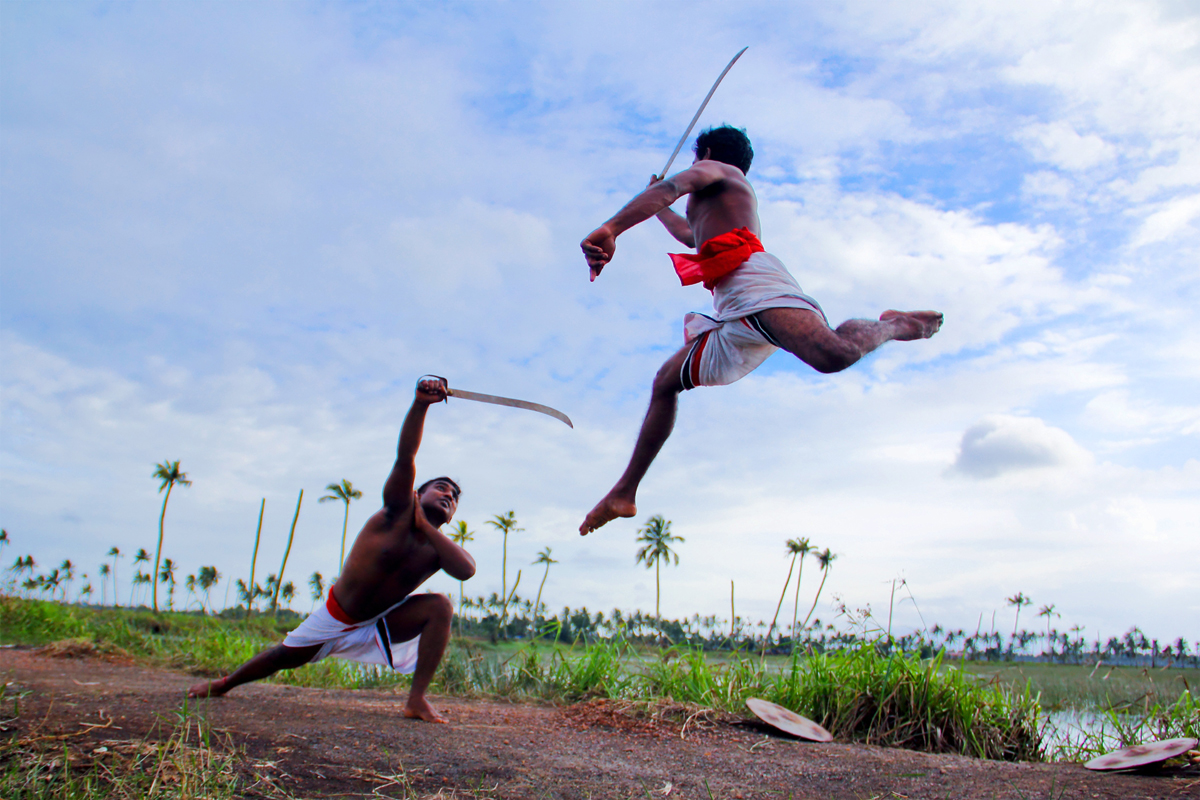
While the research does not explicitly name Kalaripayattu, the description of martial arts, agile movements, and the use of chuvadukal by Kerala's traditional warrior caste strongly suggests a foundational link to the principles of Kalaripayattu, the renowned martial art of Kerala. This places Kanyarkali on a historical continuum alongside other major Kerala performing arts, such as Kathakali and Theyyam, which also evolved their movement vocabularies from Kalaripayattu disciplines.
Go Deeper into Kerala's Ritual Arts
Explore Theyyam and the martial-ritual continuum it shares with Kanyarkali in these recommended reads.
Shop on AmazonAs an Amazon Associate, KeralaFolklore.com earns from qualifying purchases.
The Architecture of Ritual: Time, Space, and Devotion
Kanyarkali is not an isolated performance but an integrated community festival defined by specific temporal and spatial requirements.
The Agrarian and Festive Calendar
The timing of Kanyarkali anchors it firmly within the local agrarian and cultural calendar. The event generally takes place during March or April, often following the Vela (village fair) and coinciding with Vishu, which is celebrated as the start of the Malayalam month of Medam and the beginning of the agricultural year. This linkage suggests Kanyarkali is inherently an agricultural festival dance of the Nair castes, blending themes of defense, devotion, and seasonal cycles.
The festival typically runs as a four-night spectacle, though some villages observe a three-night sequence. The performance duration is considerable, beginning after sunset and lasting until dawn, embodying a sustained commitment and spiritual intensity.
Sacred Space and Ritual Commencement
The dance is performed on a carefully prepared, square stage known as a pandal, constructed specifically for the event in front of the temple or within its premises. The spiritual focus of the performance is established by a lighted lamp placed at the centre of the stage, transforming the temporary pandal into a sacred arena.
The commencement of the festival is marked by a series of specialized rituals:
- Kadikumbidal: The ritual initiation for the performers' month-long training.
- Kaniyar Kollal: The official start of the festival, traditionally the Tuesday after Vishu.
- Kelikottu: A ceremonial drumming performance that announces the impending event to the surrounding community.
- Nadavattom: The ritualized entry of the performers onto the pandal.
The duration of the performance — lasting from dusk until dawn across four consecutive nights — is more than a display of cultural fidelity; it constitutes a ritualized test of physical endurance. This structure reinforces the original requirement for vigilance and physical fitness necessary for a martial force, while the commitment required for this lengthy, multi-day undertaking demands maximum community involvement and collaboration.
The Four-Night Spectacle: Structure and Narrative Progression
The structure of Kanyarkali is characterized by a deliberate duality, oscillating between disciplined martial ritual and flexible social commentary. Each night of the spectacle carries a distinct name and function, building a narrative progression that culminates in the final dawn performance.
| Night | Local Name | Style / Focus | Core Content & Function |
|---|---|---|---|
| Night 1 | Iravakali | Ritualistic and Martial | A formal, disciplined performance focused on synchronized footwork and core martial movements. |
| Night 2 | Anadikoothu | Comedic Farce (Purattu) | Features skits blending humor and satire, often portraying village life or historical tales. |
| Night 3 | Vallon | Storytelling and Rhythmic | Slower, more narrative dances, recounting tales often concerning feudal relationships or local legends. |
| Night 4 | Malama | Climactic and Ethnographic | Highly complex performance featuring over 40 unique steps and culminating in dramatic Porattu scenes, historically involving hill-tribe themes. |
Vattakali: The Rhythmic Foundation
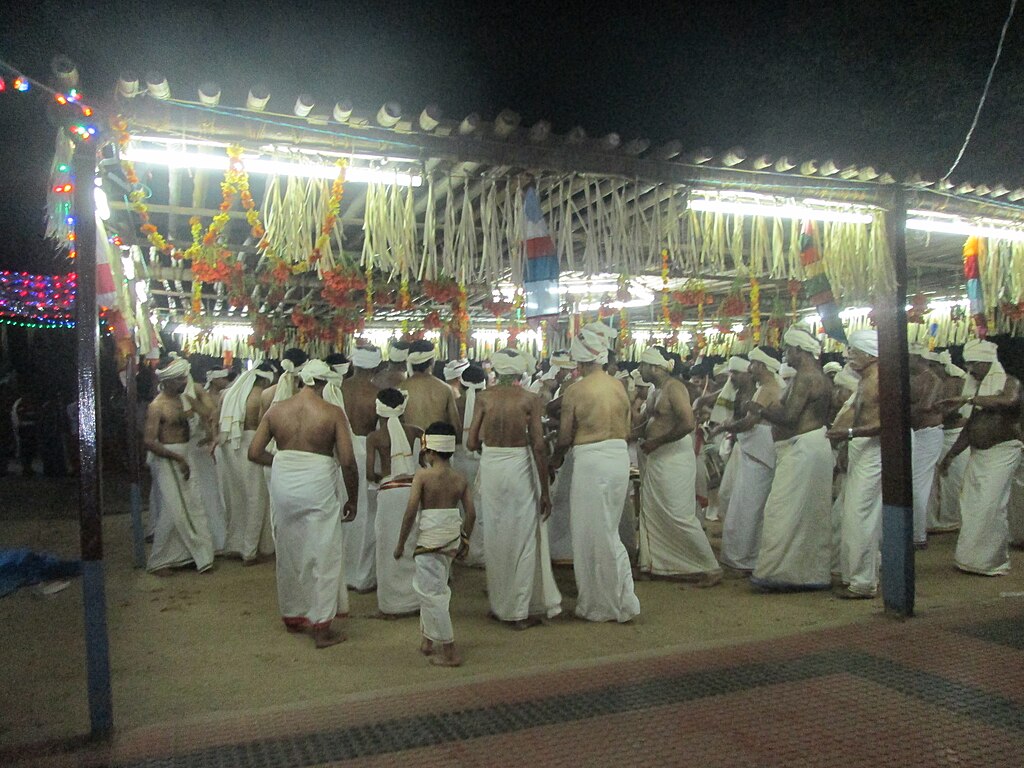
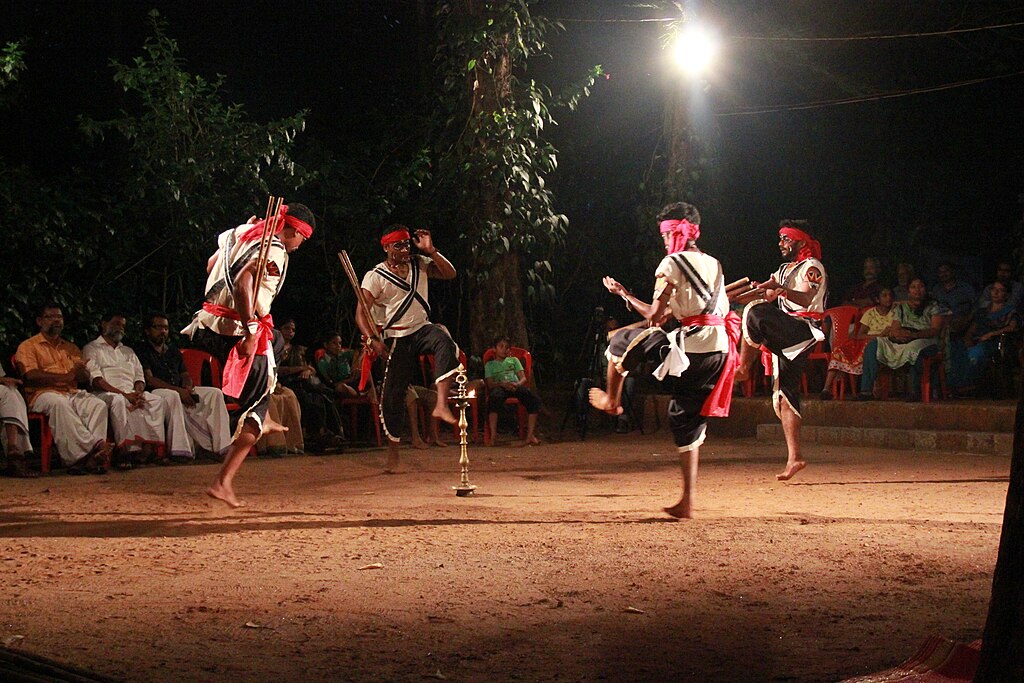
Every night commences with the Vattakali (literally, "a circular dance"). The men of the community gather to form a circle around the central lamp, performing a highly rhythmic and synchronized dance that embodies the formal, disciplined, and martial origins of the art form.
Purattu: The Satirical Heart
Following the discipline of the Vattakali, the performance shifts to the Purattu segments — a series of farces. These are non-standardized skits, each lasting about an hour, whose primary function is to provide commentary and entertainment.
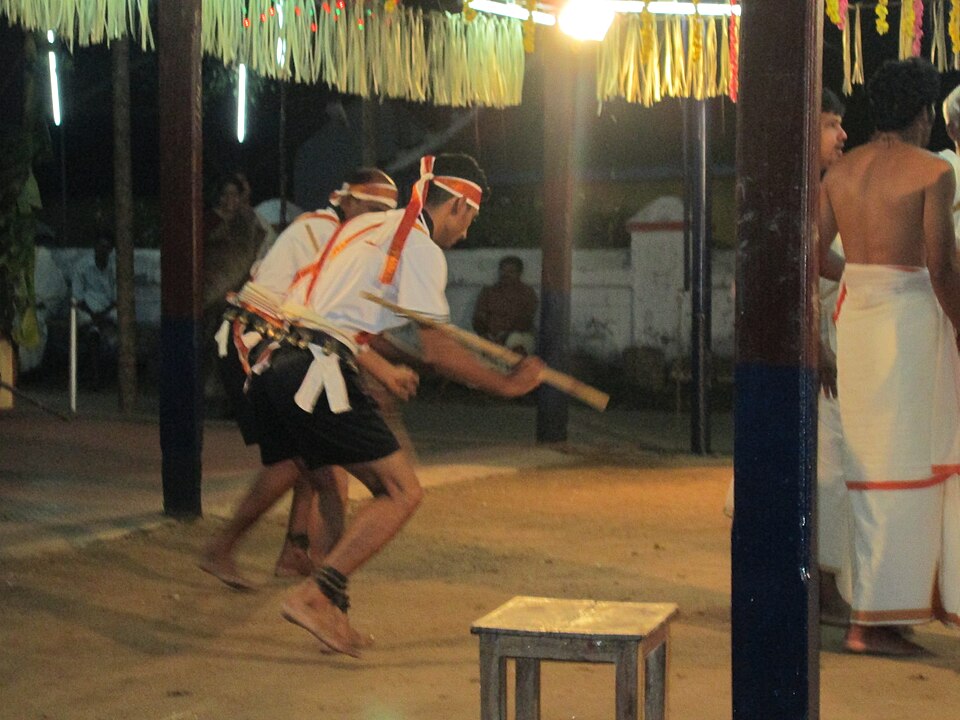
These Purattu segments are ethnographic in nature, depicting the life and social customs of various heterogeneous castes and tribes historically present in medieval Kerala and Tamil Nadu. They require the performers to adopt differing costumes, styles of dancing, and songs with varied tempos. The thematic range is broad: certain Purattu depicting fierce or warrior tribes incorporate stick fights and rapid martial movements, while others focus on humor, such as skits depicting the reunion of long-lost couples. The Erattakudan Purattu shown above is one such segment within this rich repertoire of social farce.
The strategic movement from the rigid martial structure of Vattakali to the flexible, satirical nature of Purattu is central to Kanyarkali's cultural durability. The performance satisfies the need for ritual discipline and warrior rehearsal in the first half while using the second half for popular entertainment and communal self-reflection. The inclusion of humor and satire allows the art form to retain potent social relevance, delivering sharp social commentary — such as narrating the darker aspects of feudal chieftains and the plight of their dependents — while simultaneously being shielded by the sanctity and festive context of the temple ritual.
Sensory Immersion: Costumes, Music, and Choreography
Attire and Representation
The costumes of the dancers are generally simple and traditional, consisting of kasavu mundu (gold-bordered dhotis) and turbans. This attire is notably less elaborate and stylized than the complex, hours-long makeup and costuming required for classical arts like Kathakali, marking Kanyarkali as an accessible folk expression.
Traditionally, Kanyarkali has been an exclusively all-male performance. Women's roles, particularly in the dramatic Purattu skits, were enacted by cross-dressing men who adeptly imitated the body language and speech of women. However, in a significant sign of the art form's adaptability, women have increasingly made their debut performances in the last decade, including the historic introduction of female performers in a Desappanthal at Kakkayur.
The Soundscape of Percussion and Rhythm
Kanyarkali relies on rhythmic devotional folk songs supported by a powerful and diverse percussion ensemble. The musicians occupy the central position of the pandal, with the dancers moving in circular patterns along the periphery.
The accompanying instruments include the chenda, maddalam (used specifically in Vattakali), elathalam (cymbals), and chengila. Other instruments such as the edakka, udukku, and kurumkuzhal also feature in the performances. The prominence of the chenda is a critical marker of the art form's martial and non-classical characteristics; it is traditionally classified as an Asura Vadyam (demonic instrument), signifying its use for loud, forceful, and non-harmonious music. This percussive intensity is required for martial and ritualistic performances like Kanyarkali, Theyyam, and classical Kerala arts.
Linguistically, the songs are primarily in Malayalam, reflecting the Kerala origin. However, due to the close proximity to the Tamil border, certain Purattus display a heavy influence of Tamil vocabulary and rhythm, echoing historical and cultural interaction with Kongunadu.
Bring Kerala's Artistic Heritage Home
A Kathakali-inspired piece celebrating Kerala's performance arts — a fitting companion to Kanyarkali's martial-theatrical world.
Shop on AmazonAs an Amazon Associate, KeralaFolklore.com earns from qualifying purchases.
Global Echoes: Kanyarkali in the Context of Martial Heritage Dances
Kanyarkali, in its dual capacity as military conditioning and ritualistic performance, stands as a distinctive regional example of a global cultural phenomenon: the ritualization of combat. It belongs to the broader category of "Weapon Dances" and "War Dances," which employ vigorous movement and organized ritual to affirm identity and rehearse conflict.
| Folk Art | Origin | Primary Function | Core Connection to Kanyarkali |
|---|---|---|---|
| Filipino Arnis | Philippines | Self-defense, weapon-based combat | Strategic preservation: both survived suppression by embedding combat within cultural performance. |
| Pyrrhichios | Ancient Greece (Sparta) | Warfare training, physical conditioning | Military conditioning: both trained young men in speed, stamina, and combat readiness. |
| Haka | Māori, New Zealand | War cry, cultural affirmation | Collective identity: both use synchronized movement and vocal power to express unity and pride. |
| Moreška | Korčula, Croatia | Ritualized combat performance | Ritual combat narrative: Moreška uses sword battles; Kanyarkali includes stick-fight Purattu scenes. |
The parallel between Kanyarkali and Filipino Arnis/Kali is particularly striking. In the Philippines, martial arts were suppressed during foreign rule, leading practitioners to disguise combat techniques within dances. Similarly, Kanyarkali used the temple festival as a legitimate cultural space to maintain martial chuvadukal during regional threats from Konganadu.
While ancient practices like the Greek Pyrrhichios were primarily secular military drills, Kanyarkali uniquely blends martial discipline (Vattakali) with satirical social theatre (Purattu). Kanyarkali's rapid footwork has strong ties to Kalaripayattu, making it a folk counterpart to classical forms such as Kathakali.
Sustainability and Evolution: Navigating Modern Challenges
Threats to Transmission and Context
Like many intangible heritage forms, Kanyarkali faces threats from modernization, globalization, and declining agrarian lifestyles. Youth migration from rural Palakkad reduces the performer base, while oral transmission increases vulnerability. Without written documentation, the sophisticated chuvadukal and Purattu narratives survive solely in the memory of Kaliyachans.
Resilience Through Adaptability and Reform
Kanyarkali has begun challenging historical rigidity, especially regarding caste and gender restrictions. Women have performed in a Desappanthal at Kakkayur, and non-Nair communities have joined the art.
Avenues for Revival and Formalization
Preservation efforts include documentary works such as Kanyarkali: Arangum Anushtanavum. Recognition by institutions like Kerala Sangeetha Nataka Akademi encourages revival.
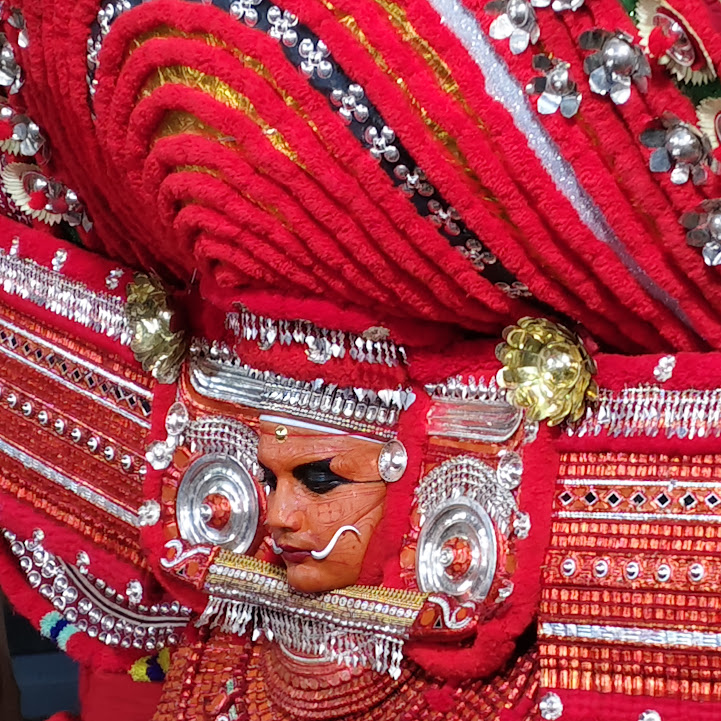
Essential Reading on Kerala Folklore
Curated folklore titles to continue exploring the traditions behind Kanyarkali and Kerala's wider performing arts.
Shop on AmazonAs an Amazon Associate, KeralaFolklore.com earns from qualifying purchases.
Conclusion: A Legacy of Agility and Adaptability
Kanyarkali is more than a folk dance; it is a meticulously preserved record of Palakkad's identity, weaving together historical defense strategies, spiritual reverence for Bhagavathy, and the sophisticated use of satire for social critique. Its origins, born out of geopolitical necessity for martial training against Konganadu, established a powerful cultural foundation where the warrior's duty was sanctified as a devotional ritual, ensuring continuous practice through performance.
The enduring structure of the four-night spectacle, moving from the disciplined martial Vattakali to the satirical social observation of the Purattu, demonstrates a masterful strategy for communal cohesion and cultural sustainability. As Kanyarkali navigates the challenges of agrarian decline and urbanization, its recent adaptations — particularly the inclusion of women and non-Nair participants — illustrate a powerful capacity for renewal. Kanyarkali stands today as a living testament to the truth that the most resilient cultural forms are those that manage to embed critical survival skills within art, ensuring that legacy is not merely remembered, but perpetually performed and renewed.
Frequently Asked Questions
What is Kanyarkali?
Kanyarkali is a martial folk performance from Kerala's Palakkad district, blending disciplined warrior movements with satirical theatre, offered to Goddess Bhagavathy or Vettakkorumakan as part of an annual temple festival.
Where is Kanyarkali performed?
Kanyarkali is geographically localized to the Alathur and Chittur Taluks of Palakkad district in Kerala, where it is performed at village temples and tharas.
How long does the Kanyarkali festival last?
Kanyarkali is typically a four-night spectacle, though some villages observe a three-night sequence. Each night's performance runs from after sunset until dawn.
What is the difference between Vattakali and Purattu?
Vattakali is the disciplined, circular martial dance that opens every night, while Purattu refers to the satirical farce segments that follow, depicting social commentary, comedy, and stick-fight scenes through varied costumes and songs.
Who traditionally performs Kanyarkali?
Kanyarkali was traditionally performed exclusively by men of the Nair community, Kerala's historic warrior caste, though in recent years women and non-Nair communities have begun participating.
What instruments accompany Kanyarkali?
Kanyarkali is accompanied by the chenda, maddalam, elathalam, chengila, edakka, udukku, and kurumkuzhal, with the chenda providing the forceful percussive intensity central to its martial atmosphere.
Is Kanyarkali connected to Kalaripayattu?
While not formally documented as a direct offshoot, Kanyarkali's chuvadukal footwork and martial movements strongly echo Kalaripayattu, Kerala's traditional martial art, reflecting their shared roots in Nair warrior training.
References
- Ayyar, K. V. Krishna. The Zamorins of Calicut. Calicut University Historical Series, 1938.
- Namboodiri, K. K. Keralathile Naadan Kalakal. Kerala Bhasha Institute, 2000.
- Čale, Srebrenka. "The Moreška Sword Dance of Korčula: History and Symbolism." Journal of Mediterranean Studies, 2011.
- Zarrilli, Phillip B. Kathakali Dance-Drama: Where Gods and Demons Come to Play. Routledge, 2000.
- Zarrilli, Phillip B. When the Body Becomes All Eyes: Paradigms and Practices in Kalaripayattu. Oxford University Press, 1998.
- Spencer, Paul. Society and the Dance: The Social Anthropology of Process and Performance. Cambridge University Press, 1985.
- Wiley, Mark V. Filipino Martial Culture. Tuttle Publishing, 1997.
- Lonsdale, Steven. Dance and Ritual Play in Greek Religion. Johns Hopkins University Press, 1993.
- Karetu, Tīmoti. Haka: The Dance of a Noble People. Reed Publishing, 1993.
- UNESCO. "Intangible Cultural Heritage Domains and Preservation." UNESCO ICH Portal, 2003.
- Panikkar, Adoor K. K. Kerala Samskaram. Kerala Sahitya Akademi, 1995.
- Subrahmaniam, V. Kerala Folk Performing Arts. Sangeet Natak Akademi, 2002.
- Kerala Sangeetha Nataka Akademi. "Ethnic Art Forms of Kerala." Official Website.