A Comparative Monograph on Kummattikali: Kerala's Ritual Mask Dance and its Global Kinship in Folk Theatre
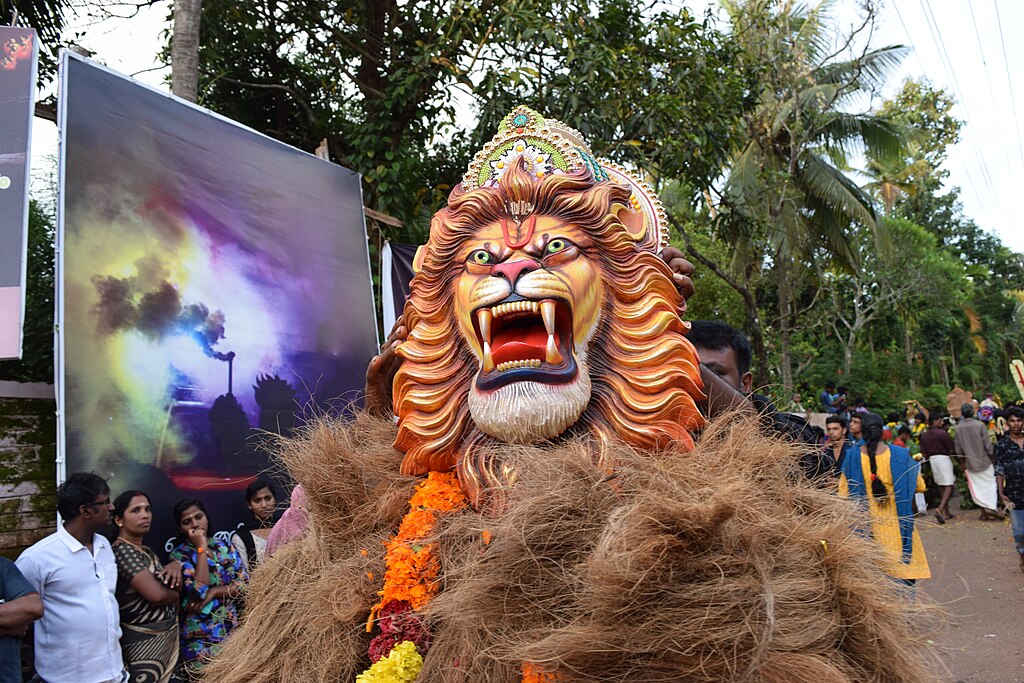
Credit: Ranjith Siji, CC BY-SA 4.0 , via Wikimedia Commons
1. Defining Kummattikali: Classification and Geographic Prevalence
Kummattikali (also referred to as Kummatti Kali) stands as one of Kerala’s most famous and visually striking traditional art forms, classified formally as a devotional ritualistic folk art.1 This art form is distinguished by its vivid, heavily painted masks and primal, elaborate costumes, making it a key highlight of regional festivals.2
Geographically, Kummattikali is most prevalent in the central and northern districts of Kerala, specifically Thrissur, Palakkad, and parts of South Malabar.1 While its practice is widespread, particularly during the festive season, regional variations exist. The tradition is fundamentally integrated with the annual state festival of Onam, which typically falls in August or September.1 The performances traditionally commence around the first day of Uthradam and continue through the fourth day of Onam, animating the village streets during this critical commemorative period.4
1.2. The Dual Purpose: Ritual Invocation and Communal Entertainment
The significance of Kummattikali lies in its synthesis of the sacred and the secular. At its core, the performance serves a profound ritualistic function: invoking prosperity and actively working to dispel misfortune and negativity from the community.1 This devotional aspect links it to other profound ritualistic arts of Kerala, such as Theyyam and Kannyar Kali, sharing a fundamental focus on mythological enactment and ritualistic execution.1
Simultaneously, Kummattikali operates as a vehicle for immense social and collective expression. By providing dynamic entertainment, the processions enhance the overall spirit of harvest abundance and community bonding that defines Onam.1 The house-to-house movements during the festival draw large crowds, especially children, who follow the troupes enthusiastically, underscoring the form’s role in animating village life and fostering social cohesion.1
1.3. Historical Context and Legitimacy
While documentation on the art form's precise chronological history remains elusive, tradition places its origins approximately 150 years ago.5 The historical consensus locates the source of its purest ritualistic expression in the Bhadrakali temple in the Palakkad district.1 This association with the powerful Mother Goddess grants the performance an authoritative sacred legitimacy.
The trajectory of Kummattikali subsequently shifted as it flourished in Thrissur, often referred to as Kerala's "cultural capital," where the performances became rampant during Onam.5 This geographical spread and popularization delineate a fascinating evolution in the art form’s social function. The tradition appears to have moved from a localized, concentrated, and intensely ritualized performance environment (Palakkad/Bhadrakali) toward a broader, more theatrical, and procession-based format (Thrissur/Onam).5 The preservation of Palakkad as the authority on its sacred origins provides an anchoring spiritual lineage, even as Thrissur's energetic, widespread practice champions its cultural visibility and communal role.
II. Mythological Foundation and Ritual Significance
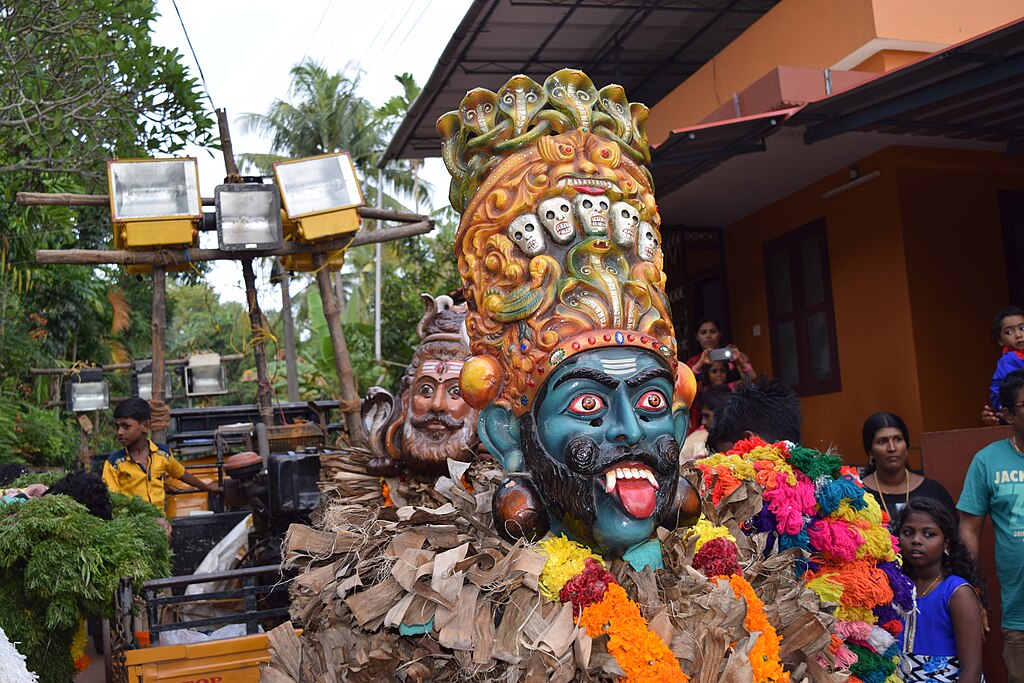
Credit: Ranjith Siji, CC BY-SA 4.0 , via Wikimedia Commons
2.1. The Legends of Origin: Shiva’s Bhoothaganas
The mythological basis for Kummattikali is firmly rooted in Shaiva doctrine and the pervasive legend of the return of the benevolent King Mahabali, which Onam commemorates.3 The performers, often men and boys,1 are believed to embody the Bhoothaganas—the spirits or attendant followers of Lord Shiva.1
In the context of the Onam festival, the Bhoothaganas are entrusted with a sacred duty. According to one prominent version of the legend, the Bhoothaganas, appointed by Lord Shiva, patrol the streets in their masked attire to oversee the land and ensure that no evil prevails during Mahabali’s annual visit.1 Another narrative suggests the Bhoothaganas were instructed to welcome the banished king back with a special dance resembling tribal art forms.3 The wearing of the mask, therefore, symbolizes a temporary transformation into these supernatural protectors, effectively bridging the human and divine realms during the ritual.1
2.2. Thematic Repertoire: Epics and Local Folklore
The narrative content of Kummattikali performances, often enacted through spontaneous mime, regional dialogue, and song, is diverse.1 The themes are frequently borrowed from grand Indian mythology, drawing upon seminal epic narratives such as the Ramayana (e.g., Bali Vadham) and the Mahabharata (e.g., Kiratarjuniya).1 Additionally, stories focusing on Lord Shiva, such as Darika Vadham, are commonly portrayed.1
A critical element is the inclusion of local folk tales, exemplified by narratives like Manjan Nayare Pattu.1 The blending of pan-Indian epic themes with vernacular oral traditions demonstrates the art form's adaptability and enduring local relevance. By presenting stories that resonate deeply with regional history and cosmology, Kummattikali ensures the continuous engagement of the community, prioritizing collective participation over rigid, scripted precision.1
2.3. Syncretism of Divine Protection
The mythological origins reveal a sophisticated religious syncretism inherent to Kummattikali. The art form synthesizes three potent spiritual elements: the Puranic hierarchy of Shiva’s Bhoothaganas; the localized tradition of Mother Goddess worship, indicated by its origins at the Bhadrakali temples;1 and the Vaishnava-aligned Mahabali mythos central to Onam.3
This confluence elevates the function of the masked dancer beyond mere entertainment. The art functions as a communal exorcism,1 where the masked figures, representing Shiva's retinue, perform a protective, cosmic policing duty during the highly liminal period of Mahabali’s annual return. The performance is fundamentally an act of safeguarding the realm, ensuring prosperity and repelling malevolence in preparation for the harvest season.
III. The Aesthetic and Material Culture of the Kummatikkolam
3.1. Mask Construction and Carving Tradition
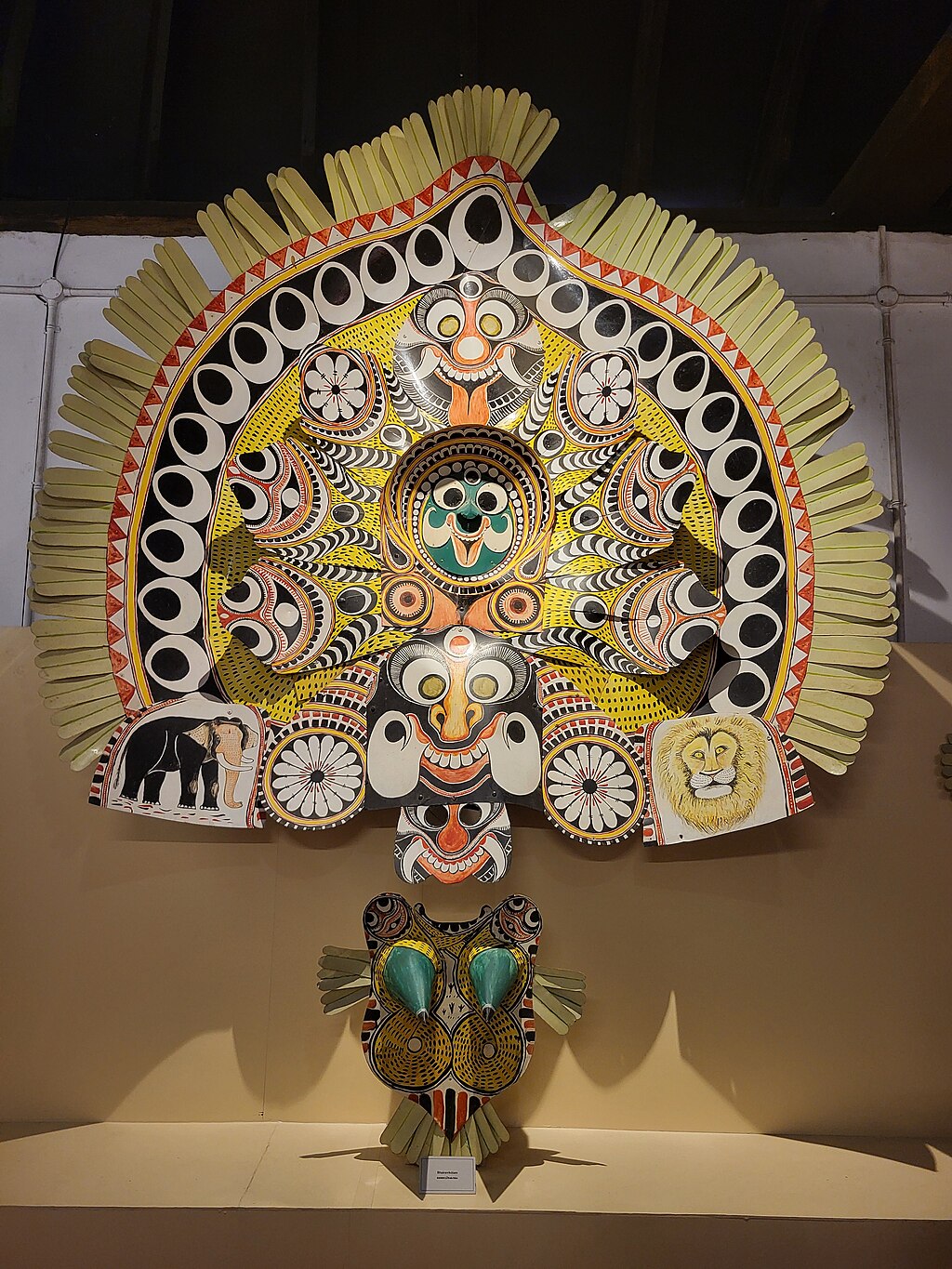
Credit: Athulvis, CC BY-SA 4.0 , via Wikimedia Commons
The masks, known as Kummatikkolam, constitute the most recognizable and artistically significant aspect of the performance. These masks are expertly crafted from specific woods, selected for their texture, durability, and availability. Common materials include the wood of the Jackfruit tree, the Coral tree, the Hog Plum tree, the Saprophyte, and the Alstonia scholaris.2 In some instances, simpler materials like arecanut spathes may also be utilized.1
The masks are typically large, heavily painted, and feature vivid colors and intentionally exaggerated features designed to captivate the audience.1 The characters depicted span a broad spectrum of the divine and the human, including deities such as Lord Shiva, Krishna, and Ganapati, mythological demons like Darika, and other characters such as Kiratha, Narada, and Hanuman.3 They also include humorous and animalistic figures, such as tigers or the prominent female character, Thalla Kummatti.1 The transformation enacted by donning these masks is central to the ritualistic identity of the Kummatti.
3.2. The Costume: The Significance of Kummatti Pullu
The costume is characterized by its reliance on natural, indigenous materials, giving the performers a bushy, primal, or forest-spirit appearance.1 Performers cover their bodies with skirts woven from plaited grass, dried leaves, or sprigs and flowers.2 Historically, dried banana leaves were used, but this was later replaced by specialized types of grass.5
Crucially, the body covering is often made from a special grass known as Kummatti pullu (also called Parpataka grass or snake-needle grass).3 The selection of this specific botanical material is not arbitrary; the grass is widely recognized in regional traditions for its medicinal properties.5 This ecological integration serves a practical function, as the Kummatti pullu is believed to produce more oxygen, helping performers maintain their energy levels during the long processional dances.5
The relationship between the material culture and indigenous ecology is therefore highly significant. The costume is an organic extension of the natural world, reinforcing the notion that the Bhoothaganas are protective, primal, forest spirits. Cladding the dancer in therapeutically valued grass integrates indigenous knowledge into the ritual act, linking the performance directly to communal health and vitality.
3.3. The Matriarchal Element: Thalla Kummatti
A notable figure within the Kummattikali repertoire is Thamma or Thalla Kummatti (the Old Woman/Huntress). This character, often featuring a unique mask with an externally attached talla (giving a toothless appearance),2 typically walks at the head of the procession, assisted by a stick.2
The presence of this matriarchal figure, who symbolizes the "mother of every being and everything,"2 leading the procession of Lord Shiva's attendants, represents a crucial cultural dynamic. It grounds the epic-level, male-dominated mythological narrative in a potent, localized matriarchal principle. This figure may be interpreted as an indigenous fertility or harvest deity—a concept highly consistent with the temple origins linked to the Mother Goddess Bhadrakali.1 The role of Thalla Kummatti serves to localize and humanize the abstract divine protection offered by the Bhoothaganas.
IV. Performance Structure, Choreography, and Musical Accompaniment
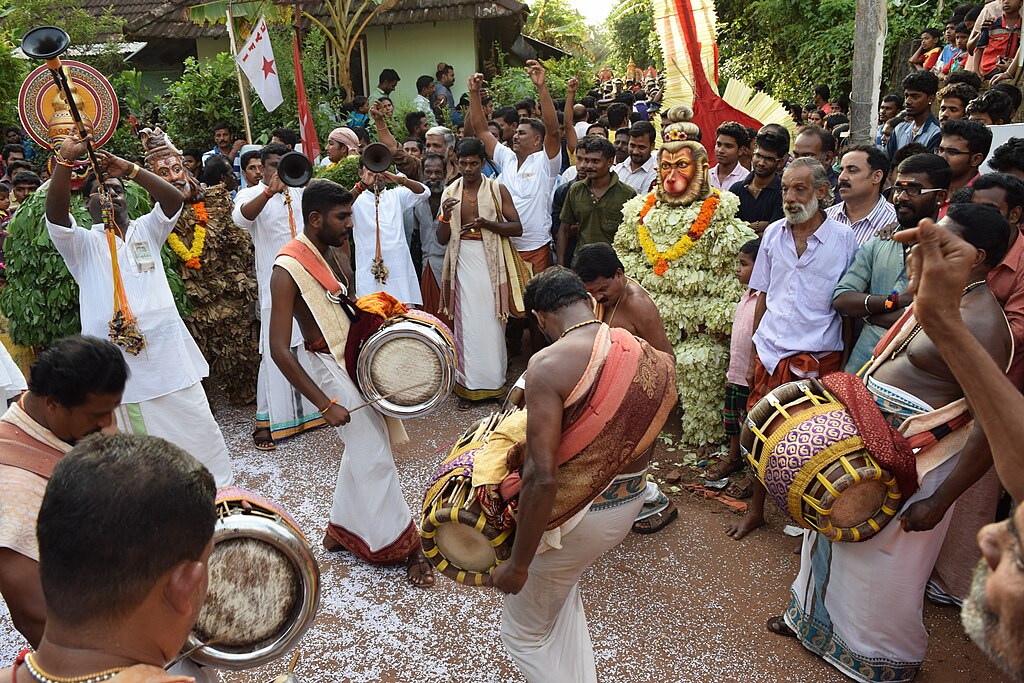
Credit: Ranjith Siji, CC BY-SA 4.0 , via Wikimedia Commons
6.3. Kummattikali as a Hybrid Form
The comparative analysis positions Kummattikali as a resilient, hybrid form. It shares the critical structural traits of community participation, improvisation, and dynamic street performance common in popular masked folk dramas like Talchum. However, it maintains the fundamental mythological function, transformative intent, and deep devotional focus characteristic of sacred temple rituals like Cham. This ability to channel high-level Puranic narratives through an accessible, ecologically integrated, and improvisational format has been key to securing its pervasive cultural presence during Kerala's annual festivities.
Table 1: Comparative Analysis of Seasonal Masked Rituals
| Feature | Kummattikali (Kerala, India) | Talchum (Korea) | Cham Dance (Tibet/Bhutan) |
|---|---|---|---|
| Primary Context | Devotional/Ritualistic Folk Art; Harvest Festival (Onam) 1 | Shamanic origins; Social/Political Satire; Seasonal (Dano) 12 | Solemn Vajrayana Buddhist Ritual; Monastic/Temple Festivals 16 |
| Mask Function | Transformation into Shiva’s followers (Bhoothaganas); Protection/Exorcism 1 | Social criticism/liberation; ridiculing the elite (yangban) 12 | Representing deities and skeletons; Warding off evil spirits 16 |
| Performer Status | Community members (laymen), often men and boys 1 | Community members; specialized folk troupes 14 | Trained Tibetan Monks (professional religious elite) 16 |
| Aesthetic/Material | Primal grass/leaves, heavy wood masks; martial movement 3 | Elaborate paper/wood masks; dialogue and singing 18 | Elaborate silk robes; large papier-mâché masks; slow, solemn movement 17 |
7. Beyond Entertainment: Kummattikkali's Cultural Heart
Kummattikkali is fundamentally classified as a "devotional art form" of Kerala.1 In regions like Wayanad and parts of Palakkad, it is performed as a ritualistic ceremony specifically to "propitiate Devi, the mother goddess".9 In Thrissur, a significant hub for Kummattikkali, performances often commence with artists seeking blessings from Lord Shiva at the renowned Vadakkumnathan Shiva Temple.2 It serves as an offering by devotees to the deity, particularly prevalent at Bhadrakali temples.1
The dance is deeply intertwined with the Onam festival, acting as a powerful unifier. Kummattikkali is a major highlight of the Onam festivities, bringing communities together through its performances and the shared joy they evoke.2 It embodies the "rustic charm and secular spirit of Kerala," fostering unity among people regardless of their religious or caste backgrounds during the Onam celebrations.7
The deep and inseparable integration of Kummattikkali with the Onam festival is not coincidental but rather a strategic cultural symbiosis.1 Festivals inherently serve as periods of heightened cultural activity and communal gathering. By being a central and expected component of Onam, Kummattikkali gains an annual, guaranteed platform for performance, practice, and intergenerational transmission.
While Kummattikkali is undeniably rooted in Hindu devotion and mythology, the explicit mention that it unites people "regardless of religious and caste differences" during Onam points to a broader, crucial social function beyond mere worship.7 It acts as a powerful mechanism for social cohesion, reinforcing a shared regional identity and cultural heritage that transcends specific religious affiliations.1
8. Guardians of Tradition: Regions, Communities, and Modern Adaptations
Kummattikkali is primarily prevalent in the Thrissur District, Palakkad District, and various parts of South Malabar.1 It is also performed in Wayanad and certain areas of Malappuram.2 Kizhakkumpattukara in Thrissur is particularly well-known for its Kummatti groups and is even considered the birthplace of this ritualistic folk art form.7 In Palakkad, the Kunisseri Kummati festival holds significant fame and has historical ties to the Samoothiri rulers.8
Historically, men from the Nair community were the primary performers of Kummattikkali.3 However, the art form has become more inclusive, with "people from all other community are also engaged in this play," indicating a significant broadening of participation.1
While maintaining its ritualistic purpose in some areas (e.g., Wayanad, Palakkad), Kummattikkali has also evolved into a form of "social entertainment," particularly in Thrissur.9 Contemporary adaptations include staging elaborate tableaus featuring "moving statues on lorry" that narrate ancient tales.1
The art form demonstrated remarkable resilience during the COVID-19 pandemic, with performances being scaled down or adapted for online platforms.19
9. Preserving the Legacy: Challenges and the Path Forward
Kummattikkali, like many traditional art forms, faces significant challenges in the modern era. Performers often contend with low remuneration and the rising costs of materials, particularly for crafting the intricate wooden masks.3 Many traditional artists and communities have found it difficult to sustain themselves solely through their art, leading them to seek "greener pastures or took up other menial jobs for sustenance".14 The high cost of producing masks further exacerbates this financial burden.8 This indicates that while the art form is culturally rich, it struggles to provide a stable or sufficient livelihood, which inevitably pushes potential artists away and discourages younger generations from dedicating themselves to its practice. Financial instability is arguably the most critical threat to the long-term continuity of Kummattikkali. Without adequate and consistent economic support or sustainable income streams, the rigorous dedication required for mastery and the crucial generational transmission of knowledge become increasingly difficult, risking the art form's slow decline.
10. Pandemic, Participation, and Professionalization
The COVID-19 pandemic also severely impacted performances, often reducing them to symbolic rituals or forcing them onto online platforms, diminishing the festive atmosphere and community participation.7 While some general discussions suggest a "declining interest" among youth in traditional arts,20 it is important to note that some sources also mention Kummattikkali in a "youth-centred" context and refer to "locally trained youth" for the art form, suggesting mixed signals or even positive engagement in some areas.20
There is a subtle but significant observation here: while some sources emphasize that "no special training or settings are required" and the art is "learned by participation," suggesting easy entry and broad community involvement,3 it is also clear that artists are leaving for other jobs due to low remuneration. This points to a deeper issue: while casual participation may be easy, achieving mastery and, more critically, sustaining a livelihood from Kummattikkali is challenging. This indicates a lack of viable monetization for those who dedicate themselves fully. This suggests that while Kummattikkali's accessibility fosters widespread participation and cultural diffusion, it struggles to support a dedicated core of professional artists. For long-term preservation, efforts need to not only encourage broad participation but also create viable economic pathways for dedicated practitioners.
11. Institutional Support and Grassroots Efforts
Despite these challenges, there are concerted efforts to safeguard Kummattikkali. Passionate groups and artists are actively striving to keep traditional art forms alive.14 Government and institutional support includes the Kerala Folklore Akademi's plans for projects like 'Maanju Pokum Munpe' (Before fading away) to visually document ancient folk art forms for future generations.14 The Directorate of Culture is developing a diamond jubilee fellowship program to protect heritage art forms, including folklore, by providing fellowships to young artists to popularize them.14 The Tourism Department also allocates funds for cultural programs during Onam, although the art community often feels these funds are insufficient to truly sustain the traditions.14
Kummattikkali organizers and groups continue to hold performances during Onam, even amidst significant obstacles like the pandemic, demonstrating a strong commitment to the art form.7 The focus on using durable materials like jackfruit wood for masks and adapting performance styles are also practical preservation strategies.1
12. Adaptation, Authenticity, and the Path Ahead
Kummattikkali's response to the COVID-19 pandemic (scaled-down rituals, online performances) and the general trend of incorporating "modern and fanciful characters" and staging performances with "moving statues on lorry" clearly demonstrate the art form's capacity for adaptation.1 This adaptability is a key to its resilience. However, this raises a critical question about the extent to which an art form can adapt before its "pristine or original form" is fundamentally altered or compromised.15 The inherent tension between its ritual core and its evolving role as entertainment is central to this discussion. The future of Kummattikkali, and indeed many traditional arts, hinges on navigating a delicate balance. It must embrace thoughtful innovation and new forms of presentation to remain relevant and accessible to contemporary audiences, while simultaneously safeguarding the core elements—the mythological narratives, the traditional craftsmanship of masks, the specific rhythms, and its devotional purpose—that define its unique cultural and ritualistic identity. Preservation efforts must proactively address this complex interplay, supporting both strict traditional practice and carefully managed modernization to ensure its authentic continuity.
13. Table 2: Kummattikkali — Evolution of Practice (Traditional vs. Modern Adaptations)
| Aspect | Traditional Practice | Modern Adaptations / Challenges |
|---|---|---|
| Mask Materials | Arecanut spathe, jackfruit wood, saprophyte, Alstonia scholaris, Hog Plum, Coral tree | Jackfruit wood (for durability), increasing material costs.2 |
| Characters Portrayed | Deities, mythical figures (e.g., Shiva, Mahabali, Daarikan) | Includes modern and fanciful characters alongside traditional ones.2 |
| Primary Performance Venue | Temples, house-to-house processions | Residential associations, schools, colleges, online platforms, other cities/countries.1 |
| Audience Interaction | Direct, reciprocal exchange of blessings and gifts (money, rice, jaggery) | Entertainment-focused, tourism, still includes gift collection.2 |
| Performer Training | Learned by participation, informal | Informal/self-taught, but sustainability challenges due to lack of professionalization.3 |
| Community Involvement | Primarily Nair community | Broadening participation to include people from all communities.1 |
| Financial Support | Community-supported (gifts) | Low remuneration, insufficient government funds, artists seeking other jobs.3 |
| Purpose | Purely ritualistic, propitiating deities | Ritualistic in some areas, but also social entertainment, especially in Thrissur.1 |
14. Conclusion: A Call to Experience Kummattikkali
Kummattikkali stands as a remarkable testament to Kerala's rich cultural heritage. Its unique mask artistry, deep mythological roots, and integral role in community life, especially during the joyous Onam festival, set it apart as a truly special folk art. Despite the contemporary challenges of financial strain and the pull of modern livelihoods, the spirit of Kummattikkali endures. This persistence is attributed to the unwavering dedication of its artists and the collective efforts of communities and cultural organizations striving to keep its flame alive.
The challenges highlighted, particularly financial issues and potential for declining interest, underscore that passive appreciation of Kummattikkali is insufficient for its long-term survival. The art form requires active patronage, which can manifest as direct financial support for artists, consistent attendance at performances, or advocacy for increased and more effective government funding. The analysis indicates that existing government funds are perceived as "insufficient" and that artists seek "more pro-active and holistic intervention".14 This implies a gap between current support and the actual needs for sustainable practice. The long-term viability of Kummattikkali, and indeed many traditional folk arts, fundamentally depends on a shift from mere cultural observation to active engagement and robust financial backing from both the public and private sectors.
We invite individuals to delve deeper into the world of Kummattikkali. Witnessing its performances during Onam or other local festivals across Kerala offers an opportunity to experience the magic of its masked figures, the rhythm of the Onavillu, and the stories that come alive. By engaging with Kummattikkali, one not only experiences a piece of living history but also contributes to the ongoing preservation of this invaluable tradition. Supporting its artists and learning its lore helps safeguard Kummattikkali’s place in Kerala’s cultural memory, allowing it to thrive in the changing times ahead.
References
- Kurup, K. K. N. (1973). The Cult of Teyyam and Hero Worship in Kerala. Indian Publications. (Google Books).
- Kurup, K. K. N. (1979). Teyyam of Kerala. Sangeet Natak Akademi. (Sangeet Natak Akademi / IndianCulture page).
- Vellayani Arjunan. Folk Arts of Kerala (selected essays and field studies). (See summaries and obituary coverage). (Biography / bibliography).
- Kerala Tourism. “Kummattikkali” — Onam Games & Rituals. Kerala Tourism official site (overview, geography, timing, and festival context). keralatourism.org — Kummattikkali.
- Kerala Folklore Academy. Institutional documentation, field reports and publications on Kerala’s folk arts (Theyam, Kummattikali, etc.). keralafolklore.org.
- Indira Gandhi National Centre for the Arts (IGNCA) — Masks and ritual-arts pages; comparative ethnographic resources on mask traditions. ignca.gov.in — Masks.
- Robinson, P. (2021). “An Analysis on the folk art – Kummattikali” (student project / thesis). Christ College (PDF report summarizing origins, materials, and field observations). (Christ College thesis PDF).
- Aggarwal, S. et al. (2022). “A Qualitative Synthesis through a Media Scanning Technique” — review of festival behavior and COVID-19 (mentions festival adaptations, including Kerala festival practices). (PubMed Central / PLOS-style article).
- The New Indian Express (2025). “Kummattikali, Thumbithullal and more: Kerala's folk arts find stage at Thudippu” — coverage of recent performances and revival efforts. newindianexpress.com (Oct 4, 2025).
- National Library of Australia / catalogue entry for K. K. N. Kurup — bibliographic record for The Cult of Teyyam and Hero Worship in Kerala. nla.gov.au — Kurup catalogue.
- Archive.org / digitized copies & listings for folk-arts publications (useful for older/rare monographs on Kerala rituals and mask traditions). archive.org — search: Teyyam Kerala.