Before WhatsApp, before the telephone, before the newspaper, before the post office — there was the Chantha. Every piece of news that mattered in a Kerala village arrived at the weekly market first. Crop prices, the arrival of a new trader, who had married whom, what the next district over was doing about the rains, whether the landlord was in a good mood. The Chantha was Kerala's original social network — periodic, structured, irreplaceable, and so embedded in village life that the day of the week a market was held often gave that day its name in local speech.
What Is Chantha — The Word, the Week, and the World It Organised
The word Chantha (ചന്ത) derives from the Sanskrit Santhai — a periodic fair or market. In Malayalam usage, it accumulated additional resonances: the Chantha was not merely a market in the modern commercial sense but a specific social institution with fixed temporal and spatial coordinates. The full phrase Azhcha Chantha combines Azhcha (week — from the Sanskrit Saptaha) with Chantha to designate the weekly market as a recurring social event rather than a permanent commercial space.
This distinction — periodic versus permanent — is fundamental. A permanent shop exists for commercial purposes; it is there every day and it serves whoever happens to arrive. The Chantha existed for social purposes first, with commerce as the mechanism. It happened once a week because a village's surplus agricultural production accumulated over a week; because the community's social needs (news, negotiation, matchmaking, dispute resolution) accumulated over a week; because a once-weekly gathering was frequent enough to maintain social cohesion but infrequent enough to retain the quality of an event, an occasion, something worth arriving for.
The market day was so significant in many Kerala villages that it functionally named the day of the week in local usage. In parts of Kerala, the day of the local Chantha became simply "market day" — a temporal anchor that organised the week's activities around its preparation, execution, and aftermath. You sold your goods at the Chantha, bought what you needed, brought home the week's news, and spent the next six days preparing for the next one.
Types of Traditional Markets in Kerala — From Weekly Chantas to Grand Fairs
Kerala's market tradition is not monolithic. It encompasses a spectrum of periodic commercial and social gatherings — from the weekly village Chantha serving a few dozen surrounding villages, to the enormous Mamankam fair that drew the entire Kerala political order once every twelve years. Understanding this spectrum illuminates how deeply the periodic market structure was embedded in Kerala's social and economic organisation.
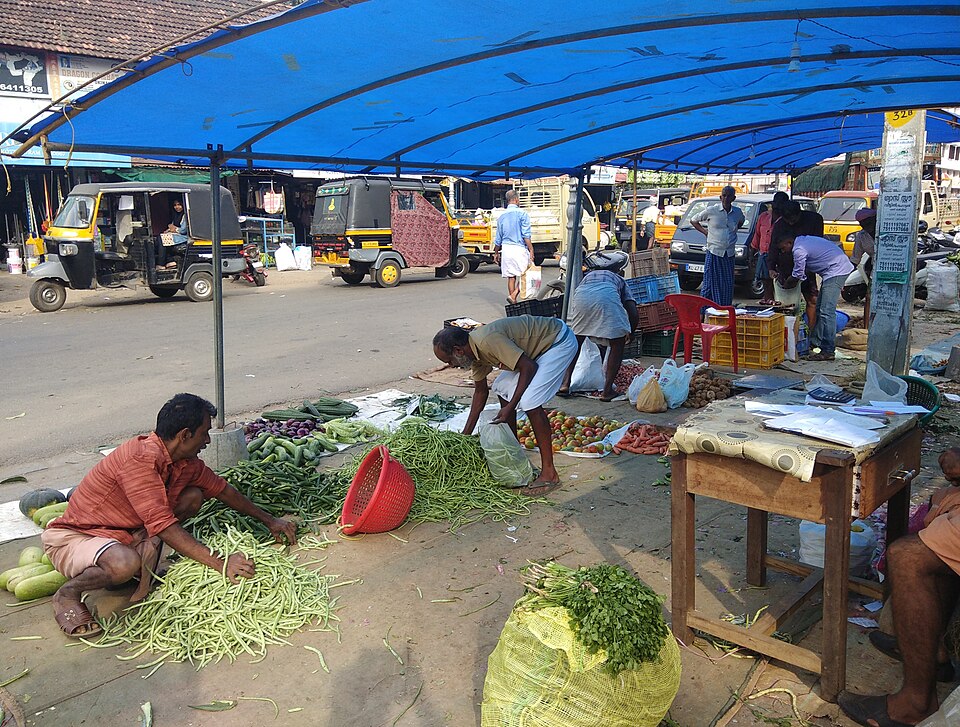
The foundational commercial institution of Kerala village life — held once a week on a fixed day at a fixed location, serving the agricultural surplus and consumer needs of surrounding villages within practical walking distance. The weekly rhythm created the social pulse of rural Kerala. Every village or cluster of villages had its own weekly day: Sunday markets, Wednesday markets, Friday markets, each defined by the community's religious calendar and agricultural cycle. The goods traded were hyperlocal: whatever the farmers and artisans of the surrounding area produced — vegetables, fruit, fish, toddy, pottery, woven goods, cattle — meeting the needs of those who could not produce everything themselves.
Specialised periodic markets focused specifically on the trade of cattle — bullocks for agricultural draught work, dairy cattle, and buffalo. Cattle markets required a larger gathering area and often a different day from the general provisions market, since cattle trading involves extended negotiation, health assessment, price testing, and the physical management of large animals in a public space. Kerala's cattle markets were concentrated in regions with both agricultural demand for working animals and supply from cattle-breeding communities — particularly in Palakkad (interface with Tamil Nadu cattle trade), Malappuram (North Kerala agricultural belt), and Pathanamthitta (Central Travancore farming zone).
Periodic markets attached to temple festivals (Vela, Pooram, Utsavam) that transformed a regular religious gathering into a major commercial event. When thousands of people gathered from surrounding regions for a temple festival, market traders followed. These temple-fair markets traded not just everyday provisions but specialist goods — silk, jewellery, ritual implements, livestock, agricultural tools, processed foods — that were not available at the weekly village Chantha. They were the commercial equivalent of today's trade fairs, creating a temporary but high-intensity market that complemented the regular weekly cycle.
The apex of Kerala's periodic market tradition — a duodecennial (every 12 years) grand fair held at Tirunavaya on the banks of the Bharathapuzha river. The Mamankam combined royal transition, religious ceremony, and commercial exchange on a scale that drew the entire Kerala political order. While distinct from the ordinary weekly Chantha in frequency and magnitude, the Mamankam demonstrates that Kerala's commerce was fundamentally structured around periodic gathering events rather than permanent markets — the same principle governing the village Chantha, expressed at civilisational scale. The last Mamankam is believed to have been held in 1755.
The Six Functions of the Chantha — Commerce Was the Least of It
To understand why the Chantha was such a central institution in Kerala's village life, you need to understand that commerce — the buying and selling of goods — was only one of its functions, and arguably not the most important. The weekly market served at least five other social purposes simultaneously, all of which contributed to its irreplaceable position in the community's life.
"The weekly market was not a supplement to village life. It was the hinge on which village life turned — the one day in seven when the community assembled, exchanged, negotiated, and renewed itself as a social entity."
Kerala's Cattle Markets — Where the Agricultural Economy Was Priced
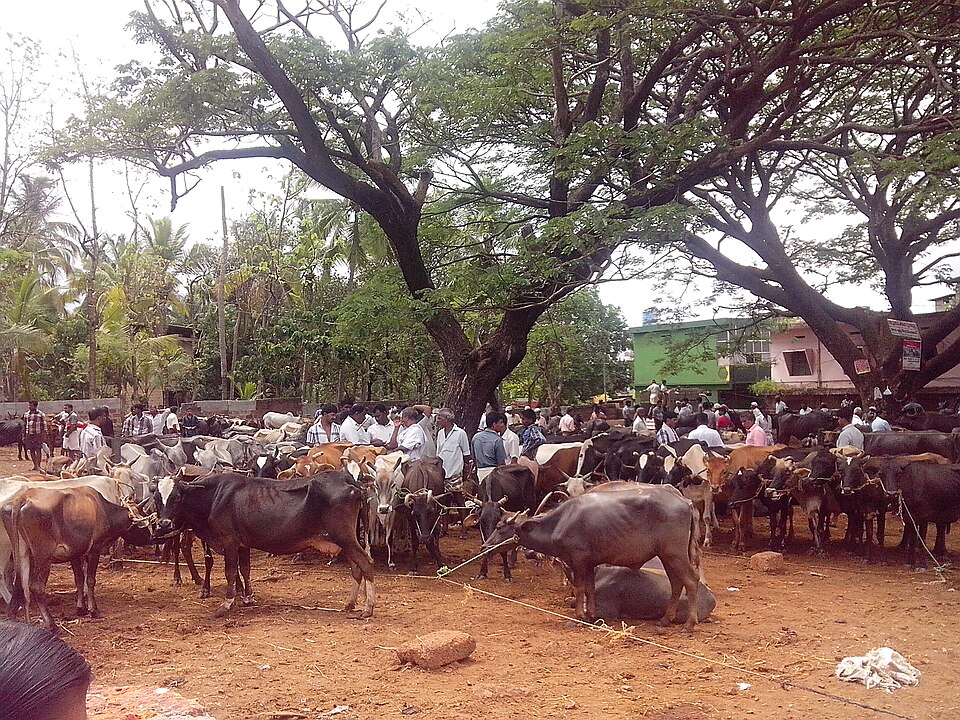
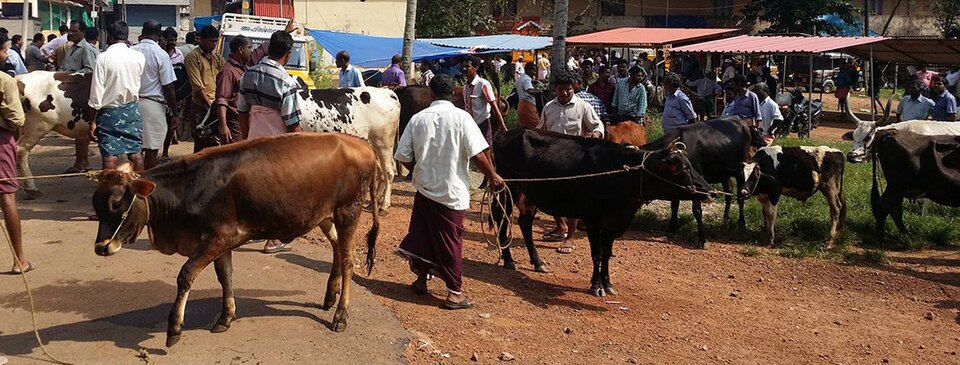
Kerala's cattle markets occupy a special position in the state's market tradition — not merely as commercial venues but as expressions of the deep cultural and economic relationship between Kerala's farming communities and their working animals. A bullock pair was not simply a farm implement. It was the farming household's most significant capital investment, its primary source of agricultural power, and in many communities an object of ritual veneration in its own right.
The cattle market therefore required a very different kind of commercial intelligence from the vegetable market. You could assess a basket of tomatoes in seconds. Assessing a bullock before purchase was a skill that took years to develop — reading the animal's gait for signs of lameness, checking its eyes and coat for health indicators, observing its response to unfamiliar sounds and handling for temperament assessment. The text of Krishi Gita — Kerala's ancient agricultural verse manual — provides detailed guidance on exactly how to evaluate a bullock before purchase, confirming that this knowledge was sufficiently important to deserve formal documentation in the tradition's most significant agricultural text.
Kuzhalmandam — Kerala's Largest Cattle Market
Kuzhalmandam, in Palakkad district, hosts what is widely described as Kerala's largest cattle market — a weekly gathering, primarily on Wednesdays, where hundreds of cattle are traded and prices set that serve as reference points for the state's broader livestock economy. The Kuzhalmandam market's significance is partly geographic: Palakkad is Kerala's gateway to Tamil Nadu, through which the state's cattle supply has historically flowed.
This geographic position made Kuzhalmandam a critical node in a larger commercial network extending across South India's cattle trade routes. When political interventions affected cross-border cattle movement — as happened in 2017 when federal regulations regarding cattle trade created controversy — Kuzhalmandam's market status made it a barometer for the entire state's meat economy and agricultural labour supply. The market's resilience through these disruptions reflects how deeply embedded the cattle market tradition is in Palakkad's farming identity.
Chelari — North Kerala's Malabar Market
Chelari, in Malappuram district, represents the cattle market tradition of North Kerala's Malabar region — an area where the conjunction of paddy farming, spice cultivation (particularly black pepper and arecanut), and significant Muslim trading communities created a distinct market culture. The Chelari cattle market draws from a broader agricultural hinterland than a typical village market, reflecting Malabar's tradition of longer-distance trade networks built through the region's historical spice trade economy.
Elavumthitta — Festival, Farm, and Market
Elavumthitta in Pathanamthitta district offers perhaps the clearest example of the intersection between Kerala's market tradition and its festival tradition. The town's cattle market history of over a century is inseparable from its Aswathy festival — a celebration that draws from surrounding regions and whose commercial fair component has always been a central part of its social function. Children in Elavumthitta save money for months to spend at the Aswathy fair; the cashew harvest provides the economic foundation for festival expenditure. Market, festival, and agricultural calendar are woven into a single social fabric.
The Chantha Revolt — When the Market Became a Battleground for Dignity
The most politically significant episode in Kerala's market history is not a trade event or a commercial milestone. It is the Nedumangad Chantha revolt — a confrontation over caste-based exclusion from market spaces that stands as one of the most powerful episodes in Kerala's long social reform history.
In late 19th and early 20th century Kerala, the caste system governed not merely social relationships but commercial ones with precision and cruelty. Lower-caste communities — particularly the Pulaya and Paraya communities — were explicitly prohibited from entering the market spaces (the Chantas) of many towns. They could not walk into the market.
The consequence was not merely social humiliation, though it was that. It was economic exploitation of a structural kind. Lower-caste farmers who had produced agricultural goods were required to place their produce outside the market boundary and wait for buyers to come to them — or for intermediaries to take their goods into the market and sell them, extracting a commission for the service of simply walking through a door the producer was not allowed to enter. Without the ability to enter the market and observe prices, negotiate directly, or compare offers, these communities received systematically lower prices for their goods. The exclusion was both symbolic and materially devastating.
"Lower caste people were not allowed to enter in the trade markets (Chantha) of Nedumangad and items brought by them from their farms have to be placed outside and used to get a lower price. A group of people under the leadership of Ayyankali questioned this social injustice which resulted in a great revolt and fought back their rights to enter and sell the goods of lower caste people in Nedumangad market and the trade markets nearby."
— Historical record of the Nedumangad Chantha revoltAyyankali — one of Kerala's greatest social reformers, a leader of the Pulaya community and a contemporary of Sree Narayana Guru — organised resistance to this practice. His approach was direct and public: bring lower-caste communities into the market space that had been declared off-limits to them, and demand the same right to trade that any other community member possessed.
The Nedumangad Chantha revolt was not simply a protest. It was a claim on citizenship — on the right to participate in the basic commercial and social life of the community on equal terms. The market was not a private space from which someone could legitimately be excluded by caste; it was a public institution that functioned in the public interest. Exclusion from it was not merely offensive to individual dignity — it was a violation of the market's own essential social function, which was to bring all producers and consumers together in a shared commercial space.
The revolt's significance extends beyond its immediate commercial context. It represents one of the earliest and most direct confrontations with caste-based economic discrimination in Kerala — challenging not the idea of caste as a social category but its specific material consequences in commercial life. The market, precisely because it was a public institution of fundamental importance, was the right ground on which to make this claim.
Notable Weekly Markets and Periodic Fairs Across Kerala
Vaniyamkulam, situated near Ottapalam in Palakkad's fertile Nila (Bharathapuzha) Valley, hosts what scholars describe as one of Kerala's oldest and most significant weekly cattle markets — a tradition tracing its documented origins all the way back to the Chera Kingdom period. This is not a regional cattle fair; it is a macro-regional livestock distribution centre. Every Thursday, traders arrive not just from across Kerala but from Tamil Nadu, Karnataka, Andhra Pradesh, Odisha, and Rajasthan — a convergence that confirms Vaniyamkulam's historical position as a node in an inter-state livestock trade network. The market's placement in the Nila Valley was no accident: the Bharathapuzha river, which served as Kerala's most important inland waterway for trade and communication, made this location a natural commercial convergence point for goods and people from multiple directions. High-trust customs like Kaiyidikkal (secret hand-negotiation under a cloth — see below) were, and continue to be, integral to the market's operation. Despite its extraordinary history, Vaniyamkulam's cattle market faces decline from the same pressures as all traditional livestock fairs: mechanised farming reducing demand for working bullocks, evolving livestock regulations, and the contraction of traditional trading networks.
One of Kerala's oldest continuously operating market areas, the Chalai Bazaar in Thiruvananthapuram (formally established in its present form in the late 18th century by Dewan Raja Kesavadas) traces its origins to a marketplace described in the 13th-century text Ananthapuravarnanam near the Padmanabha Swamy Temple. The market extended over a 2-kilometre road that became, over centuries, one of South Kerala's most comprehensive commercial corridors — fish market, spice market, textile market, provisions market, and household goods, all in a single traversable space. The Chalai's persistence for seven centuries, through colonial rule, modern urbanism, and the rise of supermarkets, makes it one of the most remarkable examples of market-as-living-heritage in India.
Kerala's largest cattle market, drawing hundreds of animals and traders from across the state and from Tamil Nadu through the Palakkad Gap. The Kuzhalmandam market's prices function as a reference index for cattle trade across Kerala. Its strategic position at Kerala's eastern gateway to Tamil Nadu reflects the historical trade routes through which Deccan and Tamil Nadu cattle have supplied Kerala's agricultural and food economies. The market gained national visibility in 2017 during controversies over cattle trade regulations, when business here became a barometer of state-wide economic and social tensions.
A historical trade festival held every year at Palluruthy since the late 18th century, the Pulavanibham combines the devotional tradition of temple access and the commercial tradition of the periodic fair in a single event. Its origin story encodes the same caste-access politics as the Nedumangad Chantha revolt: the festival was established following the Cochin Maharaja's grant of temple access rights to the Pulaya community, which had been denied entry due to caste restrictions. The market/fair that grew around this event has continued for over two centuries, carrying both commercial and social justice dimensions in its annual repetition.
The greatest periodic fair in Kerala's history — a duodecennial event combining royal succession, religious ceremony, and commercial exchange on a scale that drew participants from across the subcontinent. The Mamankam at Tirunavaya was not merely a large market but the culminating expression of Kerala's political and commercial order, occurring at 12-year intervals that corresponded to the tenure of the Perumal (regional sovereign). Its commercial dimension brought traders from as far as Arabia and China to Kerala's rivers. The last Mamankam is believed to have been held in 1755. Its cultural memory is preserved in festivals, museums, and — most recently — a 2021 film.
Kannur's central market, a property of Kannur Municipal Corporation, has been one of the state's major trading centres since the British period. Its significance reflects Kannur's position as a historic port and commercial hub of Malabar's spice trade. Local oral tradition captures its comprehensive character in the phrase "From salt to camphor, you can get it here" — a saying that encodes the market's function as a complete provisions universe for the surrounding community. The market's persistence through colonial and postcolonial transformation while retaining its central place in the town's identity makes it a significant example of market heritage.
Kerala's Chantha in Global Perspective — The Universal Weekly Market
One of the most striking features of Kerala's Chantha tradition is how precisely it parallels weekly market traditions in other parts of the world — from the Friday souk of North Africa and the Middle East, to the Thursday haat of India's tribal communities, to the Saturday Marché of rural France, to the Sunday tianguis of Mexico. Every agricultural community that developed before modern transport and communication seems to have independently arrived at the same institutional solution: a weekly gathering, at a fixed location, on a fixed day, where the community's full commercial and social needs could be met simultaneously.
This convergence is not coincidental. It reflects a set of universal constraints: the typical radius of daily travel in an agricultural community (walking distance, or at most an ox-cart's range); the typical weekly accumulation of agricultural surplus; the typical social distance between dispersed farm households that required periodic assembly to maintain community cohesion. The weekly market is the optimal response to these constraints across very different cultures and geographies.
What distinguishes Kerala's Chantha within this universal pattern is its specific embeddedness in Kerala's particular social history — particularly the way in which market access became a site of caste contestation and social reform. The Nedumangad Chantha revolt has few direct parallels in other countries' weekly market traditions, but its logic — that the public market, as a shared civic institution, cannot be used to enforce private hierarchies — is universal and speaks to the broader significance of market access as a dimension of citizenship and human dignity.
Kerala's weekly markets were deeply synchronised with the agricultural calendar. The Njattuvela system — Kerala's ancient 27-period farming calendar — determined when specific crops were harvested, which in turn determined what appeared at the market in each period. A market during Thiruvathira Njattuvela (June/July, the heart of the monsoon) offered a very different selection than a market during the post-monsoon harvest period. The market calendar and the farming calendar were not parallel systems — they were integrated, with each informing and shaping the other.
The Chantha Today — Between Supermarket Invasion and Cultural Persistence
The traditional Kerala weekly market faces the same pressures as its counterparts worldwide: supermarket chains offering standardised goods at competitive prices, the loss of physical market space to urban development, the reduction of agricultural households and their surplus production, and the availability of consumer goods through e-commerce that once required a market visit.
Yet Kerala's Chantha tradition has shown remarkable resilience. Weekly markets continue to operate across the state — on the same days they have always operated, in many cases on the same ground they have occupied for generations. Their persistence reflects something that the economists of supermarket efficiency struggle to quantify: the social value of the periodic market as a community institution. The Chantha offers not just goods but the specific experience of direct exchange — producer to consumer, known seller to known buyer, in a public space with the social accountability that physical community presence provides.
Kerala's cattle markets face more acute pressure. The displacement of animal draught power by mechanical farming has reduced demand for working bullocks. Federal regulations affecting interstate cattle transport have disrupted supply chains. And the cultural knowledge required to trade cattle competently — the ability to assess an animal's health, temperament, and work capacity from direct observation — is becoming rarer as farming communities urbanise and younger generations choose non-agricultural careers.
What survives, and what is worth preserving, is not merely the commercial function of the weekly market but its social architecture — the system of trust, knowledge, community accountability, and periodic gathering that the Chantha embodied and that no digital commerce platform has yet found a way to replicate.
Market and Festival — How Kerala's Commercial and Ritual Calendars Converged
One of the most characteristic features of Kerala's market tradition is the inseparability of commercial and festival functions. In Kerala's cultural calendar, virtually every major festival — Onam, Vishu, Thiruvathira, Shivaratri, regional temple festivals — is also a market occasion. The gathering of devotees creates a commercial opportunity; the commercial gathering creates the conditions for social and ritual exchange.
This convergence is not modern. The Mamankam combined royal succession with a massive fair. The Pulavanibham combines temple ritual with commercial gathering. Temple festival markets (Vela Chantha) attached commercial activity to religious events across Kerala's temple calendar. The principle is consistent: wherever people gather, trade follows; and wherever trade is established, social ritual is not far behind.
The most significant example is Onam itself — Kerala's harvest festival, which is simultaneously the state's most important shopping season. The purchase of new clothes (Onakkodi), the elaborate Sadya feast's provisions, the flower (Pookalam) materials, the games' equipment — all of these generate a surge in market activity during the Onam fortnight that has been a feature of Kerala's commercial calendar for as long as the festival has existed. What is marketed today through television advertisements and e-commerce platforms was marketed through the Chantha for most of Kerala's history.
Kaiyidikkal — The Secret Language Under the Cloth
Of all the customs specific to Kerala's Chantha tradition, none is more anthropologically fascinating — or more immediately mysterious to an outsider — than Kaiyidikkal (കൈഇടിക്കൽ — literally "hand-placing"), also known as Kaalam Vaanibham in the cattle-trade context. It is a centuries-old practice of silent price negotiation conducted entirely by touch, beneath the cover of a cloth or towel, in which no spoken word is exchanged during the critical moment of agreeing on price.
The mechanism is precise. Buyer and seller extend their hands under a shawl or handkerchief held between them. Neither party can see what the other's fingers are doing; only touch communicates. A specific coded system of finger gestures represents numerical values — grasping all five fingers may indicate 5 or 50 (units of currency or commodity); a tug at the index finger signals 1 or 10; two fingers grasped represent 2 or 20. More complex combinations, used by senior brokers and traders, are closely guarded professional secrets known only to those trained within the trade.
The purpose of this elaborate secrecy is entirely practical. In a high-volume wholesale market — for livestock, spices, or other high-value commodities — the agreed price between two parties is commercially sensitive information. Rival traders observing a transaction could use the knowledge of the agreed price to undercut, manipulate, or reopen negotiations. By conducting the price agreement beneath a cloth, in pure silence, the Kaiyidikkal system kept the final number between the two parties alone — a private contract sealed in a public space.
"The shawl covers the hands. What passes between them is known only to the two who touch. A price agreed under cloth is a price that cannot be disputed — because no third party witnessed it. The cloth is both the medium and the seal."
— KeralaFolklore.com, drawing from ethnographic accountsThe origins of Kaiyidikkal are debated within Kerala's historical tradition. An indigenous account traces it to the long-established high-trust trade customs of the Malabar Coast, where multi-lingual commercial relationships between Arab, Chinese, Jewish, and Malayalam-speaking merchants required a communication system that transcended language barriers. A more specific historical theory connects it to the visit of Chinese Admiral Zheng He to the Malabar Coast in 1407 CE, when a tactile sign language is said to have evolved as a bridge between Chinese, Arabic, and Malayalam-speaking traders. Regardless of its precise origin, the survival of Kaiyidikkal for over 600 years through profound social, political, and economic change testifies to its functional effectiveness.
Remarkably, parallel systems exist in other parts of the world. In the livestock markets of Somaliland, brokers finalise price figures using tactile sign language under a shawl (cumaamad) while discussing animal quality openly. This global parallel confirms that hidden negotiation is a universal economic adaptation — not a peculiarity of Kerala's market culture but a response to the universal problem of conducting sensitive commercial transactions in a public space.
Chantha Pattu — The Songs of the Market Journey
The Chantha was not only a destination but a journey — and Kerala's folk song tradition encoded this journey as vividly as the market itself. Nadan Pattukal (folk songs) referencing the market journey served as aural archives, regulating the rhythm of walking or rowing and celebrating the communal anticipation of market day.
The existence of specific songs like "Chalakudi Chandaku Pokumbol" ("When going to Chalakudy Chantha") confirms the market as a culturally significant destination — one worth immortalising in verse, one that required arduous travel by land or water. These songs served practical purposes: regulating the pace of rowing or walking with goods on head, fostering collective effort among travelling merchants, and building the anticipatory energy that made the Chantha feel like an occasion rather than an errand.
The Vanchippattu (boat songs) tradition — primarily associated with Kerala's snake boat races — was also deeply connected to the market economy. Markets like Pattambi, situated on the Bharathapuzha river, relied entirely on riverine transport for bulk goods. The rhythms of Vanchippattu, designed for coordinating the communal effort of rowing, were adapted for the economic journeys that carried cattle, spices, and agricultural surplus to the weekly Chantha along Kerala's river network. The journey to the market was a performance in itself — voice, rhythm, and water working together to move the week's commerce toward its destination.
Frequently Asked Questions — Kerala Weekly Markets and Chantha
What is Chantha in Kerala?
What is the Nedumangad Chantha revolt?
What is Kuzhalmandam cattle market?
What is Chelari cattle market?
How do Kerala's weekly markets differ from supermarkets?
What is Mamankam and how does it relate to Kerala's market tradition?
References & Image Credits
- 1Wikipedia. "Nedumangad." graphsearch.epfl.ch. Records of the Nedumangad Chantha revolt and Ayyankali's leadership.
- 2Wikipedia. "Mamankam." en.wikipedia.org. History of the duodecennial grand fair at Tirunavaya.
- 3Wikipedia. "Pulavanibham." en.wikipedia.org. History of the Palluruthy trade festival since the late 1700s.
- 4Wikipedia. "Chala, Thiruvananthapuram." en.wikipedia.org. History of Chalai Bazaar since the 13th century.
- 5Wikipedia. "History and culture of Elavumthitta." en.wikipedia.org. Elavumthitta cattle market and Aswathy festival history.
- 6Gulf News. "Business as usual at Kerala beef shops." 2017. Kuzhalmandam cattle market during federal regulation controversy.
- 7Ayyankali scholarship: Sahodaran K. Ayyappan, and documentation of the Nedumangad Chantha revolt in Kerala social reform history.
- 8KeralaFolklore.com. "Njattuvela — Kerala's Traditional Farming Calendar." keralafolklore.com.
- 9KeralaFolklore.com. "Krishi Gita — Kerala's Ancient Agricultural Guide." keralafolklore.com. On selecting bullocks at cattle markets.
- Img 1Ranjithsiji. "Vegetable market Thrissur." CC BY-SA 4.0, via Wikimedia Commons. vegetable-market-thrissur.jpg.
- Img 2Ranjith-chemmad. "Chelari cattle market." CC BY-SA 3.0, via Wikimedia Commons. chelari-cattle-market.jpg.
- Img 3Rahuldharmaraj. "Elavumthitta cattle market." CC BY-SA 4.0, via Wikimedia Commons. elavumthitta-cattle-market.jpg.