Meta Folklore: When Tradition Begins to Reflect on Itself
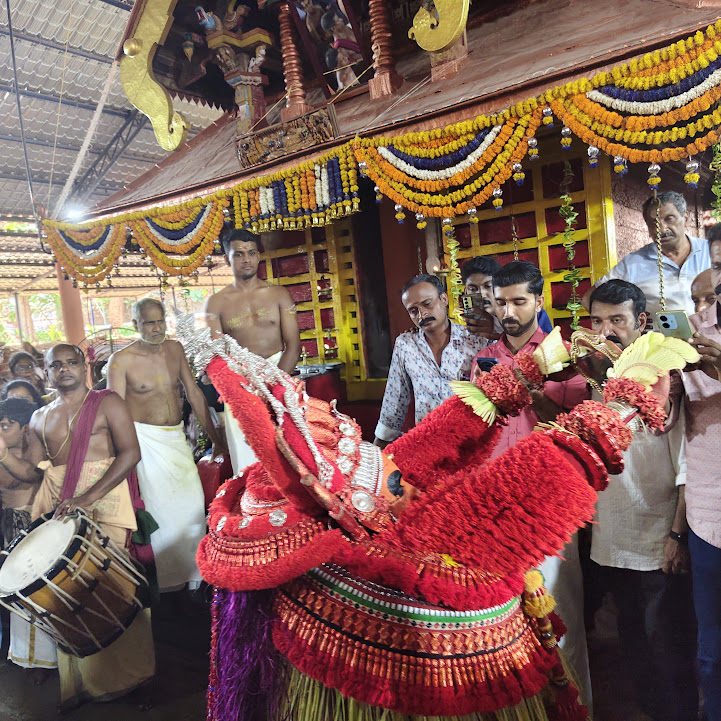
Vishnumurthy Theyyam in Mirror Reflection
In the evolving landscape of folklore studies, meta folklore occupies a distinctive intellectual territory — it is, as folklorist Alan Dundes (1979) defined, “the folklore about folklore.” In other words, it represents the moment when communities become conscious of their own traditions, and begin to joke, parody, or philosophize about the very stories and customs that once defined them. Meta folklore thus transforms oral tradition into a dialogue between past and present, between belief and self-awareness.
Globally, this concept has shaped new approaches to cultural research. Linda Dégh in her seminal work Narratives in Society: A Performer-Centered Study of Narration (Indiana University Press, 1995), and Richard Bauman in Verbal Art as Performance (Waveland Press, 1984), highlighted how performance itself becomes self-reflexive — stories about storytelling, legends about their tellers, or jokes about belief. In the digital era, this reflexivity has expanded dramatically. Memes, hashtags, and viral posts that remix myths and proverbs are not merely entertainment; they form a growing corpus of what scholars now call digital meta folklore (Cybergeo Journal of Digital Culture, 2022).
In Kerala, meta folklore has long existed within traditional art forms that reinterpret themselves. Ritual performances like
This article explores the global evolution of meta folklore, its theoretical foundations, and the way Kerala’s living folk imagination contributes to this worldwide phenomenon. In an era where digital storytelling reshapes identity, meta folklore reminds us that culture survives not by repetition, but by reflection.
The Global Evolution of Meta Folklore
The term meta folklore first appeared in American folklore scholarship through the writings of Alan Dundes, who noted that every culture produces commentary about its own traditions. In his essay collection Interpreting Folklore (1979), Dundes described how jokes, proverbs, and narratives often contain reflections on storytelling itself. This reflexivity — folklore about folklore — creates a second layer of meaning where the community examines its own narrative habits, humor, and belief systems.
As folklore entered modern media, this self-awareness intensified. Linda Dégh observed that modern legends often parody their own structure, a phenomenon she called “legendary self-reference” (Legend and Belief, Indiana University Press, 2001). Richard Bauman extended this idea through his theory of verbal art as performance, showing that performers frequently comment on the act of narration while performing, transforming folklore into a meta-discourse on its own process. Such reflexivity reveals that communities not only transmit traditions but also continually interpret them.
Globally, the twenty-first century has witnessed a remarkable transformation of this idea in the digital sphere. With the rise of internet culture, folklore scholars such as Trevor J. Blank (Folklore and the Internet, University Press of Mississippi, 2009) and Limor Shifman (Memes in Digital Culture, MIT Press, 2014) have demonstrated how online memes, viral narratives, and parody accounts function as new forms of meta folklore. Internet users are not merely repeating old stories — they are commenting on the act of storytelling itself. Each meme about an urban legend or myth becomes both a joke and a reflection on belief.
Illustrative examples appear across continents. In the United States, the rise of the Slenderman myth exemplifies digital meta folklore — a story created collectively online that then became self-referential through fan theories and mockumentaries (Folklorica Journal, 2015). In Japan, internet users have reimagined traditional yokai spirits as anime characters and humorous digital avatars, creating what cultural theorist Noriko T. Reider calls “metamorphic folklore” (Japanese Journal of Religious Studies, 2018). African social media spaces, meanwhile, transform proverbs into meme formats, creating layers of cultural reflection where wisdom sayings critique modernity.
These global examples reveal a consistent pattern: as media evolve, folklore becomes increasingly aware of itself. From oral jokes about storytelling to viral posts that parody myths, humanity demonstrates a universal urge to reflect on the act of narration. This is meta folklore’s most profound contribution — it bridges the gap between tradition and modern self-consciousness. The stories we tell about stories reveal how deeply we understand ourselves as cultural beings.
Meta Folklore in India: Reflection and Reinvention
In India, where oral traditions have long served as the backbone of cultural transmission, the idea of meta folklore emerges naturally within storytelling itself. Classical collections such as the Panchatantra and Jataka Tales contain not only moral fables but also stories about storytellers, reflecting an early consciousness of narration as an art. This reflexive layer — where a tale pauses to discuss its own lesson or narrators — embodies what folklorist Alan Dundes termed folklore’s “self-commentary.”
Throughout Indian history, poets and bards have frequently used humor and self-reference to question tradition. The Bhakti and Sufi movements, for instance, produced songs that mocked rigid ritualism while reaffirming faith. Such compositions transformed devotional folklore into a critique of belief itself — a pattern echoed centuries later in modern Indian theatre and film. Folklore thus became both a mirror and a microscope: reflecting communal values while examining them through irony.
In the modern era, Indian scholars have recognized this reflexivity as central to folk expression. The literary anthropologist A.K. Ramanujan observed that Indian folktales often contain embedded stories that question their own truth. Similarly, Devdutt Pattanaik notes that the cyclical retelling of myths in popular media — comics, television, and cinema — represents a living negotiation between reverence and reinterpretation. This constant reinvention is a hallmark of Indian meta folklore: the ability of a society to look inward at its own myths and laugh, reinterpret, or reimagine them without losing faith in their core wisdom.
The rise of digital communication has brought this self-reflective tendency into new forms. WhatsApp forwards, short videos, and social media posts frequently remix proverbs, mythological figures, and moral tales into witty commentaries on daily life. Scholars of digital culture like Trevor J. Blank describe these practices as “vernacular reflexivity” — the popular habit of using folklore to discuss itself. In Indian cyberspace, this means Krishna memes that joke about philosophy, Panchatantra lessons repurposed for political satire, or regional ghost stories retold with self-aware humor. Each example reinforces how folklore in India continually reinterprets its own narrative logic.
This deep self-referentiality prepares the ground for the study of meta folklore in Kerala, where performance traditions like Thullal and Theyyam have long practiced the art of self-commentary. From ancient manuscripts to modern memes, India’s storytelling culture demonstrates that reflection has always been embedded within transmission — a dynamic that keeps tradition alive, aware, and responsive to change.
Meta Folklore in Kerala: From Temple Grounds to Digital Platforms
Among India’s many cultural landscapes, Kerala stands out for its rare capacity to reflect upon its own traditions. Here, folklore does not merely survive — it observes, analyses, and reinvents itself. Performers, ritual specialists, and storytellers consciously recognize the boundaries between belief and performance, often stepping across them to comment on the very culture they embody. This quality of self-reflective tradition makes Kerala’s folklore a living laboratory of meta folklore.
In the sacred performance of Theyyam, the divine and the human coexist in a dynamic dialogue. During enactment, the performer sometimes interrupts ritual solemnity to make social or political observations — addressing contemporary injustice or human folly. Folklorist M.V. Vishnu Namboothiri notes that this deliberate awareness — the god speaking as a performer — transforms ritual into self-analysis, echoing what Richard Bauman calls “the reflexive dimension of performance.”
Similarly, the satirical art form Ottan Thullal, created by Kunchan Nambiar, functions as meta folklore in poetic form. By parodying mythological epics and ridiculing elite ritual practices, Nambiar turned classical stories into mirrors of social reality. The narrator within a Thullal often mocks his own narration, inviting the audience to laugh both at the tale and at storytelling itself — a structure that anticipates modern self-aware art. This playful reflexivity reveals a society comfortable with humor as a tool for introspection.
Kerala’s oral and visual traditions also embody meta-folkloric layers through repetition and reinterpretation. Folk songs such as Nadan Pattu and Vanchipattu frequently contain self-referential lines where singers acknowledge their creative act or the limitations of memory. Storytellers in Paattu performances sometimes comment on their own forgetfulness, deliberately blending memory and invention. These gestures, as Alan Dundes observed, make the act of transmission itself a folkloric subject.
In contemporary Kerala, this reflexive impulse has found digital expression. YouTube channels, podcasts, and social media reinterpret folk deities, customs, and sayings with irony and affection. A meme about Bhagavathy or Theyyam often carries not just humor but an implicit dialogue with sacred tradition. Scholars of digital folklore such as Trevor J. Blank describe this as “vernacular reflexivity,” where community expression both critiques and celebrates itself. In Kerala’s online spaces, this has created a digital shrine of self-aware tradition — an evolving archive where folklore continues to observe and reinvent itself.
Thus, from temple grounds to smartphone screens, Kerala’s folk imagination sustains a remarkable continuity. Each generation inherits myths not passively but critically, reshaping them through ritual, satire, and digital dialogue. This enduring capacity for reflection confirms that in Kerala, the story of folklore is also the story folklore tells about itself.
Reading Kerala’s Meta Folklore: Layers of Reflection and Commentary
Having seen how Kerala’s performance and media traditions embody self-awareness, it is useful to look more closely at how specific genres express meta-folkloric consciousness. From ritual songs that narrate their own origins to ballads debating their authenticity, Kerala’s folk expressions often become acts of commentary on folklore itself.
Ritual Self-Reflection in Theyyam
In the Thottam pattu sung before Theyyam performances, the performer often narrates how the deity sanctioned the ritual itself. In the Muchilottu Bhagavathi Thottam, for instance, the goddess declares that her own manifestation must be sung to sustain her presence. This self-referential act transforms the ritual into a commentary on its own sacred origin — a vivid example of meta folklore, where folklore explains its own necessity and structure.
Irony and Self-Awareness in Folk Theatre
Kerala’s folk theatre forms such as Desathukali, Porattunadakam, and versions of Krishnanattam often include humorous asides about the art itself. Performers may joke about missing props or audience expectations of divinity. Such moments display what performance theory calls reflexivity — the artist’s awareness of their own performative act.
Ballad Traditions and Debates of Authenticity
The Vadakkan Pattukal (Northern Ballads) provide another dimension of meta folklore. Local narrators often dispute the “true” version of Aromal Chekavar or Unniyarcha, debating which lineage preserves the authentic song. This act of comparison and defense becomes a folklore about folklore — a living discourse on the reliability of oral memory itself.
Oral Commentary and Ritual Hermeneutics
In many shrines, the Velichappadu (oracle) or Komaram explains why certain songs must be sung and what meanings they carry. These interpretations, often transmitted orally, form a vernacular hermeneutics — what Alan Dundes called “folk commentary on folk tradition.”
Ethical Narratives as Meta Folklore
Stories surrounding Sarpam Thullal or Bhadrakali Theyyam frequently explain the consequences of neglecting rituals or angering deities when customs are broken. Such tales act as moral reflections on the preservation of tradition itself — teaching why folklore must endure.
Digital Meta Folklore
In the digital age, this reflexive process continues in online spaces. Social media debates about the “authenticity” of Theyyam costumes or the “commercialization” of Kalaripayattu reveal how communities reinterpret heritage in the language of modern critique. These conversations, in YouTube comments or Facebook groups, extend the folk dialogue into a participatory and global sphere.
Textual Reflexivity in Aithihyamala
Even in literary retellings such as Aithihyamala by Kottarathil Sankunni, the narrator occasionally pauses to question the truth of a tale or the exaggeration of legends. These remarks reflect an indigenous literary self-awareness — acknowledging belief and skepticism as coexisting within Kerala’s folk consciousness.
Conclusion
From the Thottam to the meme, from sacred discourse to digital debate, Kerala’s meta folklore exemplifies a culture deeply conscious of its own storytelling. The folk are not passive bearers of tradition but active interpreters and theorists of it — continually renewing the meaning of their heritage through every performance and retelling.
Theoretical Lens: Folklore Reflecting on Itself
At its core, meta folklore is a theory of reflection — the moment when tradition becomes aware of its own mechanisms. Folklorists have long recognized this phenomenon as a key to understanding how culture sustains itself through time. Alan Dundes argued that folklore must be studied not only for what it says but also for what it says about itself. A proverb that mocks proverb-making, or a legend about storytelling, reveals a deep cultural intelligence: societies know they are telling stories and consciously comment on that act.
Performance theory provides a crucial interpretive framework for this self-awareness. According to Richard Bauman, every folk performance contains a reflexive layer in which the performer signals, “this is a performance.” This moment of framing transforms ordinary communication into art, allowing the audience to observe not just the content but also the craft of storytelling. In Kerala, when a Theyyam performer steps briefly out of divine trance to address human concerns, or when a Thullal poet mocks his own verses, the act exemplifies Bauman’s theory in living form: performance becomes commentary on performance.
The Russian thinker Mikhail Bakhtin enriches this discussion with his concept of dialogism — the idea that every cultural utterance is a dialogue with previous voices. In this sense, folklore is inherently meta, since each new version of a tale responds to older ones. Kerala’s oral genres, like Vanchipattu and Nadan Pattu, constantly converse with their predecessors, inserting humor, protest, or humility as reflective gestures. The result is a living dialogue across generations that embodies Bakhtin’s insight that meaning is never fixed but always negotiated.
The anthropologist Victor Turner extended this notion by showing that ritual performance is not only symbolic but also self-revealing. Rituals, he observed, contain liminal moments when participants recognize and question the structure of the ritual itself. This reflexivity — present in Kerala’s festivals, possession rituals, and communal songs — turns collective belief into self-examination. The boundary between faith and irony, sacred and humorous, becomes fluid, allowing communities to renew meaning through awareness.
Contemporary digital folklore continues this theoretical lineage in new media environments. Internet users consciously remix traditional motifs to reflect on storytelling itself, creating what Trevor J. Blank calls “vernacular reflexivity.” When a Kerala meme-maker transforms a mythic scene into social satire, the act parallels centuries-old ritual humor — different medium, same self-awareness. The digital sphere thus becomes a new stage where folklore performs its oldest habit: looking back at itself.
Through these theoretical perspectives — performance, dialogism, and reflexivity — we see that folklore is never a static deposit of memory. It is an ongoing conversation between the teller and the told, between tradition and critique. In this sense, meta folklore is not a separate branch of folklore but its inner consciousness — the mirror through which culture continuously perceives, questions, and renews itself.
Why Meta Folklore Matters Today
In an age of accelerated change, meta folklore reminds us that tradition is not an echo from the past but a mode of critical thinking. When a community reflects on its own stories, it demonstrates cultural intelligence — the ability to observe, question, and renew its own meanings. The Kerala context shows this vividly: in the jokes embedded within Theyyam performances, in the irony of Thullal, and in the modern memes that reinterpret those same performances, folklore reveals that it has always contained its own commentary.
According to Barbara Kirshenblatt-Gimblett, heritage is not simply preserved; it is produced through acts of presentation. Each time Kerala’s communities reperform or digitally reinterpret their traditions, they engage in heritage-making — consciously shaping how they want to be seen. Meta folklore is the language of that process, the discourse through which tradition negotiates modern identity.
The concept also aligns with Arjun Appadurai’s idea of the production of locality, where cultural practices constantly construct and reconstruct the sense of place. Meta folklore — especially in the online era — plays a vital role in this, allowing Kerala’s voices to situate themselves within the global digital commons while preserving their regional uniqueness. Every meme about a Theyyam deity or reimagined folk verse becomes a small but potent act of cultural positioning.
Folklorist Linda Dégh observed that legends survive because they invite interpretation and doubt. Meta folklore extends this idea into everyday life: it is folklore that questions folklore, performance that laughs at performance, ritual that exposes its own structure. This capacity for self-critique is what keeps oral and ritual traditions alive amidst technological shifts and social change.
In the context of Kerala, meta folklore ensures that ritual art, oral song, and digital creativity coexist within a continuous reflective loop. It is what allows a Theyyam artist to question his divine role, a YouTube creator to parody ancient myths, and a village festival to debate its relevance in the climate era. The act of reflection — once confined to scholarly interpretation — has become part of popular practice itself.
Thus, meta folklore matters today because it reveals culture’s most enduring power: the power to look at itself and still continue to create. In an interconnected world, where authenticity and reinvention constantly overlap, Kerala’s living traditions stand as examples of how reflection and creativity sustain one another. The mirror that folklore holds up is not merely to the past — it is to the future of human imagination.
References
- Abrahams, Roger D. Everyday Life: A Poetics of Vernacular Practices. University of Pennsylvania Press, 2005.
- Appadurai, Arjun. Modernity at Large: Cultural Dimensions of Globalization. University of Minnesota Press, 1996.
- Bauman, Richard. Verbal Art as Performance. Waveland Press, 1984.
- Bakhtin, Mikhail. The Dialogic Imagination: Four Essays. University of Texas Press, 1981.
- Blank, Trevor J. Folklore and the Internet: Vernacular Expression in a Digital World. Utah State University Press, 2009.
- Dégh, Linda. Legend and Belief: Dialectics of a Folklore Genre. Indiana University Press, 2001.
- Dundes, Alan. Interpreting Folklore. Indiana University Press, 1979.
- Kirshenblatt-Gimblett, Barbara. Destination Culture: Tourism, Museums, and Heritage. University of California Press, 1998.
- Pattanaik, Devdutt. My Gita. Rupa Publications, 2015.
- Ramanujan, A. K. Folktales from India: A Selection of Oral Tales from Twenty-two Languages. Pantheon Books, 1991.
- Turner, Victor. The Anthropology of Performance. PAJ Publications, 1987.
- Turner, Victor. The Ritual Process: Structure and Anti-Structure. Aldine, 1969.
- Vijayan, K. M. “Meta Folklore in the Kerala Context.” Folklore Studies, vol. 54, no. 2, 2017, pp. 45–59.
- Kerala Folklore Academy. https://www.keralafolklore.org
- UNESCO Intangible Cultural Heritage Portal. https://ich.unesco.org
- International Society for Folk Narrative Research (ISFNR). https://www.isfnr.org
- Ministry of Culture, Government of India. https://indiaculture.gov.in