The ritual landscape of North Malabar — historically the region of Kolathunadu — is defined by the thunderous percussion of the Chenda and the fiery, crimson manifestations of living gods. Theyyam is where the oppressed become the divine. And nowhere is this inversion more profound, more paradoxical, or more politically significant than in the tradition's treatment of the female: the same patriarchal society that silenced women in life has been compelled to worship them as goddesses in ritual for over a thousand years.
The Central Paradox: Celebrating Female Power Through the Male Body
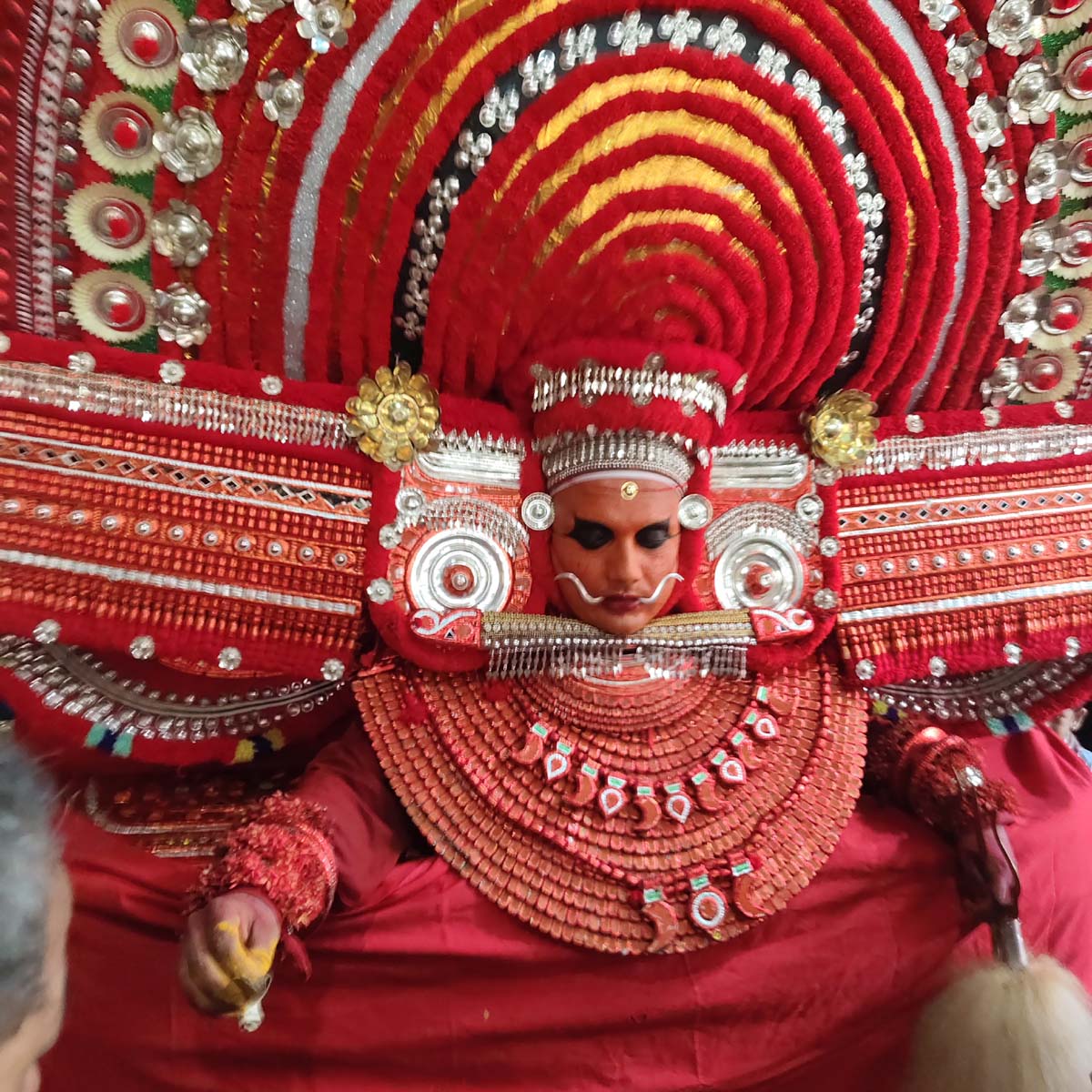
A feminist examination of Theyyam begins not with celebration but with a paradox. The Amma Daivangal — the Mother Goddess Theyyam forms — are among the most powerful, most elaborate, and most politically subversive elements of Kerala's ritual tradition. They encode stories of women's suffering, women's intellectual courage, and women's demand for justice with extraordinary vividness and emotional force. Yet almost every one of these female deities is performed by a man.
This is the productive contradiction at the heart of Theyyam's gender politics: a tradition that preserves women's stories in their most vivid, most enduring form, while simultaneously maintaining male bodies as the authorised vessels for transmitting those stories to the world. Feminist scholars have read this tension in multiple ways — as ritualized empathy, as a male appropriation of female trauma, as an unintentional but genuine form of consciousness-raising, and as a subaltern archive whose subversive potential has outlasted the patriarchal social structures it critiques.
This essay draws from feminist scholarship, ritual performance theory, Judith Butler's concept of gender performativity, postcolonial studies, and psychoanalytic theory to analyse Theyyam's female-centric deity traditions. It examines the legends of Kadavankottu Makkam, Muchilottu Bhagavathy, Neeliyar Bhagavathy, Vasoorimala, and the rare exception of Devakoothu. For a comprehensive overview of Theyyam itself, see our full Theyyam guide.
The Socioreligious Architecture of Theyyam — Gods of the Marginalized
Theyyam is fundamentally a product of the complex interplay between indigenous tribal traditions, Dravidian nature worship, and later Brahmanical influences — but its social architecture is unlike anything in the Brahmanical mainstream. Unlike the transcendental deities of the Vedic tradition housed in stone temples, Theyyam deities are immanent: they reside in Kavus (sacred groves) and ancestral homes, they hear direct petitions, they pronounce justice on local disputes, and they respond to the specific grievances of specific communities. The deity is not remote. The deity is here, now, present, accessible.
The right to perform Theyyam is a traditional prerogative of specific Dalit and Scheduled Caste communities — Vannan, Malayan, Pulayan, Mavilan, and Velan among the most prominent. This creates one of the most remarkable ritual inversions in the history of caste society: the marginalised artist transcends his social position to become a deity whom even the highest-caste Brahmin must revere, prostrate before, and receive blessings from.
| Community | Ritual Role | Major Deities Embodied | Social Context |
|---|---|---|---|
| Vannan | Primary performers, traditional medicine men | Muchilottu Bhagavathy, Pottan Theyyam | Knowledge of traditional medicine and Thottam ballads; guardians of Bhagavathy traditions |
| Malayan | Primary performers, percussionists | Rakthachamundi, Vishnumoorthy, Puli Bhagavathy | Specialists in fierce deities and exorcism rituals; forest community knowledge |
| Pulayan | Agricultural labourers and performers | Pottan Theyyam, Gulikan, Panchuruli | Performances characterised by sharp social satire and fire rituals; oral literature keepers |
| Mavilan | Forest-dwelling community | Makkam and her children, mountain spirits | Associated with the Kadavankottu Makkam tradition; forest and boundary deities |
| Velan | Performers and oracle-keepers | Neeliyar Bhagavathy, Vasoorimala | Custodians of specific female-deity Theyyam traditions and their Thottam Pattu ballads |
The Female Deity Forms — A Visual Gallery
Theyyam's female deity forms constitute one of the most visually extraordinary traditions in world ritual performance. Each form has its own distinct costume, makeup, crown, and gestural vocabulary — a complete aesthetic system developed over centuries to express the specific mythological character and emotional register of that deity.
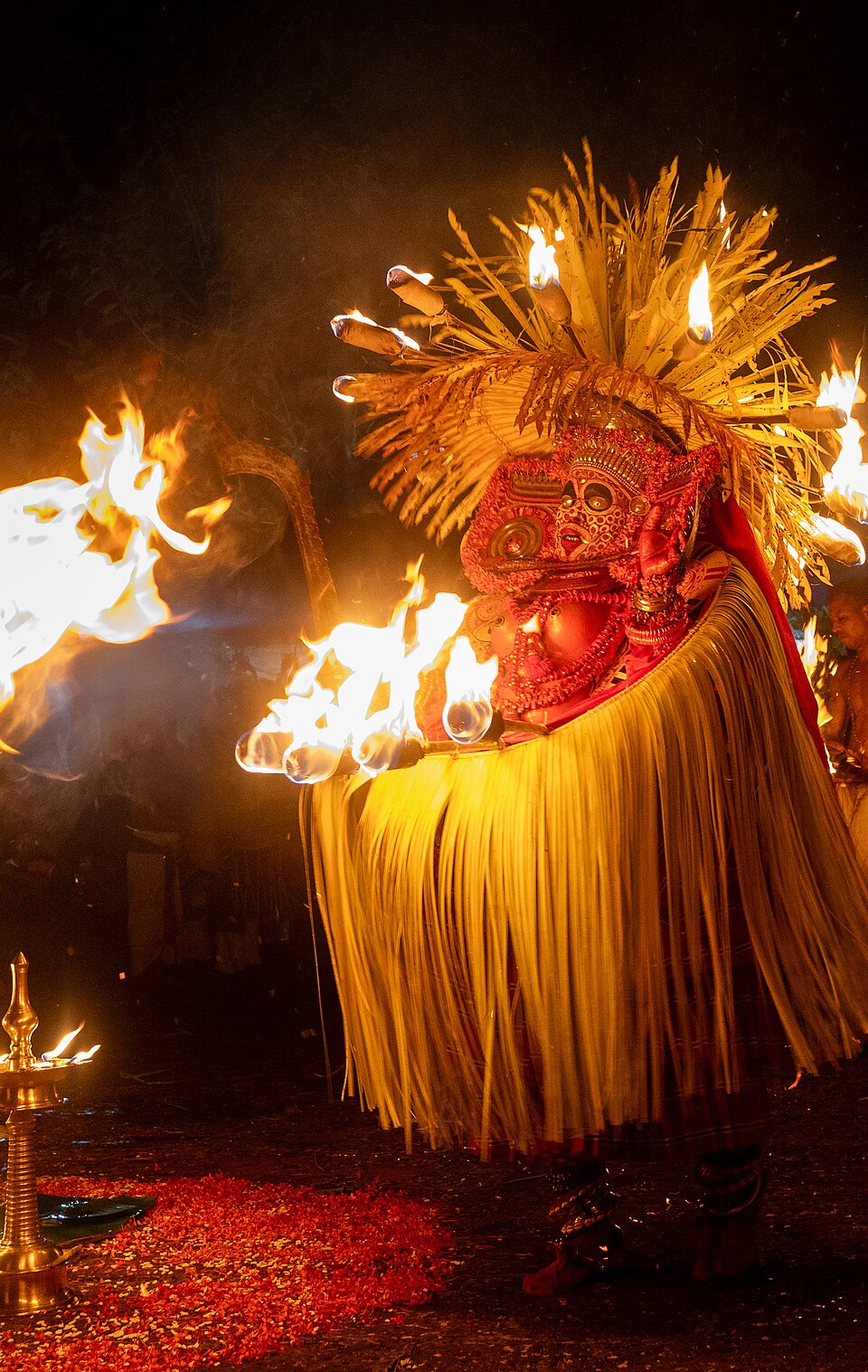
Photo: Uajith, CC BY-SA 4.0, via Wikimedia Commons
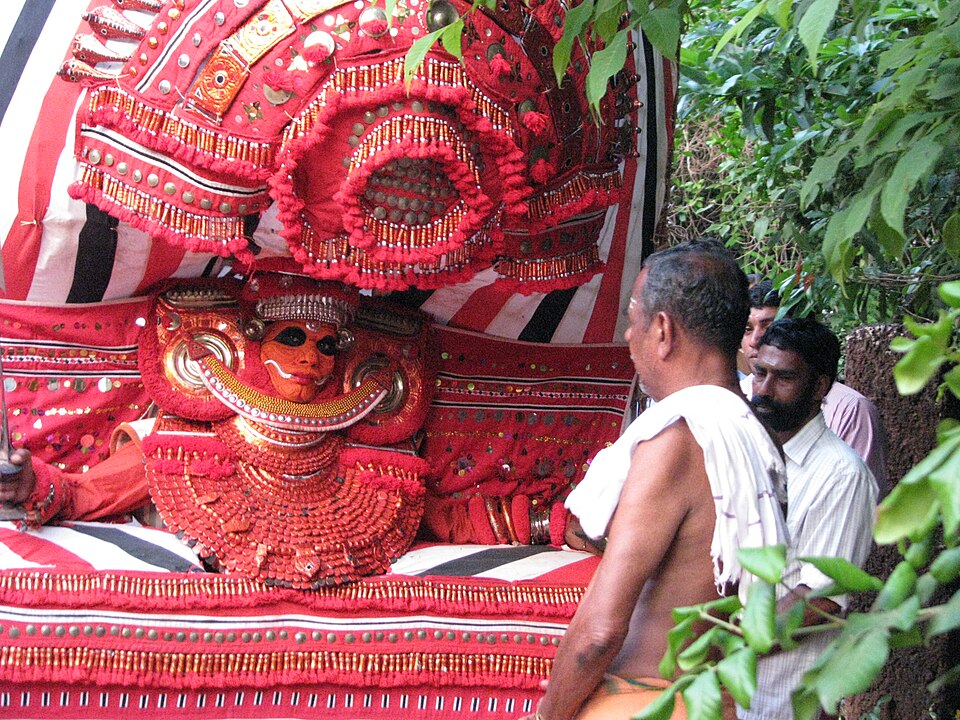
Photo: Shijualex, CC BY-SA 3.0, via Wikimedia Commons
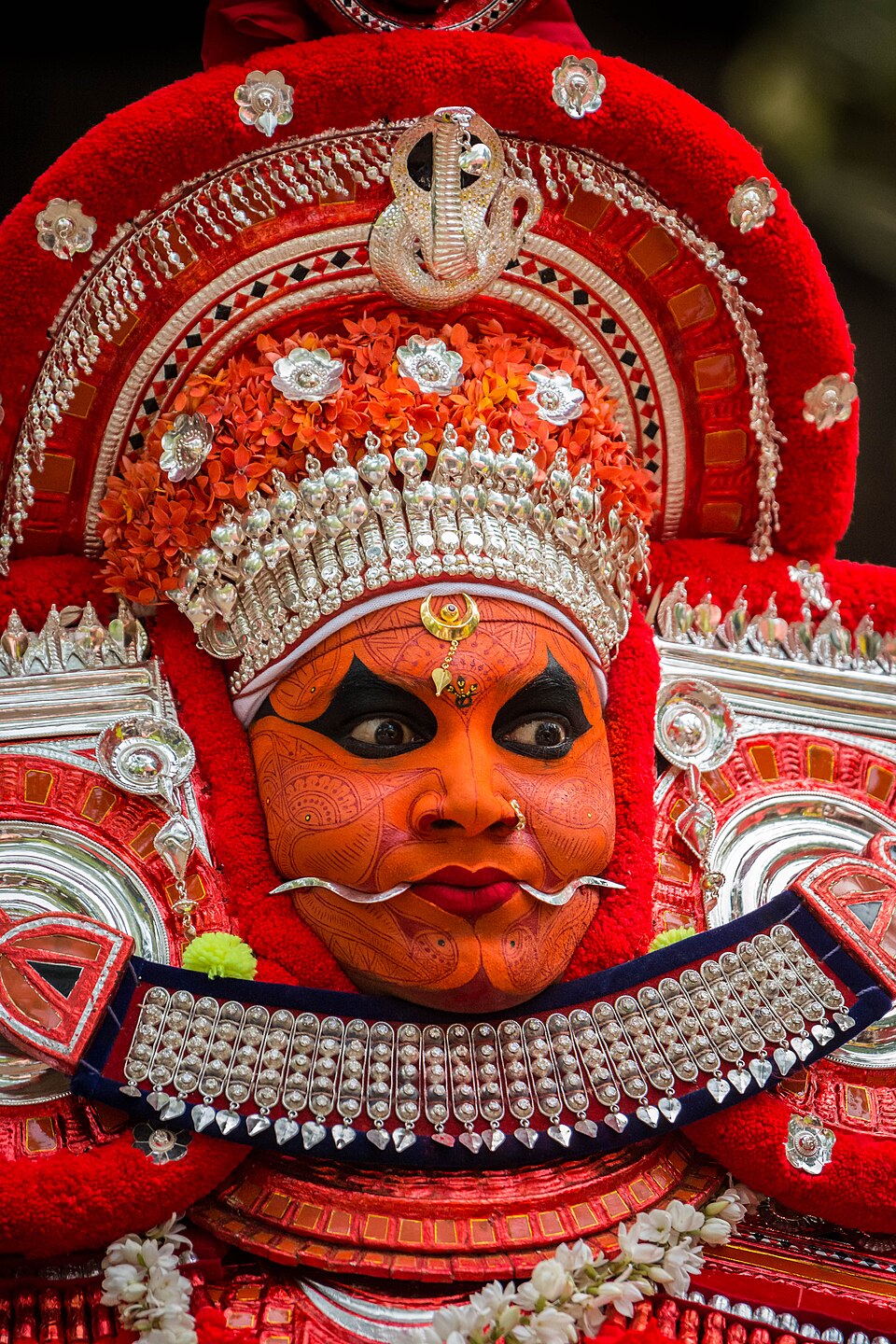
Photo: Lightframer007, CC BY-SA 4.0, via Wikimedia Commons
Kadavankottu Makkam — The Martyrdom of a Mother and the Birth of a Goddess
The legend of Kadavankottu Makkam is perhaps Theyyam's most devastating feminist narrative — a story of domestic conspiracy, patriarchal "honour," and the murder of a mother and her children by the very family sworn to protect them. It is preserved in the Thottam Pattu (ritual ballad), sung before the performance in a long, lamenting recitation that ensures every community member understands exactly why this deity exists and exactly who is responsible for what she became.
Makkam was born as the treasured only daughter of the Kadangot Nambiar family in Kunhimangalam, near Payyannur. In the matrilineal (Marumakkathayam) society of the time, a daughter was essential for the continuation of the family name — and Makkam, arriving after twelve sons, was beloved by all. She married her maternal uncle's son, Kuttinambar, and gave birth to twins: a boy and a girl named Chathu and Chiru.
The tragedy began when Makkam's mother died and her husband fell ill. Suddenly unprotected, she became vulnerable to the jealousy of her eleven older brothers' wives — who feared that the brothers' deep love for Makkam would see her children inherit the family wealth. In a period when the brothers were away at war, a Vaniyan (oil-monger) arrived to deliver oil for the family deity. Because Makkam was menstruating — ritually impure by the norms of the time — she could not personally receive the oil. She asked her sisters-in-law for help. They refused, forcing her to instruct the Vaniyan to enter the house himself.
The sisters-in-law saw their opportunity. As the Vaniyan emerged, they raised an outcry, accusing Makkam of an illicit affair. When the brothers returned, the wives convinced them that Makkam had shamed the family's "splendour." Blinded by a misguided sense of masculine honour — the same honour that had never protected Makkam when she genuinely needed it — the eleven older brothers resolved to eliminate Makkam and her children. Only the youngest brother, Kuti Rama, protested.
Under the pretence of taking her to a festival, the brothers led Makkam and her children on a long journey. Makkam, possessing a foresight the narrative frames as divine, sensed the truth — but chose not to resist, instead praying at every temple they passed, making her innocence visible to any god who might witness it. At a well near Kayalode Achankarappalli, her brothers instructed her to look into the water to see a "divine lamp." As she bent forward, they beheaded her and killed her two children, dumping the bodies into the well. A Mavilan man who witnessed the act was also killed to prevent the story from emerging.
Her spirit did not accept silence. The ancestral home was consumed by fire. The eleven brothers and their wives died through mysterious and terrible means. Makkam appeared in a dream to the kind woman at Chala who had given them milk on the journey, requesting a shrine. Today, the Makkappothi Theyyam performance stages the full enormity of this story: the male performer carries two small dolls representing the murdered children, embodying a mother whose only power in life was the love she was destroyed for having.
Muchilottu Bhagavathy — The Intellectual Rebellion That Became Divine


Where Makkam's story is one of domestic terror, Muchilottu Bhagavathy's legend is one of intellectual warfare — a woman whose brilliance threatened the male monopoly on sacred knowledge, and who was destroyed not through ignorance but through the weaponisation of sexuality as slander, the oldest tool in the patriarchal arsenal.
Born as Devi into the scholarly Namboothiri family of Rayaramangalathumana in Perinchalloore, she was a child prodigy educated in the Vedas, grammar, and literature. Her knowledge was not merely impressive — it was threatening. When she reached marriageable age, she declared that she would only marry the man who could defeat her in public debate. A group of scholars, led by the elderly Peringellur Mootha Gurukkal, accepted the challenge. For two days, Devi answered every question with precision that left the scholars humiliated.
Faced with the possibility of actual defeat — and the social consequence of being bested by a woman — the scholars resorted to entrapment. They posed two questions they claimed only sexually experienced persons could answer: What is the greatest pleasure in life? and What is the greatest pain? Devi, drawing on her deep knowledge of classical theory and biological reality, answered: Sringara (erotic love) and Prasava Vedana (labour pain). The scholars immediately declared she was unchaste. Her family, unwilling to investigate the truth, expelled her from the village.
Devi walked to Karivellur and chose to prove her purity through self-immolation. When the fire was insufficient, a Vaniya man of the Muchilottu clan — who was carrying oil to a temple — recognised her divinity and poured the oil onto the pyre. She blessed him and disappeared into the flames. The Vaniya community subsequently deified her as Muchilottu Bhagavathy, the scholar-goddess, and she became one of Theyyam's most aesthetically elaborate forms: gentle in demeanour, but carrying within that gentleness the full, terrible weight of what was done to her.
Neeliyar Bhagavathy & Puli Bhagavathy — The War Cry of the Dispossessed
Neeliyar Bhagavathy — The Slave Who Learned the Puranas
The story of Neeliyar Bhagavathy intersects the feminist and caste critiques of Theyyam with particular clarity. Neeli was a slave woman (Adiyar) of extraordinary memory and intelligence who, through listening to recitations in the households she served, had memorised large portions of the Puranas — sacred texts considered the exclusive domain of upper-caste male scholars. Her knowledge was not acknowledged as learning. It was classified as transgression.
She was killed for knowing what she was not permitted to know. Her spirit — initially a violent, uncontrollable force described in the oral tradition as a "vortex of trauma" — haunted the rulers who had killed her and the community that had sanctioned their action. Eventually, through ritual propitiation, her spirit was transformed into Neeliyar Bhagavathy: a fierce but now structured deity, whose performance continues to hold the community accountable for what was done in its name. The knowledge they killed her for, she now dispenses as goddess — in judgements, blessings, and curses that the very community which destroyed her now seeks.
Puli Bhagavathy Theyyam — The Tiger Goddess
Puli Bhagavathy — the Tiger Goddess — represents a different register of female divine power in Theyyam's spectrum. Where Muchilottu Bhagavathy's power is that of suppressed intellect and Makkam's is that of betrayed maternal love, Puli Bhagavathy embodies the raw, sovereign power of the forest predator: untameable, non-negotiating, territorial. Her striking black-and-red tiger-stripe face paint is one of Theyyam's most immediately recognisable visual vocabularies — a declaration of power that requires no story of victimhood to justify it.
The tiger in Kerala's cultural imagination is a figure of absolute sovereignty — a being that acknowledges no hierarchy above itself. By embodying this power in a female deity, Puli Bhagavathy posits a model of female divine authority that is pre-patriarchal, pre-social, rooted in natural rather than social order. She belongs to the mode of the goddess who is not elevated through suffering but simply is — sovereign, fierce, demanding nothing because she can take what she requires.
Vasoorimala Theyyam — The Protective Mother Against Disease
Vasoorimala represents the protective-maternal dimension of Theyyam's divine feminine spectrum. Her domain is disease prevention — particularly smallpox and related afflictions that historically devastated communities without warning or explanation. In Kerala's folk medical understanding, epidemic disease was not merely physiological but was connected to the state of the community's spiritual relationships — including its relationship with powerful female deities who had the power both to inflict and to prevent affliction.
The propitiation of Vasoorimala through Theyyam performance was thus simultaneously a medical and a social act: the community acknowledging its obligations to this divine feminine power and, through the ritual, re-establishing the relationship that maintained community health. Her elaborate golden ornamental costume marks her as a guardian deity — one whose power is available to the community that properly honours her. She represents the dimension of female divine authority that is less about the redress of past injustice and more about the maintenance of present wellbeing.
Gender Performativity — When the Male Body Becomes the Goddess
"In Theyyam, gender is not what you are but what you do — and what is done to you, in costume and trance and fire, by a tradition that has always known that divinity requires no particular body to manifest."
Judith Butler's concept of gender performativity offers a productive framework for understanding what happens when a male Kolan (performer) embodies Kadavankottu Makkam or Muchilottu Bhagavathy. For Butler, gender is not an expression of an inner essence but a "stylised repetition of acts" — a performance that creates the illusion of a stable, coherent gender identity through its repetition over time. Theyyam literalises this insight in a way that Butler's theory only addresses abstractly.
The transformation from male performer to female deity is effected through exactly the mechanisms Butler identifies: specific gestures, specific vocal registers, specific costumes, specific ornamentation. But in Theyyam, this is not merely a theoretical point about the constructed nature of gender — it is a sacred necessity. The deity requires a body. That body is, in the ritual context, not male or female in any social sense. It is divine. The category that matters is not the performer's biological sex but the goddess's spiritual reality — which the performance brings into being through exactly this process of stylised, sacred repetition.
The Ritual Process of Transformation
A period of rigorous self-discipline lasting up to 41 days. The performer maintains a vegetarian diet, abstains from alcohol and sexual activity, and increasingly isolates from ordinary social life. This is not theatrical preparation — it is an ontological transition, gradually thinning the boundary between the performer's personal consciousness and the deity's being.
The first stage of performance, conducted without the full costume or crown. The performer sings the Thottam Pattu — the deity's origin ballad — recounting her history in full. For female Theyyam forms, this can take many hours and constitutes the entire story of the deity's earthly suffering and deification. The community hears the full narrative before witnessing the divine embodiment.
An intricate process using natural pigments — rice flour, turmeric, charcoal, and specific plant-based dyes — applied over hours by skilled practitioners. The face paint is not decorative: it is a visual system for encoding the deity's specific character. For fierce female goddesses, aggressive red patterns predominate. For gentle forms like Muchilottu Bhagavathy, more serene patterns are used. The painting process is itself a meditation, gradually replacing the performer's personal face with the goddess's.
The culminating act: the sacred Mudi (headgear), sometimes reaching extraordinary heights, is placed on the performer. At this moment, the deity is believed to inhabit the body. The performer takes the hand-held mirror (Mukhadarshanam) and gazes at his own reflection — seeing not himself but the goddess. From this moment, those who approach are approaching the deity, not the performer. Devotees kneel. The social hierarchy of the ordinary world is temporarily, completely inverted.
Devakoothu — The Sole Female Performer in 456 Theyyam Forms
Theyyam is documented to have approximately 456 forms. Of these, exactly one is performed by a woman: Devakoothu at the Thekkumbad Koolom Thayakav temple, performed once every two years. The singularity of this exception is itself the feminist argument: one form out of 456 suggests not inclusion but the precise measurement of exclusion.
The Myth of Devakoothu
Devakoothu tells the story of a goddess who descended from Devaloka (the celestial realm) with her companions to pick flowers on the lush island of Thekkumbad. The goddess became lost in the dense creepers (Valli) and was abandoned by her companions. A local villager rescued her, providing shelter and safety. The sage Narada eventually arrived with clothes and ornaments to help her return to the heavens. Moved by the islanders' hospitality, the goddess promised to return every two years to bless them.
The Female Vrata — A More Demanding Penance
| Ritual Element | Requirement for Devakoothu Performer |
|---|---|
| Eligibility | Historically restricted to post-menopausal women, removing the ritual pollution concerns associated with menstruation — demonstrating how even the sole female exception to Theyyam's gender rules is constrained by the same patriarchal body-management ideology |
| Duration of Vrata | 41 days of strict isolation, vegetarianism, and ritual purity — the same duration as male performers, suggesting the penance itself is not gendered, only access to it |
| Sacred Text | Study of the Pallimala — the mantras and ritual procedures specific to this performance |
| The Koochil | A temporary hut of coconut leaves where the performer resides during the festival days, in ritual isolation from the ordinary domestic world |
| Performance Character | Gentle, rhythmic movements accompanied by a soft Chenda rhythm — notably different from the intense, high-energy martial and fire-based movements of male Theyyams |
| Current Performer | M.V. Ambujakshi — who has performed this role across multiple cycles, representing an unbroken continuity of this singular female Theyyam tradition |
The existence of Devakoothu does not represent Theyyam's openness to female participation. It represents its precise structuring of female exclusion: one form is permitted, and that form is gentle, non-threatening, and restricted to women whose bodies are no longer considered a ritual risk. The remaining 455+ forms remain closed. The boundary is not cultural contingency — it is architectural.
Theyyam as Subaltern Archive — Caste, Justice, and the War Cry of the Marginalized
Theyyam is not merely a religious event. It is a mechanism for what scholars of ritual performance call "ritualistic catharsis and social commentary" — a structured space in which historical grievances can be narrated, performed, and publicly acknowledged within a sacred framework that cannot be dismissed as political agitation.
The political logic of Theyyam's deification follows a specific and consistent pattern: those who are murdered by the powerful are resurrected as gods whom the powerful must then worship. This is not theology abstracted from social reality — it is theology generated by social reality, embedding the community's most urgent moral arguments into its most enduring cultural form.
- Pottan Theyyam reenacts a direct confrontation between Adi Shankaracharya (representing Brahmanical philosophical authority) and a Pulayan (untouchable). The Pulayan challenges Shankaracharya's caste pride with a question that the tradition renders as irrefutable: "If you cut us both, won't the blood be red?" The Brahmin philosopher is humbled by the low-caste man. The deity this story creates is worshipped by the community — including its Brahmin members.
- Thottinkara Bhagavathy deifies a Thiyya woman who was murdered for the "transgression" of literacy — killed for knowing how to read in a society that had decided women of her caste should not. Her deification ensures that her intellectual defiance is immortalised in the community's ritual calendar.
- Neeliyar Bhagavathy — the slave woman killed for learning the Puranas — transforms the very knowledge she was killed for having into the source of her divine authority. As goddess, she teaches what as slave she was murdered for knowing.
- Kathivanur Veeran deifies a warrior hero of lower-caste origin who was betrayed by a feudal lord's treachery — the same class of feudal lord who historically patronised and therefore controlled Theyyam performances. The deity the lord must worship is the man his predecessor murdered.
"Theyyam is not merely remembering the dead. It is allowing the dead to speak — with full divine authority — to the living descendants of those who silenced them."
— KeralaFolklore.com analysis, drawing from oral traditionThe Visual Vocabulary of the Female Divine
The aesthetic of a female Theyyam form is a carefully codified language of symbols developed over centuries. Every visual element communicates the deity's specific mythological origin, emotional register, and relationship to the community. The following table provides a key to reading this visual language:
| Ritual Attribute | Application in Female Theyyam | Symbolic Significance |
|---|---|---|
| Red (Chuvappu) | Dominant colour in face paint and costume for fierce goddesses | Shakti, blood, sacrificial fire, fertile energy, anger — the colour of the divine feminine in its active, demanding mode |
| Wooden/Coconut Breastplates | Worn by male performers embodying mother goddesses | The maternal aspect of the goddess — the body's capacity for nourishment and protection physically added to a male torso |
| Bamboo Mudi (Crown) | Elaborate structures sometimes reaching 42 feet, decorated with coconut leaves and red cloth | The deity's cosmic height — the physical manifestation of the goddess's authority extending beyond the human scale |
| Ekir (Fangs) | Small silver or wooden protrusions from the mouth | The Rudra aspect — the fierce, consuming dimension of divine feminine power hidden within a gentle or beautiful form |
| Fire Torches | Carried by fierce goddesses such as Rakthachamundi and Puli Bhagavathy | The power to incinerate evil and cleanse contamination — fire as both weapon and purifier |
| Hand-Held Mirror | Used by Muchilottu Bhagavathy and several other female forms | Commemorates the ritual moment of self-recognition — the performer seeing the goddess, the goddess seeing herself — and in Muchilottu's tradition, her reflection in the well where she first manifested after death |
| Tiger-Stripe Paint | Distinctive face paint of Puli Bhagavathy | Forest sovereignty, predatory power, freedom from social hierarchy — the goddess who answers to no human order |
Contemporary Feminist Challenges — Breaking the Ritual Boundary
As Theyyam moves through the 21st century, it faces an intensifying set of challenges that place its traditional gender boundaries under unprecedented scrutiny. Modern feminist voices in Kerala are increasingly asking a question that the tradition's own internal logic invites: if Theyyam was created to honour and embody women who were silenced and excluded — why are women themselves excluded from the performance?
The Sabarimala Context
The 2018 Supreme Court ruling allowing women of all ages to enter the Sabarimala temple unleashed a broader cultural conversation about women's access to Kerala's ritual spaces. Critics of Theyyam's gender exclusions draw the parallel explicitly: the same tradition that deifies women for their intellectual courage and moral defiance maintains rules that prevent contemporary women from occupying the performative space that those deified women are supposed to embody. The "fake equality" of Devakoothu — one permitted performance out of 456 — is increasingly read not as inclusion but as its most precisely structured form of exclusion.
Seetha Sathish and the Thirayattam Breakthrough
A significant moment in the evolution of this debate came in 2023, when Seetha Sathish became the first female performer of Thirayattam — a ritual art form closely related to Theyyam, practised in South Malabar, historically an exclusively male performance tradition of Dalit communities. Her entry, encouraged by the master practitioner Peethambaran Moorkkanadu, was both a cultural and a symbolic act: demonstrating that the male monopoly on embodying divine power in ritual performance is not a theological absolute but a social arrangement subject to change.
Seetha's breakthrough has become a catalyst for a broader conversation about gender equality in Kerala's sacred arts. Whether the Theyyam tradition itself will respond remains an open question — one that the tradition's own internal logic, with its centuries of insistence that the oppressed deserve representation and voice, may eventually be unable to answer in the negative.
The Commercialisation Tension
A parallel challenge is the increasing commercialisation of Theyyam through tourism and wealthy temple committees, which critics argue dilutes the tradition's subversive potential. There is a tension between Theyyam as a "living cult" of the marginalised — a tradition whose power derives precisely from its rootedness in the specific grievances of specific communities — and its transformation into a "cultural spectacle" for outside consumption. Once the audience is tourists rather than the community whose ancestors created the deity, does the ritual's political dimension survive? Or does spectacle, inevitably, replace social critique?
Conclusion — The Endurance of Ritual Resistance
Theyyam remains one of India's most powerful examples of what scholars have called an "indigenous archive of the subaltern" — a ritual space where the history of the oppressed is not merely remembered but embodied, where the past is made present through the specific mechanism of divine possession, and where the community is required to reckon with what was done in its name every year.
The female-centric Theyyam forms — from the scholarly Muchilottu Bhagavathy to the betrayed Kadavankottu Makkam, from the murdered Neeliyar to the sovereign Puli Bhagavathy, from the protective Vasoorimala to the isolated Devakoothu — constitute a multi-dimensional archive of female experience in North Kerala's social history. These are not myths. They are memories — given narrative form, given ritual continuity, given a sacred authority that resists suppression precisely because it inhabits the community's most fundamental relationship with the divine.
The central paradox — female power celebrated through male bodies, female trauma processed within a tradition that remains largely closed to women — does not resolve. It persists as a productive tension that the tradition holds, imperfectly, across centuries of social change. What can be said with certainty is this: Theyyam remembers. And what it remembers, it does not permit to be forgotten.
Frequently Asked Questions
What is the feminist significance of Theyyam's female deities?
Who is Kadavankottu Makkam in Theyyam?
Who is Muchilottu Bhagavathy?
Why does a man perform female Theyyam deities?
What is Devakoothu and why is it significant?
What is the caste significance of Theyyam?
References & Academic Sources
- 1Kurup, K.K.N. Theyyam: Ritual Art of North Malabar. Department of Information and Public Relations, Government of Kerala, 1986.
- 2Freeman, Rich. "Performing Possession: Ritual and Consciousness in the Theyyam Complex of Northern Kerala." Asian Folklore Studies, Vol. 55, No. 2. Nanzan University, Japan, 1996.
- 3Butler, Judith. Gender Trouble: Feminism and the Subversion of Identity. Routledge, 1990.
- 4Menon, Dilip. Cultural History of Modern India. Social Science Press, New Delhi, 2006.
- 5Janu, C.K. Mother Goddess Traditions in Kerala Folk Culture. Kerala Sahitya Akademi, Thrissur, 2009.
- 6Gopinath, M.J. "Folk Deities and Social Protest in Kerala." Indian Folklore Research Journal, Vol. 18, 2012.
- 7Kerala Folklore Academy. "Theyyam and Female Deities in North Malabar Folk Traditions." keralafolkloreacademy.org.
- 8Sahapedia. "Theyyam: Gender, Power and Ritual Performance." sahapedia.org/theyyam.
- 9Chopra, Radhika (Ed.). Reframing Gender in South Asian Rituals. Routledge India, 2014.
- 10Bose, N.K. Culture and Society in India. Asia Publishing House, Bombay, 1967.
- 11Spivak, Gayatri Chakravorty. "Can the Subaltern Speak?" In Nelson & Grossberg (Eds.), Marxism and the Interpretation of Culture. Macmillan, 1988.
- 12Gordon, Avery F. Ghostly Matters: Haunting and the Sociological Imagination. University of Minnesota Press, 1997.
- Img 1Uajith. "Puli Bhagavathy Theyyam." Wikimedia Commons. commons.wikimedia.org. CC BY-SA 4.0.
- Img 2Shijualex. "Neeliyar Bhagavathy Theyyam." Wikimedia Commons. commons.wikimedia.org. CC BY-SA 3.0.
- Img 3Lightframer007. "Vasoorimala Theyyam." Wikimedia Commons. commons.wikimedia.org. CC BY-SA 4.0.