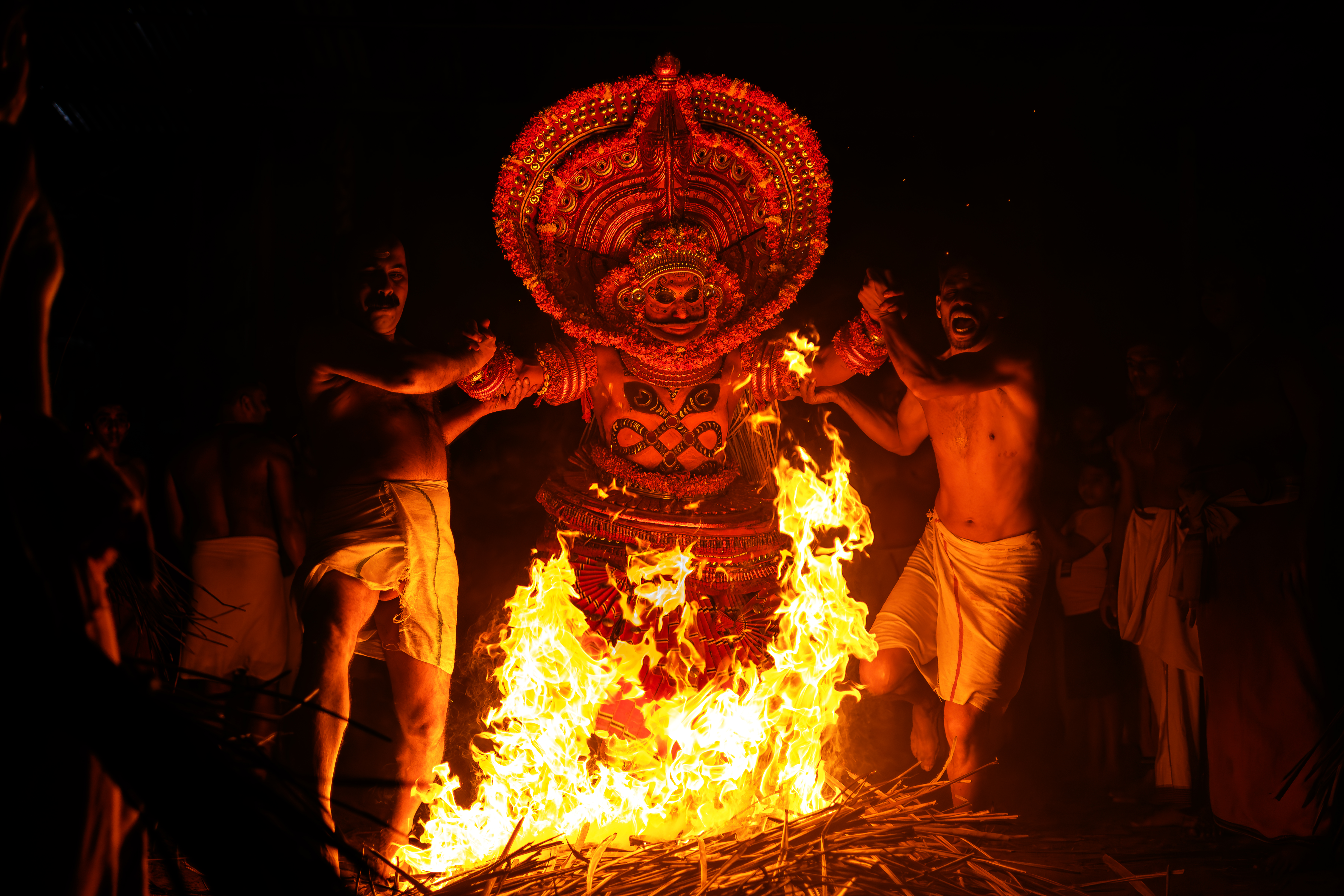
Theyyam is North Malabar's living tradition of divine embodiment — where over 400 distinct deities and ancestral spirits descend into the bodies of hereditary performers. Among them, Bhairavan Theyyam occupies a position of singular cosmic power: it embodies Bhairava, Shiva's most fierce and terrible form, the deity associated with cosmic time, destruction, and the absolute limit of all things. To witness it is to witness, according to the tradition's own understanding, the descent of that power into the world.
The Mythology — Bhairava, Shiva's Fierce Cosmic Form
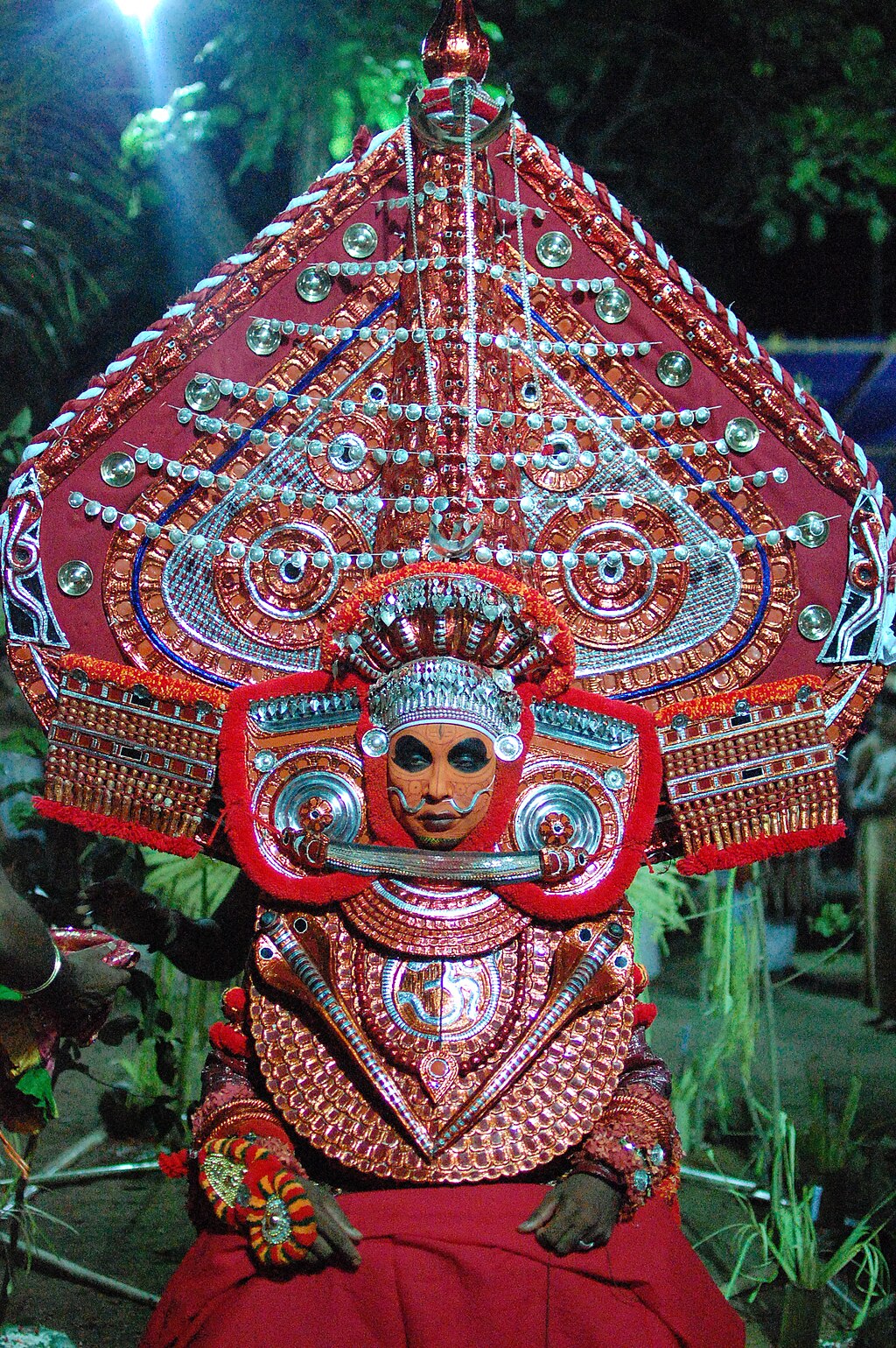
In Hindu cosmology, Bhairava is one of Shiva's most powerful and fearsome manifestations — the destroyer-ascetic who roams the cremation grounds, wears a skull garland, carries the severed head of Brahma, and represents the absolute boundary of time and existence. The word Bhairava derives from the Sanskrit root meaning "terrible" or "frightful" — and the deity's iconography in both classical temple tradition and in the Theyyam ritual embodies that quality in its fullest cosmic dimension.
Bhairavan Theyyam belongs to the Mantra Murti category of Theyyam deities — those of exceptionally intense divine power whose manifestation is considered especially charged and whose ritual requires the most stringent preparation. The tradition recognises eight distinct forms of Bhairava embedded in this Theyyam, including the widely revered Kala Bhairava (Lord of Time) and Kapala Bhairava (the Skull-Bearer) — two of the eight Bhairavas described in classical Shaivite texts.
The narrative lineage of Bhairavan Theyyam is historically connected to Tamil literature — specifically the Periya Puranam, the 12th-century Tamil Shaivite hagiography by Sekkizhar. This incorporation of classical pan-Indian Shaivite mythology alongside indigenous North Malabar folk traditions demonstrates the remarkable cultural synthesis that makes Theyyam unique: it is simultaneously a local village ritual and a carrier of classical Sanskrit theology, both at once, neither diminished by the other.
"The cosmological understanding in North Malabar holds that divinity is not a distant, abstract force confined to the temple sanctum, but rather a protective power that actively manifests among the community, listens directly to sorrows, and safeguards the land."
— Freeman, J. R. (1991). Purity and Violence: Sacred Power in the Theyyam Worship of MalabarThe performer of Bhairavan Theyyam wears the ascetic beggar's garb associated with Shiva's Bhairava incarnation — a deliberate visual statement of cosmic paradox: the most powerless-appearing figure (a wandering beggar) is simultaneously the holder of supreme cosmic authority. This paradox is central to Bhairavan's theology and is carefully encoded in every element of the performer's preparation and appearance.
The Performing Communities — Custodians of a Sacred Heritage
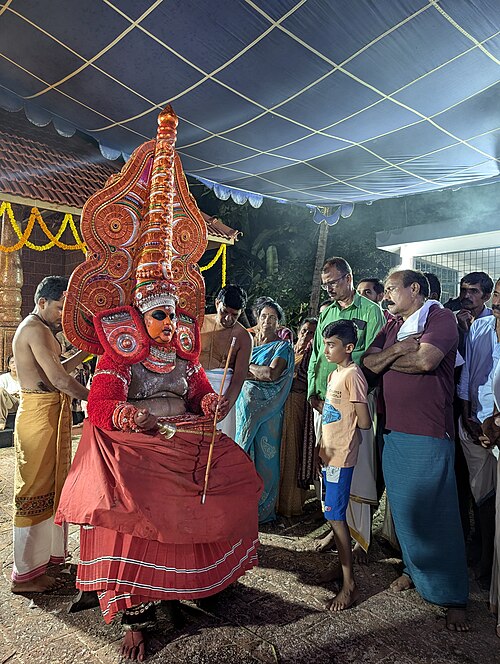
The integrity of Theyyam hinges entirely on the dedication and hereditary rights of specific performing communities. Bhairavan Theyyam is performed primarily by artists from the Malayan and Paanan communities — both Scheduled Caste communities of North Malabar who are the hereditary custodians of numerous Theyyam traditions. The deity is specifically recognised as the prime divinity of the Paanan community, giving their performers a special sanctified relationship with this particular Theyyam.
These communities are the chief performers and hereditary custodians of nearly 400 different Theyyams across the region. Their knowledge — the specific Thottam Pattu verses for each deity, the precise Mukhathezhuthu designs, the order of ritual steps, the mantras recited at each stage — is transmitted through generations of direct apprenticeship within families. This makes the performing communities not merely artistic practitioners but living archives of an extraordinarily complex cultural and theological tradition.
The Sacred Inversion of Social Hierarchy
A remarkable dynamic exists within the North Malabar social framework: when the Theyyam performer is embodied by the deity, secular power structures are temporarily reversed. Despite potential social or economic disadvantages in daily life, the performer — once the Mudi is placed and the deity manifests — commands absolute respect from all present, regardless of their social standing.
No social power supersedes the Theyyam for any devotee, whether Brahmin, Nambiar, Thiyya, or Malayan. This temporary equalisation of social hierarchy — enacted publicly, witnessed communally, and repeated annually — makes Theyyam one of the most significant forms of ritual social commentary in South Asian cultural tradition. The hereditary performer of a socially marginalised community becomes, for the duration of the ritual, the most powerful person in the sacred space.
Thottam Pattu — The Sacred Invocation Song
Before the main performance begins, the Thottam Pattu (literally, "invocation song") is performed — a ballad sung by the performer or supporting artists that recounts the deity's mythological origins and life story. These chants serve as the narrative prologue that establishes the theological context for the manifestation that follows, maintaining an atmosphere of devotion among devotees.
The function of Thottam Pattu goes beyond recitation. It acts as the primary mechanism for transmitting the historical and theological foundation of the deity, providing the spiritual context necessary for the manifestation. These oral compositions are among the most important repositories of North Malabar's mythological and historical memory — encoding in song the narratives that define each deity's identity, origin, and relationship with the community.
In the case of certain Theyyams — such as Pottan Theyyam — the Thottam Pattu contains strong elements of social satire, using old Malayalam idiom to critique historical caste discrimination. For Bhairavan, the Thottam Pattu draws on the Shaivite narrative tradition of the Periya Puranam, establishing the deity's cosmic authority before the physical transformation begins.
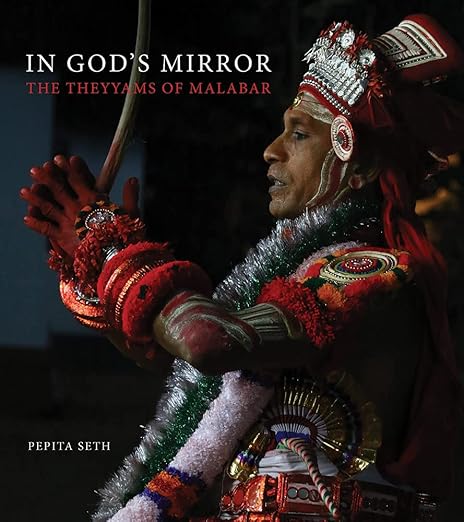
Go deeper into Theyyam's world — from scholarly studies of ritual structure, caste dynamics, and Shaivite mythology to photographic journeys through the kavus of Kannur and Kasaragod. Essential reading for understanding what you witness when Bhairavan descends.
Browse Theyyam Books →Affiliate link — we earn a small commission at no extra cost to you.
The Ritual Transformation — Eight to Ten Hours to Become a God
The physical manifestation of the deity in Bhairavan Theyyam is achieved through a multi-hour process of meticulous preparation that combines art, devotional labour, and specialised aesthetics. The complete process — from the first application of face paint to the placement of the Mudi — typically spans 8 to 10 hours, with chanting of mantras accompanying each stage.
The performer undergoes ritual purification before the preparation begins. The Thottam Pattu is sung, establishing the deity's mythological narrative. Mantras specific to Bhairavan are recited. The sacred space is prepared. This preparatory stage can begin many hours before the main transformation.
The foundation of transformation. Natural pigments are applied in the specific intricate patterns unique to Bhairavan — an art form requiring years of training, demanding pinpoint accuracy. For Bhairavan, the colour palette and line work convey the fierce ascetic-cosmic nature of the deity. The face becomes a sacred canvas communicating divine identity.
The body is decorated with colours and materials that distinguish the deity. The Aniyalangal (sacred ornaments) — Chilambu (leg ornaments), Cudakam and Kaivala (hand ornaments), Talapali (head garment with suspended metal strip) — are applied. These accessories are handmade by the Theyyakkaran (performer) and their team, each element carrying specific theological meaning.
As part of the ceremonial process, the performer consumes madhyam (toddy) — a substance believed to suppress the performer's personal, human consciousness, allowing the pure divine consciousness of the devatha to fully manifest. This act marks the progressive surrender of the mortal self to the incoming deity.
The placement of the Mudi (sacred headgear) is the climax — the precise moment when the deity is believed to enter the performer's body. For major deities, the Mudi can reach 50–60 feet in height, constructed from bamboo, areca nut palms, and coconut leaves. Night performances (Vellattam) use a smaller Mudi; day performances employ the full towering version.
The philosophical foundation of this transformation is described in texts such as the Yoga Vasistha — the concept of parakāya praveśanam: the entry of a divine entity into a human body. The performance rests on the community's conviction that immortal spirits temporarily inhabit a mortal body to perform a ritual dance of divine revelation. This direct, accessible manifestation — the deity present among the people, blessing them, hearing their sorrows, pronouncing judgements — ensures that Theyyam remains far more than an art form. It is a living spiritual institution.
Mukhathezhuthu — The Sacred Art of Divine Appearance
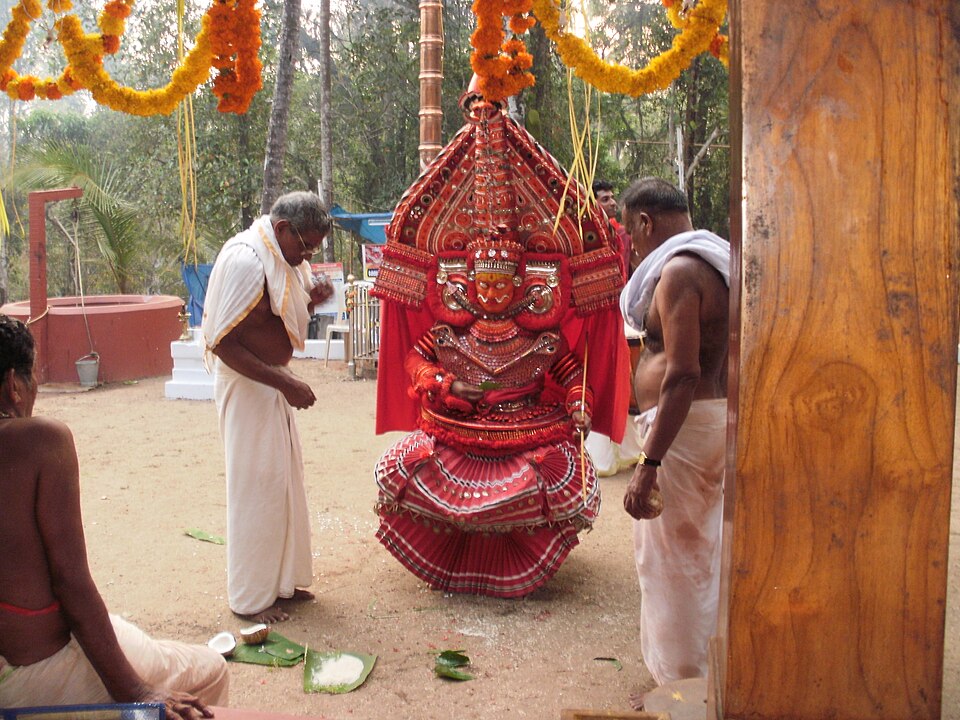
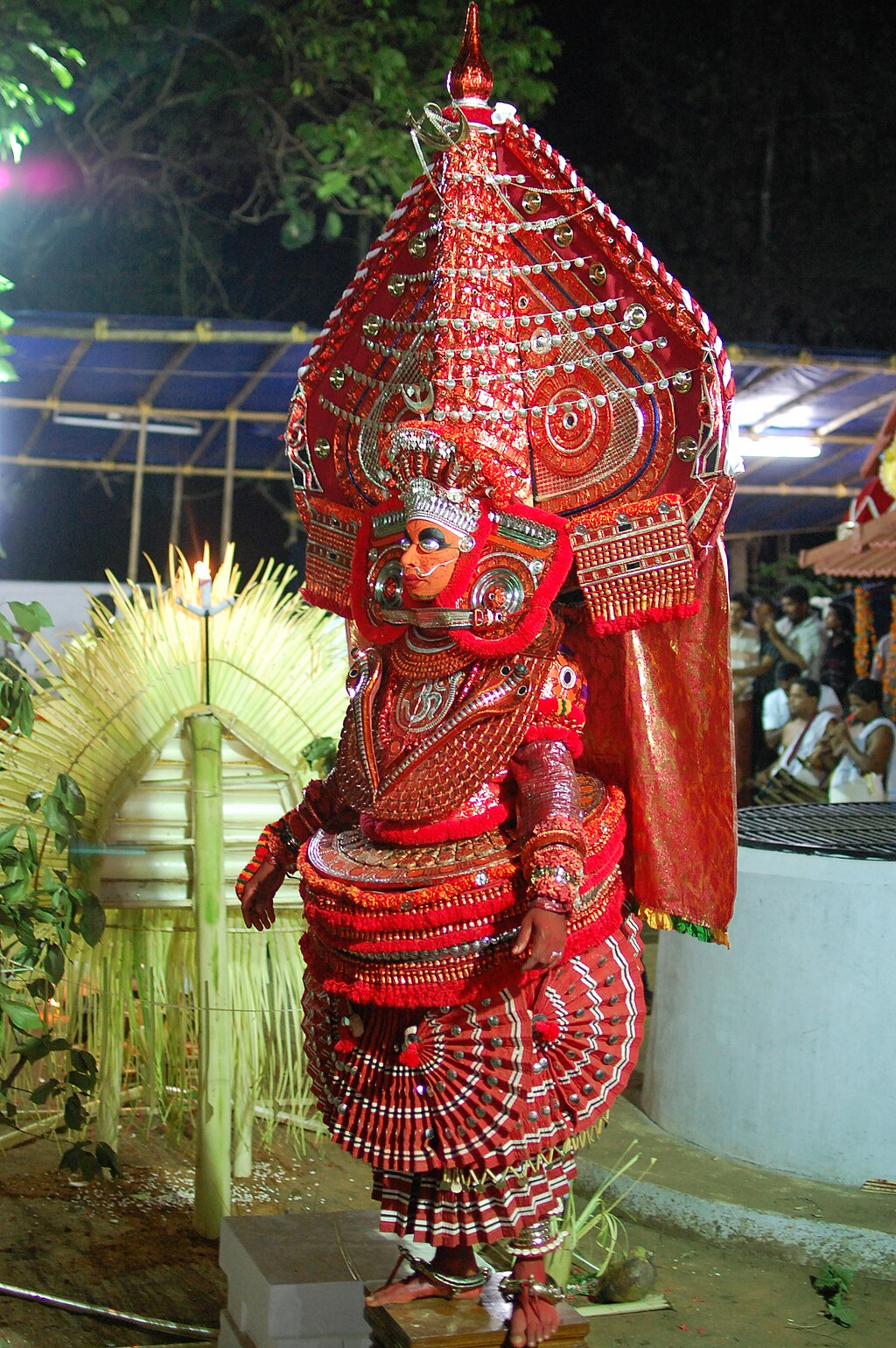
The Mukhathezhuthu of Bhairavan Theyyam is one of the most visually striking in the entire Theyyam tradition. Natural pigments — red (chayilyam), black (made from soot), white (rice paste), and yellow (turmeric) — are applied in patterns that have remained consistent across centuries of transmission, each line and colour choice encoding specific theological information about the deity's nature, attributes, and cosmological role.
For Bhairavan, the ascetic-cosmic nature of the deity is encoded visually: the fierce gaze, the exaggerated circular eyes suggesting omniscience, the white patterns against dark backgrounds suggesting the cremation ground aesthetic associated with Shiva's Bhairava form. The face painting is not decorative — it is a portrait of divine identity, executed in a visual language that the community of devotees reads with precision.
Bhairavan Theyyam is typically a night performance (Vellattam) — the ritualistic dances often culminating in the cold, deep hours of the early morning. Night performances use a smaller Mudi than the full towering version used in daytime performances of major festivals. The 4:00 AM timing of some verified performances is characteristic of intense Kolams like Bhairavan and is a critical detail for planning a visit.
The Theyyam Season — When and Where to Witness Bhairavan
The primary Theyyam season in North Malabar runs from November through May each year, following the traditional Malayalam calendar based on lunar and solar cycles. Bhairavan Theyyam typically takes place as a nocturnal performance within this season, often concluding in the pre-dawn hours between midnight and 4:00 AM.
The schedule for each Kavu and Tharavad is set independently by its temple committee, following the Malayalam calendar. This decentralised structure means that no single comprehensive calendar lists every Bhairavan Theyyam performance — planning requires direct contact with individual venues or consultation of the DTPC Kannur and DTPC Kasaragod official schedules.
| Kavu / Temple | District | Historical Note | Scheduling |
|---|---|---|---|
| Karammel Vellora Tharavad Devasthanam | Kannur (Payyannur Taluk) | DTPC-listed major event; verified 4:00 AM Bhairavan performance timing recorded for this venue | Annual — confirm current year dates with DTPC Kannur or Payyannur tourism desk |
| Sree Kuttichathan Madam, Pachapoika | Kannur | Major multi-day festival hosting Bhairavan alongside 50 Kuttichathan Kolams; Secretary: Mr Balan (+91 9747934141) | Annual; dates within 3-day festival window — confirm directly with secretary |
| Kanayi Bhairavan Temple, Moolakaran Tharavad | Kannur | Temple specifically dedicated to Bhairavan; annual date may align with Kaal Bhairav Jayanti (November) | Annual — Kaal Bhairav Jayanti timing varies by year; confirm directly with temple |
| Nileswaram Karinthalam Tharavad Devasthanam | Kasaragod (Nileswaram) | Listed as major Kavu for Bhairavan by Kerala Folklore Academy | Annual — contact local Tharavad committee directly for dates |
| Udinur Sree Pavoor Veedu Tharavad | Kasaragod (Udinur) | Recognised traditional location with regular annual performance | Annual — specific dates require local confirmation |
| Mattannur Malur Aryaparambu Sree Koottakkalam | Kannur (Mattannur) | Prominent annual location listed in DTPC Kannur schedule | Consult DTPC Kannur for confirmed festival window |
Official contacts: DTPC Kannur — dtpckannur.com | Kerala Tourism — keralatourism.org
Many Theyyam performances take place in familial Tharavadu shrines and local Kavus that are not listed in central tourism calendars. The most reliable approach is to contact the specific temple committee or the DTPC office of the relevant district. Schedules are set annually and can change based on local customs and the Malayalam calendar.
Witnessing the Living God — Ethical Spectatorship
Theyyam is fundamentally a living ritual, not a staged folk performance. Understanding this distinction is the first requirement of ethical engagement for any visitor. The Theyyam performer, once the Mudi is placed and the deity manifests, is not a person playing a role — in the tradition's understanding, and in the sincere belief of the devotees present, the performer has ceased to be themselves and become the living deity.
- Prepare for duration: The complete ritual spans 8 to 10 hours. Bhairavan's intense Kolam often culminates in the pre-dawn hours. Arriving early and staying through the full ritual is both practically necessary and respectful of the tradition's structure
- Observe the devotees: At the moment of the deity's blessings and pronouncements, devotees approach with genuine requests and sorrows. This is a deeply personal sacred interaction — observe with silence and give devotees full access to the deity's presence without obstruction or photography intrusion
- Photography with discretion: Conduct any documentation discreetly, ensuring that the devotion and privacy of worshippers are never compromised. Specific sacred moments — particularly the consumption of madhyam and the deity's pronouncements — should generally not be photographed at all
- Dress appropriately: Traditional dress is expected in the sacred space. The same reverence appropriate in any temple setting applies here — arguably more so, since the deity is present not behind a sanctum screen but physically among those gathered
- Support the performing communities: The hereditary performers of Theyyam are the living custodians of this extraordinary tradition. Acknowledging their skill and sacred role — and supporting the cultural institutions that document and preserve this heritage — is part of ethical engagement
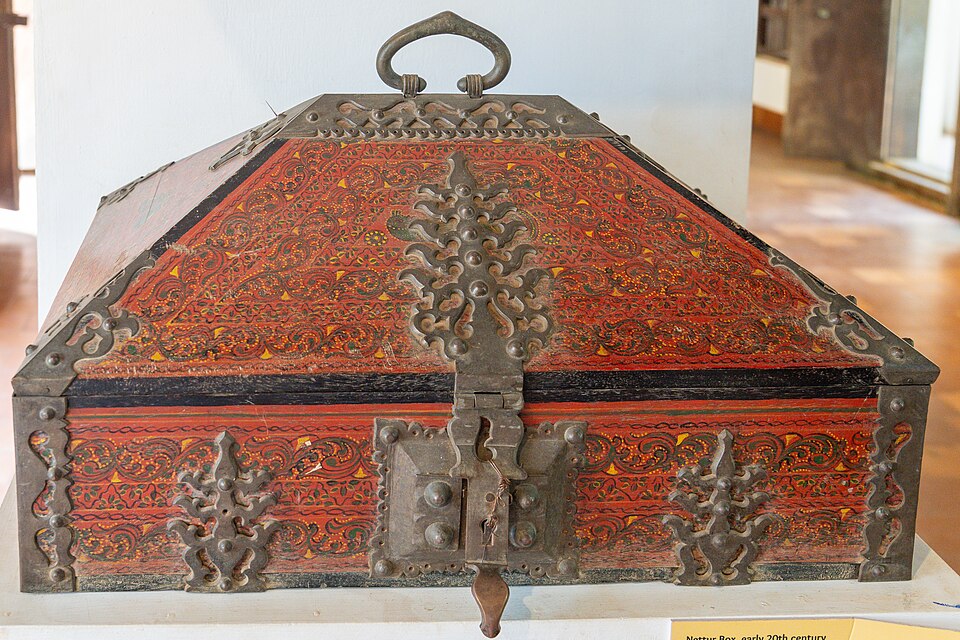
The same cultural tradition that produces Bhairavan Theyyam also produced Kerala's extraordinary craft heritage — Nettur Petti, Aranmula Kannadi, bronze ritual objects, and Theyyam-inspired art. Authentic handcrafted Kerala objects by master artisans, available on Amazon.
Browse Kerala Crafts →Affiliate link — we earn a small commission at no extra cost to you.
Frequently Asked Questions — Bhairavan Theyyam
What is Bhairavan Theyyam?
Who performs Bhairavan Theyyam?
What is the mythology behind Bhairavan Theyyam?
When is the Theyyam season for Bhairavan in Kannur?
What is the significance of the Mudi in Bhairavan Theyyam?
How should visitors respect Bhairavan Theyyam?
References & Image Credits
- 1Freeman, J. R. (1991). "Purity and Violence: Sacred Power in the Theyyam Worship of Malabar." Journal of Ritual Studies, Vol. 5(2), pp. 73–89.
- 2Menon, A. Sreedhara. (2007). A Survey of Kerala History. DC Books, Kottayam.
- 3Panikkar, K. N. (1995). "Cultural Forms and Class Consciousness in Malabar." In Essays on Modern Kerala, P. K. Michael Tharakan (Ed.), pp. 145–168.
- 4Thurston, Edgar. (1909). Castes and Tribes of Southern India, Vol. 5. Madras Government Press.
- 5Nambiar, C. V. (2019). Theyyam: The Ancient Ritual Theatre of Kerala. Kerala Folklore Academy, Kannur.
- 6Kramrisch, Stella. (1981). The Presence of Siva. Princeton University Press.
- 7Kurup, K. K. N. (1986). The Cult of Theyyam and Hero Worship in Kerala. Kerala Historical Society, Trivandrum.
- 8Kerala Folklore Academy. (2023). Official Theyyam Schedule and Classification Data. keralafolkloreacademy.com.
- Img 1Sreejithk2000. "Bhairavan Theyyam." Wikimedia Commons. CC BY-SA 3.0. bhairavan-theyyam1.jpg.
- Img 2Vijayanrajapuram. "Bhairavan Theyyam at Cherakkara Tharavad, Kanhangad." Wikimedia Commons. CC BY-SA 4.0. bhairavan-theyyam-at-cherakkara-tharavad-kanhangad.jpg.
- Img 3Lalsinbox. "Bhairavan Theyyam 3." Wikimedia Commons. CC BY-SA 3.0. bhairavan-theyyam3.jpg.
- Img 4Sreejithk2000. "Bhairavan Theyyam 2." Wikimedia Commons. CC BY-SA 3.0. bhairavan-theyyam2.jpg.