Every sport has a beginning. Kalapoottu's beginning was not a stadium or a governing body — it was a waterlogged paddy field in post-monsoon Kerala, where a farmer discovered that yoking two bullocks to a plank and letting them sprint was both an efficient way to puddle the soil for rice planting and an irresistible spectacle. What started as an agricultural necessity became a ritual, became a celebration, became a contested legal battle, and is now a legally revived cultural sport under the Prevention of Cruelty to Animals (Kerala Amendment) Act, 2025. The mud, the speed, and the community spirit were always there. The law finally caught up with them.
What Is Kalapoottu — The Yoking Competition of Kerala
Kalapoottu (കാളപൂട്ട്) — the word breaks down precisely: kala (paddyfield) and poottu (yoking) — literally means "yoking the paddy field." The formal extension, Kalapoottu Malsaram, adds malsaram (competition), giving us "paddy field yoking competition." The name encodes the entire event: it is a competition that happens in a paddy field and involves a yoke.
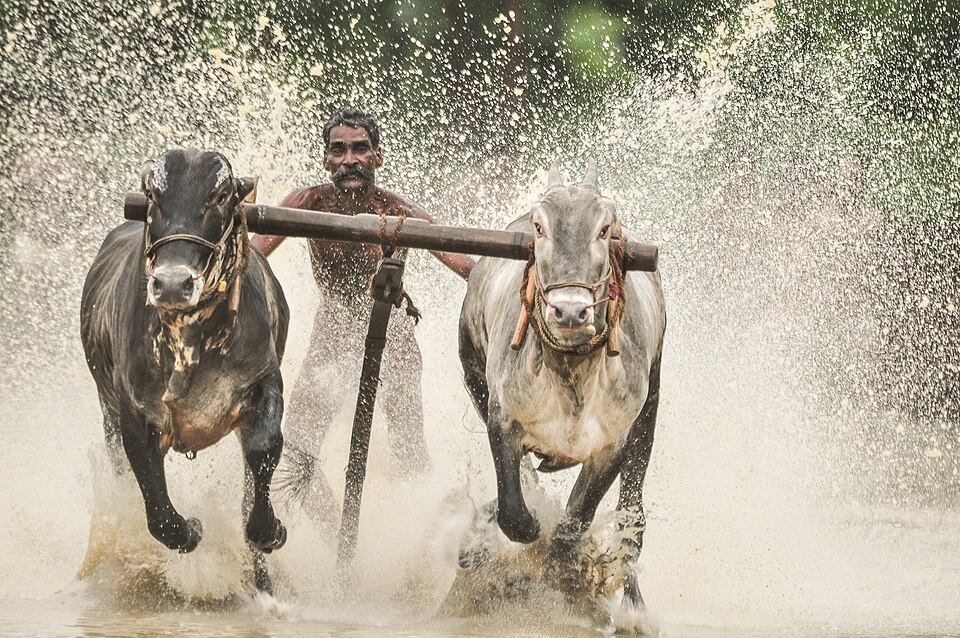
The race format is specific. Two bullocks of comparable size, temperament, and speed are linked by a kalappu (wooden yoke). This yoke is often connected to a thin wooden plank or crossbar on which the jockey stands — or more accurately, surfs — as the animals sprint across the track. The arena is not grass or gravel but a kandam: a stretch of freshly ploughed, waterlogged paddy field, typically several hundred metres long. The bullocks must generate explosive speed while navigating deep mud and standing water. The jockey must simultaneously motivate the animals and maintain balance on the skimming, bouncing plank at full sprint across completely uneven, slippery terrain.
What emerges from this combination of animals, mud, speed, and skill is something genuinely unlike any other competitive sport in the world — which is precisely why the international media term "bull surfing" became attached to it and has stuck. The visual of a person surfing a plank through a flooded field behind two galloping bullocks is so arresting, so unlike anything in the global sporting repertoire, that no other description seemed adequate.
Bull Surfing — The Spectacle That Earned a Global Name
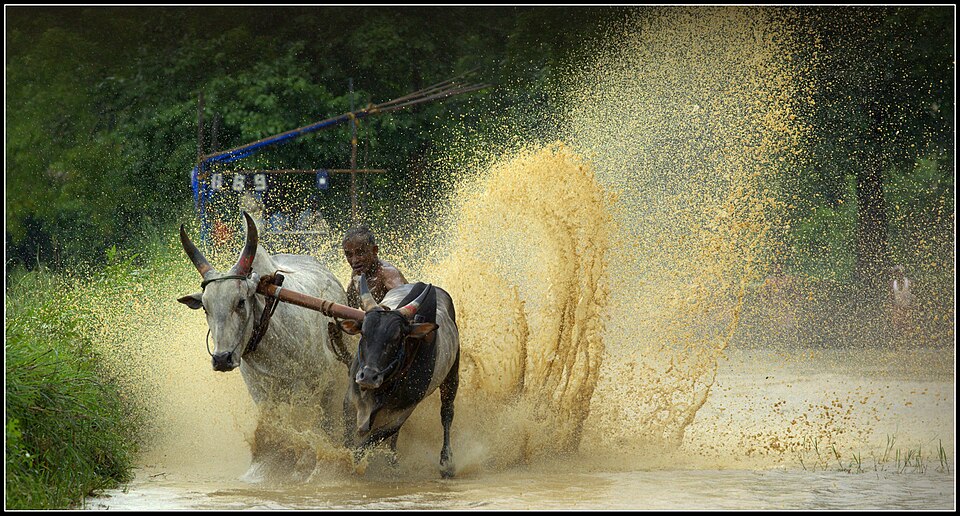
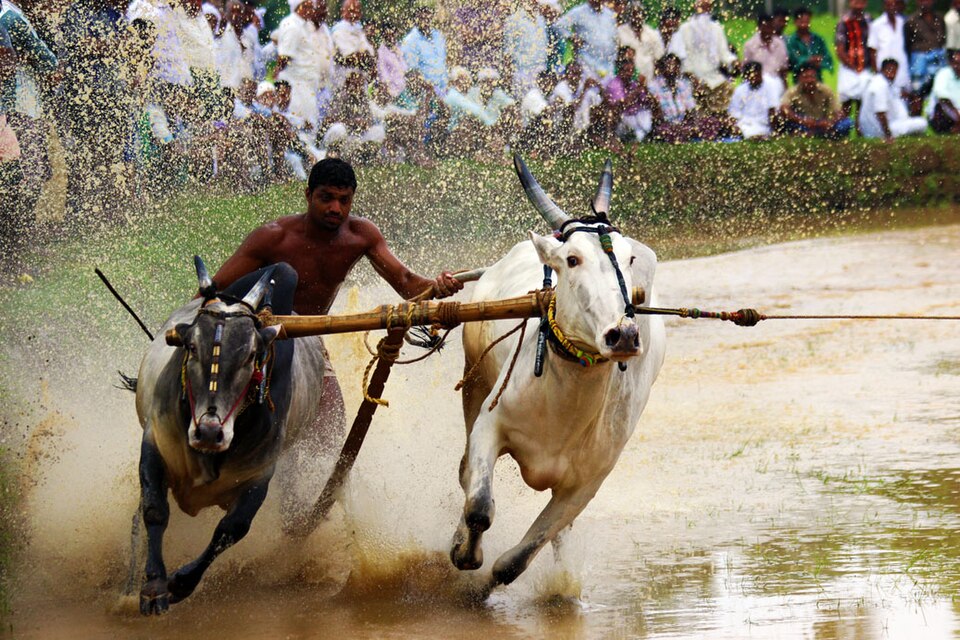
The "bull surfing" label arrived from outside Kerala — from international media and photography platforms that encountered images of Kalapoottu and found that no existing vocabulary described what they were seeing. The image of a human being riding a plank through a flooded field behind two galloping animals at full speed, with mud flying and the paddy field surface acting as a kind of liquid runway, genuinely looks like surfing. And the comparison stuck.
But the local understanding of what the jockey is doing is different from surfing. In surf culture, the surfer reads and responds to a wave that exists independently of their actions. In Kalapoottu, the jockey is simultaneously the navigator, the motivator, and the brake. Their weight distribution on the plank affects the animals' direction. Their commands, physical cues, and the way they hold or release the rope connecting to the yoke all influence the animals' speed and trajectory. The jockey is not a passenger but a partner in a system that requires continuous physical intelligence at full sprint across terrain that punishes any lapse of attention.
"The kandam doesn't care about your balance. The bullock doesn't care about your plan. The only thing that matters in Kalapoottu is the partnership between the jockey and the animal — and that partnership is built over months before the race reaches the field."
A Tradition With Many Names — Regional Identities of the Same Race
Kerala's Kalapoottu tradition is known by multiple names across the state's diverse agro-climatic regions — a multiplicity that reflects not linguistic variation for its own sake but the independent cultural evolution of the same agricultural practice in distinct communities across different geographic zones. Each name carries a specific regional identity and social ownership.
| Local Term | Regional Tendency | Etymology and Specific Context |
|---|---|---|
| Kalapoottu | General / Central Kerala / Official | Kala (paddy field) + poottu (yoking). The most comprehensive formal term, used in legislative documents and academic descriptions. Emphasises the agricultural arena and the mechanical act of yoking. |
| Maramadi | Southern districts (Pathanamthitta, Alappuzha, Thiruvananthapuram, Kollam) | From mara (wood) + madi (strike / plank). Refers specifically to the wooden plank (kalappu) on which the jockey rides — emphasising the distinctive equipment that gives the event its "surfing" visual quality. |
| Kannupoottu | Northern districts (Malappuram, Kozhikode, Kannur) | From kannu (eye, but here referring to the front of the yoke) + poottu (yoking). Emphasises the yoking mechanism from a different directional perspective, reflecting Malabar's distinct agricultural vocabulary. |
| Pothottam | General / Descriptive across regions | From pothu (bull/bullock) + ottam (race/run). The most straightforwardly descriptive term: "bullock race." Used colloquially across regions without specific geographic identity. |
| Uzhavu | Legislative / Formal documents | The Sanskrit-rooted Malayalam word for ploughing. Used in the 2025 Kerala Amendment Act to frame the tradition as an agricultural practice rather than performance — a legally strategic choice. |
Agrarian Origins — When Farming Became Sport
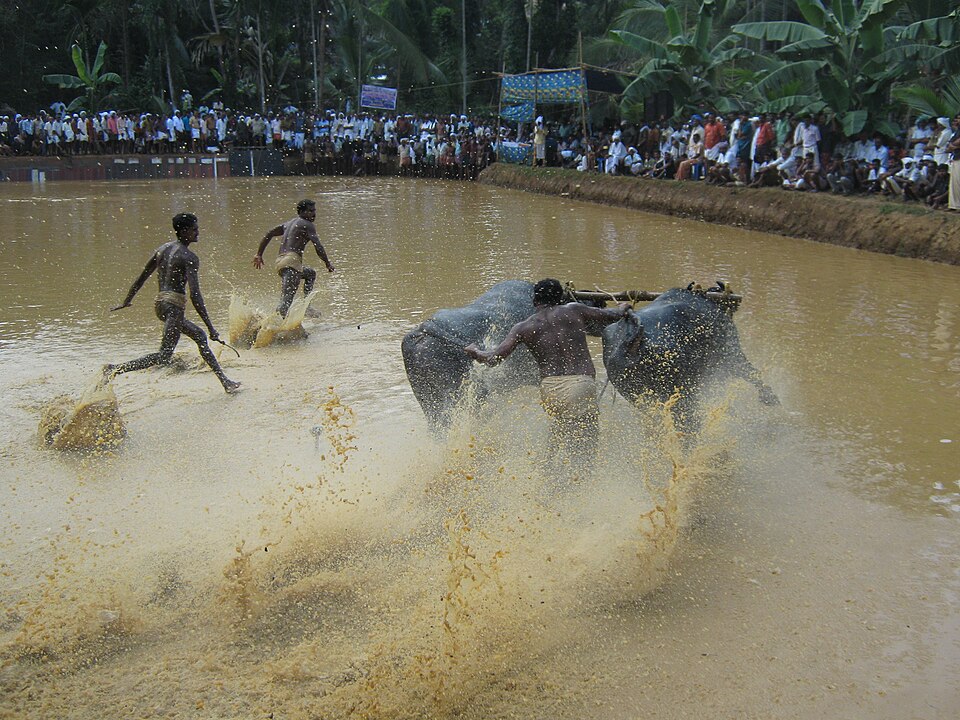
The genius of Kalapoottu's origin story — and it is genuinely ingenious — is that it converts a labour-intensive agricultural necessity into a competitive spectacle that nobody has to be persuaded to participate in or attend.
The problem it originally solved was specific: after the heavy Southwest Monsoon subsides in Kerala (typically September–October), paddy fields are waterlogged and deeply muddy. Before rice can be planted for the Mundakan (second crop) season, this soil must be puddled — broken up, churned, and prepared into the correct substrate for transplanting. This is physically demanding work for both farmer and animal, and must happen within a narrow seasonal window before the planting deadline.
The Kalapoottu solution: yoke the two strongest bullocks to the heaviest plank, and make them run as fast as possible across the field. Their weight, their speed, and the plank's dragging action churn the soil far more efficiently than a methodical ploughing pass. Multiple runs across the field — as in a competitive event — achieve thorough puddling. The competitive element ensured that farmers selected and trained their fastest, most powerful animals. The social element — prize money, prestige, community gathering — ensured that everyone participated and everyone watched, maximising the social return on an agricultural activity that would have to happen regardless.
This timing also placed Kalapoottu at exactly the right moment in the agricultural and social calendar. The monsoon's end is Kerala's great seasonal transition — from the lean, wet, indoor months of Karkidakam into the prosperous, clear, harvest-approaching season of Chingam and beyond. Kalapoottu, held right at this transition, became a celebration of that passage — a community affirmation that the hard monsoon months were over and the productive season had arrived. The races that followed Onam in some regions extended this festive logic into the post-harvest period.
The timing of Kalapoottu within the agricultural year was not casual — it aligned precisely with the Njattuvela system's period indicators for field preparation and second-crop cultivation. The same traditional knowledge framework that told Kerala's farmers when the monsoon's character would change also signalled the correct window for post-monsoon field preparation — and therefore for the Kalapoottu season. The race was embedded in the same temporal fabric as every other agricultural activity.
Kalapoottu in the South Indian Tradition — How Kerala's Race Differs
Kalapoottu belongs to a family of South Indian agrarian livestock sports that reflect the deep cultural relationship between farming communities and their draught and working animals across the region. Understanding how Kerala's tradition relates to and differs from its regional cousins clarifies both its unique character and its shared cultural roots.
| Tradition | State | Animal | Terrain | Format | Legal Status |
|---|---|---|---|---|---|
| Kalapoottu / Maramadi | Kerala | Bullocks (pair, yoked) | Waterlogged paddy field (kandam) | Two bullocks yoked and sprinting; jockey surfs wooden plank behind them | Legalised by Kerala Amendment Act, 2025 |
| Jallikattu (Eruthazhuvuthal) | Tamil Nadu | Single bull (untamed) | Open ground / enclosure | Participants attempt to grab prize from charging bull's horns; human-bull confrontation | Legalised by Tamil Nadu Amendment Act, 2017 |
| Kambala | Karnataka | Buffalo pair (yoked) | Flooded rice fields | Very similar to Kalapoottu — buffalo pair yoked and raced across waterlogged fields; jockey behind | Legalised by Karnataka Amendment Act, 2018 |
| Rekla Race | Tamil Nadu | Bullocks pulling cart | Dry track | Bullock cart races on dry or semi-dry tracks; driver seated in cart, not surfing | Regulated under Tamil Nadu laws |
| Bail Gadi (Bullock Cart Race) | Maharashtra, Goa | Bullocks pulling cart | Dry track | Traditional bullock cart racing — vehicle-based, not plank-surfing | Varied legal status by state |
The comparison between Kalapoottu and Karnataka's Kambala is particularly instructive — both involve pairs of animals yoked together racing through flooded fields, and both faced the same central legal prohibition before state-level amendments resolved their status. The difference is animal species (bullocks vs buffalo) and the specific field culture. Kerala's legal approach in 2025 explicitly followed the Karnataka model, using the same constitutional framework to create a state-level exemption from the central PCA Act.
The Race as Living Folklore — Bulls, Heroes, and Community Identity
The Kalapoottu tradition generates its own folklore — a body of oral narrative, community memory, and social mythology that surrounds the race as thickly as the mud surrounds the kandam.
The Racing Bull as Protagonist
In Kerala's Kalapoottu communities, a champion racing bull is not merely a productive farm animal. It is a protagonist — a character with a name, a lineage, a reputation, and a following. Oral traditions in racing villages document the histories of famous bull pairs with the kind of detailed narrative usually reserved for human heroes: their first race, their greatest victory, the race they won against impossible odds, their temperament and their quirks. Bull owners speak of their animals' personalities with an intimacy that reflects years of close daily contact and the social stakes involved in their performance.
A winning bull pair elevates its owner's social status in ways that persist long after the race is over. The prestige is not abstract — it translates into real social capital: greater influence in village decisions, enhanced standing in negotiations, increased demand for the bull's breeding services. The race is the public declaration of a farmer's competence, investment, and community identity all at once.
The Jockey — Strength, Skill, and Rural Masculinity
The Kalapoottu jockey occupies a specific cultural role in the agricultural community — one that combines the respect accorded to skilled labour with the admiration given to athletic achievement. Steering two powerful, sprinting bullocks across a deeply ploughed, waterlogged field while maintaining balance on a wooden plank at full sprint requires a specific combination of physical strength, reflexes, animal understanding, and the ability to perform under intense community scrutiny.
Successful jockeys become celebrated figures in their communities — their performances discussed in the agricultural equivalent of sports commentary: how they managed the turn, how they kept the pair in line across the muddy section, how they pushed through when the field deepened. Their skill is understood as a proxy for the village's strength and agricultural vitality, making the jockey's performance a representation of the community as a whole, not merely an individual achievement.
The Legal Battle — A Decade of Prohibition
The story of Kalapoottu's prohibition and revival is the story of a fundamental tension in modern Indian law: the conflict between animal welfare legislation designed for one context (prevention of deliberately cruel animal performance) and traditional agricultural and cultural practices that emerged from an entirely different relationship between humans and working animals.
The Central Government issued a notification banning the exhibition and training of bulls (along with five other animal species) as performing animals under the Prevention of Cruelty to Animals (PCA) Act, 1960. This notification laid the legal foundation for challenging traditional bull sports across India, including Kerala's Kalapoottu.
A court ruling determined that the Central Government's 2011 ban applied directly to Kerala's bull race tradition. This was a decisive blow against the legal argument that Kalapoottu was categorically different from other prohibited animal performances. Requests by agriculturist associations for District Collector permissions were subsequently rejected on PCA Act grounds.
The Bull Race Club of India's appeal to the Kerala High Court was dismissed, upholding the ban and confirming that Kalapoottu and Maramadi were prohibited under the PCA Act. PETA India's active legal campaigning — following successful litigation against Jallikattu in Tamil Nadu — contributed to the enforcement climate. Twenty individuals were booked and convicted for organising an illegal race in Thiruvananthapuram.
Tamil Nadu successfully legalised Jallikattu through a state amendment act in 2017, following the massive community protests of January 2017. Karnataka enacted a similar exemption for Kambala in 2018. These precedents provided Kerala with the constitutional roadmap for its own legislative solution — demonstrating that state-level exemptions from the central PCA Act were judicially viable.
The Kerala Legislative Assembly passed the Prevention of Cruelty to Animals (Kerala Amendment) Act, 2025, creating a state-level exemption for Kalapoottu, Maramadi, Kannupoottu, Pothottam, and Uzhavu. The Bill was introduced and passed on the same day — reflecting the intense political and cultural pressure to resolve the decade-long legal deadlock. The Act explicitly justified the exemption on the grounds of preserving agricultural traditions, conserving native cattle breeds, and protecting the livelihoods of cattle keepers.
The 2025 Kerala Amendment Act — Conditional Revival
The Prevention of Cruelty to Animals (Kerala Amendment) Act, 2025 is not a blanket legalisation. It is a conditional exemption — one that requires organisers to meet specific standards before and during every event. Understanding these conditions is essential for anyone involved in organising or attending Kalapoottu events post-revival.
Every Kalapoottu event must obtain prior permission from the District Collector before it can legally proceed. This creates an administrative checkpoint that ensures events are organised under official oversight rather than informally.
All participating animals must possess current veterinary fitness certification — confirming that the bullocks are in good health before competing. This is the primary animal welfare safeguard: no animal in poor health can be compelled to race.
The Act explicitly mandates penal action for any violations of the prescribed rules. The exemption is conditional; events that do not comply with the administrative and veterinary requirements remain illegal and prosecutable.
The 2025 Act inserts a new Section 28A into the central PCA Act, declaring that PCA provisions shall not apply to bull races conducted strictly in accordance with state-prescribed conditions. It also inserts a new clause under Section 3, legally recognising these bull races as a means to "promote agricultural traditions and culture, conserve native breeds, and protect the livelihood of cattle keepers." This legal framing — conservation, livelihood, culture — is both philosophically consistent with the tradition's actual social functions and strategically designed to withstand future animal welfare challenges.
"By legally framing the practice as essential for the conservation of native breeds and the livelihood of traditional keepers, the state strategically constructs a constitutional argument rooted in protecting cultural rights and economic activity — one that is far more robust than a simple cultural exception."
— KeralaFolklore.com analysis of the 2025 Amendment ActNative Cattle Breeds and the Conservation Argument
The 2025 Act's explicit connection between Kalapoottu and the conservation of native cattle breeds is not merely legal rhetoric — it reflects a genuine and important agricultural concern. Kerala is home to several unique indigenous cattle lineages whose survival is increasingly threatened by the displacement of draught cattle by mechanised farm equipment and the preferential breeding of exotic dairy varieties.
- Vechur Cow: The world's smallest cattle breed, native to Vaikam in Kottayam district, Vechur cows are renowned for high-quality milk fat content and disease resistance — but their numbers collapsed to near-extinction before conservation programmes reversed the decline.
- Kasaragod Dwarf Cattle: Another Kerala-specific indigenous breed of small stature and exceptional heat and disease tolerance, similarly threatened by exotic breed displacement.
- Draught Bullocks (Non-Descript / Cross-Bred Racing Lines): The specific bullock types trained for Kalapoottu racing represent an informal breed selection process based on performance in a demanding, specific environment — exactly the kind of selection that, over generations, produces locally adapted traits of value to the agricultural ecosystem.
The argument — that maintaining Kalapoottu as a competitive event with economic prizes creates a specialised market for high-performance draught cattle, thereby making traditional cattle keeping economically viable when it would otherwise be abandoned — is not uniquely Kerala's. It mirrors the conservation arguments made by hunters for game species and by traditional farmers for heritage crop varieties: that the economic mechanism of prestige and competition sustains practices that pure subsistence economics would abandon. The race creates the financial incentive to keep training, breeding, and maintaining draught animals that mechanised farming no longer strictly requires.
Frequently Asked Questions — Kerala Bull Race
What is Kalapoottu?
What is Maramadi?
Is Kalapoottu legal in Kerala?
What is 'bull surfing' in Kerala?
How does Kalapoottu differ from Jallikattu?
What is the cultural significance of Kalapoottu?
References & Image Credits
- 1Government of India. Prevention of Cruelty to Animals Act, 1960. legislative.gov.in.
- 2Kerala Legislative Assembly. Prevention of Cruelty to Animals (Kerala Amendment) Bill, 2025. niyamasabha.nic.in.
- 3Menon, A. Sreedhara. A Survey of Kerala History. DC Books, 2007.
- 4Sasikanth, M.G. "Agrarian Rituals and Rural Competitions in Kerala." Journal of South Indian Folklore Studies, Vol. 12, 2016.
- 5Animal Welfare Board of India. Reports on animal welfare violations and guidelines for cattle sports, 2015–2023. awbi.gov.in.
- 6Mathrubhumi. "Kalapoottu and Rural Sports of Malabar." mathrubhumi.com.
- 7Ramakrishnan, V. Culture, Ecology and Agrarian Systems of Kerala. Centre for Development Studies (CDS), Trivandrum, 2013.
- 8Kerala Veterinary and Animal Sciences University (KVASU). Research on native cattle breeds of Kerala. kvasu.ac.in.
- Img 1Challiyil Eswaramangalath Pavithran Vipin. "Bull race Kerala." CC BY-SA 2.0, via Wikimedia Commons. bull-race-kerala.jpg.
- Img 2Joseph Lazer. "Maramadi." CC BY-SA 2.5 IN, via Wikimedia Commons. maramadi.jpg.
- Img 3Sameerct. "Kerala bull surfing." CC BY 3.0, via Wikimedia Commons. kerala-bull-surfing.jpg.
- Img 4Rafeeq kzr. "Pothu poottu Keezhattoor." Public domain, via Wikimedia Commons. pothu-poottu-keezhattoor.jpg.
- Img 5Mr. Arjunan S Raj, Freelance Photographer. "Bull-race at Pullaloor Village, Kozhikode District." Image courtesy of photographer. cattle-race1.jpg.
- Img 6Mr. Arjunan S Raj, Freelance Photographer. "Cattle race." Image courtesy of photographer. cattle-race2.jpg.