The word coir comes from the Malayalam kayar — twisted fibre. Alappuzha (Alleppey) has been twisting this fibre into the world's finest products since 1859. Before that, the infrastructure was being laid — canals in 1762, a port that would make this district Travancore's primary export hub. Before that, the coconut palms were already there, lining the labyrinthine backwaters whose specific water chemistry would prove to be the decisive ingredient in the most distinctive natural fibre craft in the world. This is not simply an industry. This is a civilisation built on a coconut husk.
A Heritage Forged in Salt — The Industrial Roots of Alleppey Coir
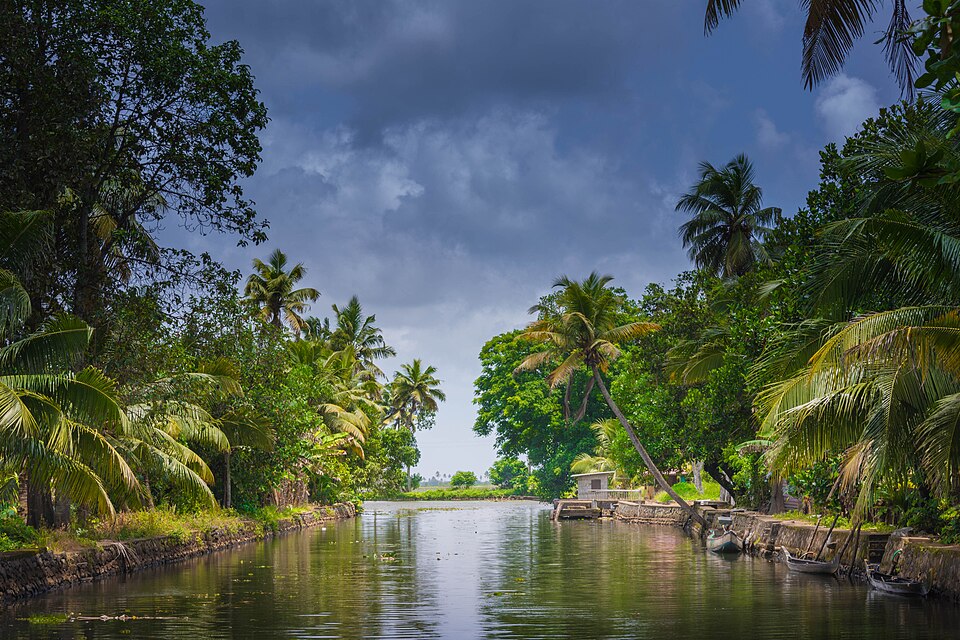
The destiny of Alappuzha as the global centre for coir production was sealed not by accident but by deliberate infrastructural vision. During the reign of Travancore, Alappuzha served as the chief port of the princely state — a position amplified in 1762 when Raja Kesavadas constructed two parallel canals specifically designed to link the backwaters to the port. These canals created an efficient logistics pipeline between the coconut-growing hinterland, the processing waterways, and the export harbour — transforming Alappuzha into Travancore's financial nerve centre, primarily as a depot for coir yarn and matting.
The combination of infrastructure, geography, and raw material abundance attracted international capital at a pace that speaks to the opportunity the location represented. The industrial era began in 1859 when James Darragh — an Irish-born American entrepreneur — established India's first coir factory in Alappuzha, founding Darragh Smail and Company with Henry Smail. This single establishment triggered a rapid succession of over 25 large coir factories over the following decade. William Goodacre and Sons arrived in 1862. Aspinwall and Co. in 1867. Volkart Brothers Company in 1869. In under twenty years, Alappuzha had become the global capital of coir manufacturing — built on foreign capital leveraging geography-dependent local labour.
"This rapid, planned industrialisation immediately oriented the industry toward export. The intense reliance on international markets, established in the mid-19th century, means that the livelihood of the approximately 80,000 workers currently employed in the vicinity remains vulnerable to the erratic fluctuations originating in foreign demand — a structural dependency that continues to define the sector's inconsistent sustainability today."
— KeralaFolklore.com, drawing from Coir Board of India dataWater, Climate, and Certification — The Alchemy of Premium Fibre
The reputation of Alleppey Coir is not marketing. It is geography. The superior quality of the fibre — its distinctive golden-yellow colour, its unusual pliability, its natural resistance to rotting — is a direct and irreproducible consequence of the specific water chemistry of Alappuzha's backwaters and the region's tropical climate. The process that produces this quality is called retting, and it is one of the most patient manufacturing processes in the world.
Retting involves immersing well-matured coconut husks in the brackish backwaters for six to ten months. During this immersion, naturally occurring pectinolytic bacteria and fungi in the water decompose the pectin-rich tissues surrounding the fibre strands through biological action. This slow decomposition loosens the dense fibre pack, making the strands individually separable, naturally fluffy, and chemically treated against decay. The specific microbial community in Alappuzha's backwaters — shaped by the water's salinity, temperature, and biological history — produces a result that cannot be replicated in freshwater, inland water, or artificially treated water.
| Factor | Geographical Element | Impact on Coir Fibre |
|---|---|---|
| Retting Medium | Saline and brackish backwaters (6–10 months) | Pectinolytic bacteria and fungi decompose surrounding tissues, creating pliable, golden-yellow, naturally rot-resistant fibre |
| Raw Material Supply | Abundant coastal coconut palms lining the backwater network | Provides a steady, high-volume, hyperlocal supply of husks with minimal transport cost |
| Processing Infrastructure | Canals and waterways (constructed 1762 onwards) | Facilitates both transport and the immersion-retting process without industrial infrastructure |
| Climate | Tropical humidity, monsoon rainfall, consistent warmth | Sustains the biological decomposition process and accelerates pectinolytic activity at optimal rates |
| GI Certification (2007) | Ambalappuzha and Cherthala taluks, Alappuzha district | Legally protects the geographical process-dependent quality; certifies handloom-produced mats, mattings, and carpets |
This necessary time investment creates the market-differentiating quality that defines Alleppey Coir globally — and in 2007, the Government of India recognised this geographical specificity through a World Trade Organisation (WTO) Geographical Indication (GI) tag for "Alleppey Coir." The GI certification legally protects the authenticity of coir mats, mattings, and carpets produced on handlooms by traditional workers in the Ambalappuzha and Cherthala taluks. It confirms that the specific quality is not a manufacturing technique that can be transplanted — it is a consequence of place itself.
The Hands That Spin the Sea — Living Craftsmanship of Alappuzha Coir
Once the retting process is complete, the husks are ready for defibering — traditionally a labour-intensive phase carried out primarily by women, who beat the retted husk with wooden mallets to extract the golden-yellow fibre within. This physical process — repeated across thousands of households and cooperative workshops throughout the cluster towns — is one of the most visible expressions of the craft's community character. It is not factory work. It is skilled, knowledge-dependent manual labour that requires experienced hands.
The complete manufacturing process involves seven defined steps: sorting, dyeing, winding, warping and beaming, weaving, finishing, and bundling. While certain stages now utilise modern machinery, the core craft — whether hand-spinning yarn or operating a handloom — relies on the artisan's personal skill, accumulated through years of practice. The cluster sustains approximately 25,000 established handlooms and provides livelihoods to about 80,000 workers across Alappuzha, Kayamkulam, Mannancherry, and Cherthala.
Approximately 80% of coir workers are women — making this one of India's most distinctly women-led traditional industries. Women are involved at every stage from defibering through hand-spinning and handloom weaving. Their economic vulnerability when the export market declines, and their persistence in maintaining the craft across generations of inconsistent wages, is the human heart of the coir industry's story. Supporting GI-tagged Alappuzha Coir is directly supporting the economic independence of women in Kerala's backwater communities.
The versatility of Alleppey Coir products reflects both the craft's artistry and its economic adaptability. Products include specialised mats (Creel Mats, Rod Mats, Sinnet Mats, Lovers' Knot Mats), durable carpets, clinical mattresses, natural ropes, garden products, and high-performance geo-textiles for soil erosion control and civil engineering applications. This diversification from floor coverings to environmental engineering materials is not merely artistic breadth — it is the industry's strategic adaptation to a world where eco-friendly alternatives to plastic and synthetic materials command a growing premium.
The International Coir Museum — The World's Only Museum of Its Kind

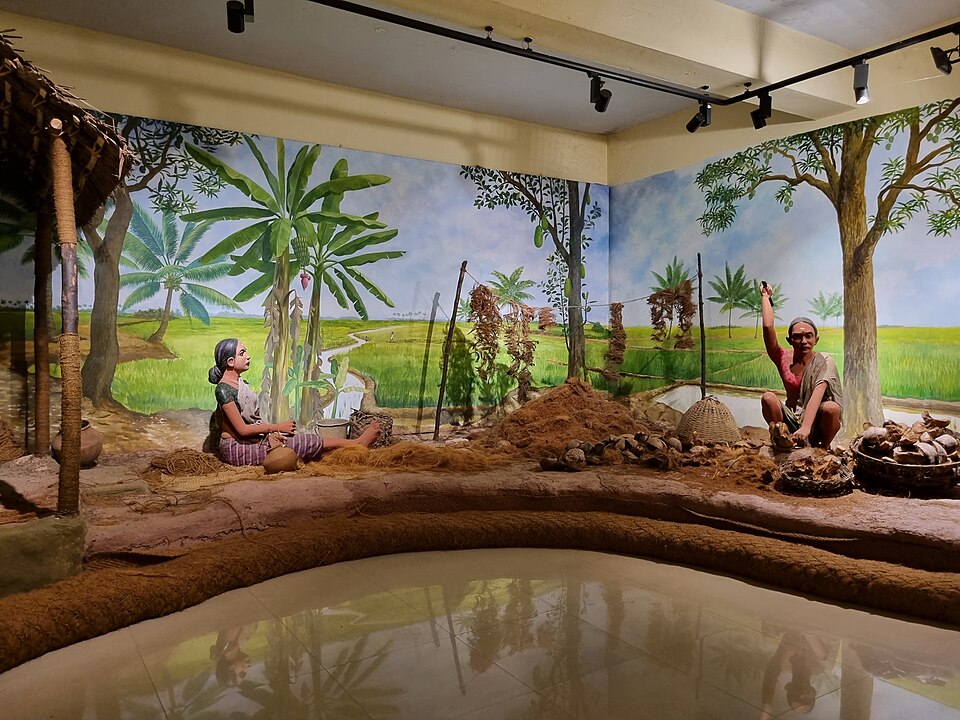
A short drive from Alappuzha town, at Kalavoor, stands the International Coir Museum — the world's first and currently only dedicated coir museum, established on 27 May 2014 and managed by the Coir Board of India. For cultural travellers interested in Kerala's material heritage, it is one of the region's most distinctive institutional experiences — a museum that takes an entirely familiar material and makes it utterly surprising.
The museum showcases the complete evolution of coir through life-sized models, historical photographs, traditional weaving tools spanning from the earliest hand-spinning implements to modern handlooms, and a collection of innovative coir products that reveal the material's contemporary applications in furniture, architecture, fashion, and environmental engineering. Documentary films on fibre extraction and the seven-step manufacturing process are screened regularly. A souvenir shop offers mats, handicrafts, and decorative coir objects made by local artisans — among the most authentic and economically supportive souvenirs available in Alappuzha.
The museum complex also houses the Central Coir Research Institute (CCRI) — the principal research body developing sustainable processing technologies, including mobile fibre extraction machines and bio-chemical retting solutions that could eventually decouple the craft's quality from the environmental cost of traditional open-backwater retting. The museum and the research institute together represent the industry's institutional commitment to both preserving its heritage and transforming its processes for a sustainable future.
The Socio-Economic Reality — Navigating the Tides of Trade and Labour
Despite its cultural importance, GI recognition, and centuries of global trade, the coir industry faces profound socio-economic challenges that test the resilience of its workers at every level. The structural issue is both historical and persistent: more than three-fourths of Kerala's coir production was traditionally destined for export, creating an industry whose tens of thousands of workers are materially dependent on the purchasing decisions of consumers in Europe, North America, and Japan who have never seen the backwaters where the fibre was retted.
When global demand shifts — as it has repeatedly, for reasons ranging from synthetic fibre competition to freight cost fluctuations to changing interior design trends in target markets — the consequences are immediate and severe for workers who have no alternative income during slack periods. Wages in the coir sector have historically been low; while trade union activity achieved significant improvements, the resulting higher labour costs created their own paradox, making small units less competitive and accelerating mechanisation in ways that reduced overall employment.
The most acute current challenge is a critical labour shortage. Industry surveys indicate that approximately 20.3% of coir units cite labour availability as their topmost production problem. The reason is generational: children who have watched their parents navigate a lifetime of erratic demand and inconsistent wages are choosing different careers. The knowledge transfer that has sustained the craft for 165 years is breaking — not because the craft has become less beautiful or less technically distinctive, but because the economic case for dedicating a working life to it has become harder to make.
"The most meaningful souvenir from Alappuzha is the knowledge that one has supported a tradition fighting to preserve both its unique cultural skill and the ecological integrity of the backwaters that birthed it."
Stewardship and Innovation — Coir's Path to Sustainable Survival
The environmental cost of traditional coir processing is the industry's most difficult self-confrontation. The retting process that creates the world's finest coir fibre also creates the most serious ecological damage to the waterways that make it possible. Traditional open-backwater retting releases wastewater highly contaminated with microbial agents and dissolved organic solids — the same biological activity that softens the fibre also depresses dissolved oxygen levels in the water, reducing biodiversity among plankton and benthic fauna, causing periodic large-scale fish mortality, and polluting the freshwater wells that backwater-adjacent households depend on.
This environmental paradox — the same water that produces the best coir is also damaged by producing it — has driven significant institutional response. The Coir Board of India, the CCRI at Kalavoor, and the National Coir Training and Design Centre have championed several modernisation initiatives:
- Mobile fibre extraction machines — portable equipment that can perform defibering at the husk source, reducing transport distances and enabling processing closer to coconut farms rather than exclusively at backwater locations
- Bio-chemical retting solutions — enzyme and microbial preparations that replicate the pectinolytic activity of backwater retting in controlled conditions, producing comparable-quality fibre in shorter timeframes without persistent backwater contamination
- Geo-textile market development — the state budget for 2024–25 allocated ₹350 lakh toward coir cooperative revival, with specific funds earmarked for model geo-textiles projects with the Public Works and Irrigation departments, creating stable domestic institutional demand that reduces dependence on volatile export markets
- Cooperative support and working capital — financial assistance targeted at coir cooperative societies that coordinate production and provide workers with more stable income structures than piece-rate factory employment
The geo-textile path deserves particular attention. Coir geo-textiles — woven coir mesh used for slope stabilisation, riverbank erosion control, road construction, and agricultural soil retention — provide a durable, fully biodegradable, carbon- sequestering alternative to synthetic geo-synthetic materials. Kerala's road and irrigation infrastructure requirements alone create a potentially enormous domestic market that could absorb significant coir production while simultaneously serving public engineering needs. This is not a compromise between tradition and modernity — it is the tradition's most promising contemporary application.
The Immersive Traveller — Alappuzha's Living Coir Heritage Experience

For the cultural tourist, Alappuzha offers an unparalleled heritage experience — a "coir heritage tour" that transforms a standard backwater cruise into an exploration of one of the world's most distinctive living craft industries. The landscape through which the houseboat drifts is not decorative backdrop; it is the active processing environment for the fibre that has been floating in these same waters for six to ten months before the spinning begins.
What to Visit and Experience
- International Coir Museum, Kalavoor — the world's only coir museum; documentary films, weaving tools, artistic coir collections, and the CCRI research institute. Open most days; small entry fee; souvenir shop with artisan-made products
- Coir manufacturing units and cooperative societies — many units in Kayamkulam, Mannancherry, and Cherthala welcome visitors; observing the seven-step process from raw fibre to finished mat provides a direct connection to the craft's community character
- Mullakkal Market, Alappuzha town — the recommended purchase point for authentic GI-tagged coir products; direct from cooperatives and certified artisans, ensuring economic return reaches the workers
- Backwater retting observation — coconut husks visible in the water at various stages of the retting process are a characteristic feature of Alappuzha's canals; boat tour guides familiar with the industry can point out active retting sites
Ethical Purchasing — Why the GI Tag Matters
When purchasing coir products in Alappuzha, the GI tag is your guarantee of authenticity and your assurance that the product was made by the process that created its quality — and by the workers who understand that process. Non-GI-tagged coir products sold in tourist markets may be produced elsewhere, by mechanised methods, without the specific quality that defines Alleppey Coir. The price difference between authentic GI-tagged products and non-certified alternatives is typically modest; the difference in supporting the craft community is not.
Book backwater homestays, heritage resorts, and guided tours that give direct access to coir-making villages and the International Coir Museum:
Some links above are affiliate links — we earn a small commission if you book, at no additional cost to you. We recommend only services we trust.
Essential Kerala Travel Guidelines
A journey through Kerala's backwaters requires practical preparation alongside cultural curiosity. Key considerations for international visitors:
- Visa: Tourist or e-Tourist visa required for most nationalities. Apply online in advance. Required documents include valid passport, bio-page digital copy, passport photo, return tickets, and accommodation confirmation
- Best season: October to March — pleasant temperatures (18–30°C), post-monsoon clarity in the backwaters, and the most comfortable conditions for outdoor industry observation
- Health: Carry water consistently in Kerala's tropical climate. Comprehensive travel insurance covering medical evacuation and trip cancellation is strongly recommended. Platforms like Airhelp, Wayaway, and Compensair offer flight and travel protection
- Legal note: Satellite phones and GPS devices are illegal in India; penalties are severe
- Cultural etiquette: Conservative dress for temple visits and traditional village areas; remove footwear when entering homes and workshops when invited
- Backwater etiquette: On houseboats, dispose of waste in designated bins; do not throw any materials into the backwaters; choose eco-certified vessels; conserve water and electricity — the backwater ecosystem is fragile and directly connected to the coir craft you came to experience
Frequently Asked Questions — Kerala Coir Industry
What is Alleppey coir and what makes it special?
When did the coir industry start in Alappuzha?
How many workers are employed in Kerala's coir industry?
What is the GI tag for Alleppey coir?
What is the International Coir Museum in Alappuzha?
Is coir from Kerala eco-friendly and sustainable?
References & Image Credits
- 1Coir Board of India. "Coir | Coirboard." coirboard.gov.in.
- 2Coir Board of India. "History | Coirboard." coirboard.gov.in.
- 3Kumaraswamy Pillai, M. "Alleppey Coir — The Geographical Indication." Presentation for WIPO and Coir Board, 2007. wipo.int.
- 4Nair, Karthika S., and Samuel, Liji. "Production and Marketing Process of Coir Industry: A Case Study of Alappuzha District." Shanlax International Journal of Economics, vol. 11, no. 1, Dec. 2022, pp. 8–17. ideas.repec.org.
- 5Anu A.V. and Sebastian, Deepu Jose. "Production Problems Faced by Coir Co-operative Societies: A Study in Alappuzha District, Kerala." Review of Research, vol. 7, no. 12, Sept. 2018. oldror.lbp.world.
- 6Informatics Journals. "Performance of Coir Industry in Alappuzha and the Case of Labour." informaticsjournals.co.in.
- 7Bhaskaran Unnithan, K. Coir Industry in India: With Special Reference to Marketing and Trade. Coir Board, 1970.
- 8District Alappuzha, Government of Kerala. "History | Alappuzha District." alappuzha.nic.in.
- 9Scribd. "Detailed Report About Coir Industry." scribd.com.
- 10Incredible India. "About International Coir Museum Alappuzha." incredibleindia.gov.in.
- Img 1Avinash Singh. "Serene Backwaters Alleppey." Wikimedia Commons. CC BY 2.0. serene-backwaters-alleppey.jpg.
- Img 2Ganesh Mohan T. "Coir artworks, International Coir Museum." Wikimedia Commons. CC BY-SA 4.0. coir-artworks-international-coir-museum.jpg.
- Img 3Ganesh Mohan T. "Coir artworks, International Coir Museum (2)." Wikimedia Commons. CC BY-SA 4.0. coir-artworks-international-coir-museum2.jpg.
- Img 4KeralaFolklore.com. "Dusk over Alappuzha village." dusk-alappuzha-village.jpg.