The Malayalam word sadya means banquet. But the concept it describes cannot be translated. A Kerala Sadya is a complete philosophical statement about the relationship between food and the body, the individual and the community, the living and those who lived before. It is the most sophisticated communal eating tradition in India — not because of the number of dishes (though there are many), but because of the intelligence embedded in every decision about what goes where, served when, eaten in what order, for what reason.
What Is Kerala Sadya — The Feast That Is Also a Philosophy
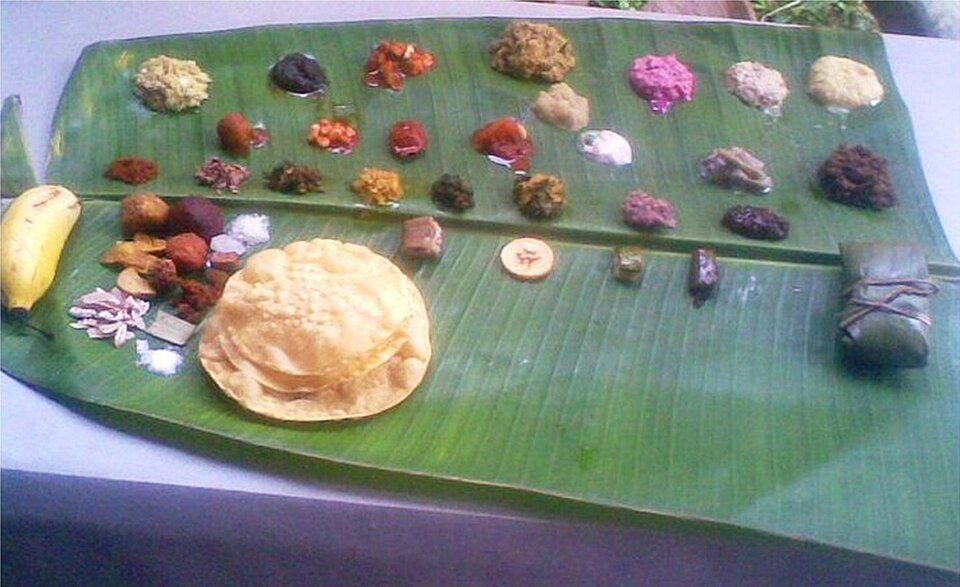
Kerala Sadya (സദ്യ) is the state's grand traditional vegetarian feast — served on a fresh banana leaf, consisting of between 20 and 64 dishes arranged in a specific traditional order, eaten with the right hand while sitting on the floor. The word sadya means banquet or assembly in Malayalam — and both meanings are active in every Sadya. It is simultaneously a meal and a gathering, a food preparation event and a social ritual, a demonstration of culinary skill and an expression of communal generosity.
Sadya is the obligatory feast at Onam, Kerala's state festival. It is served at Vishu (the Malayalam New Year). It is mandatory at Kerala's traditional weddings — the Sadya served at a wedding is the family's most public expression of hospitality, and the quality and quantity of dishes offered carries lasting social implications. It accompanies major temple festivals, thread ceremonies, and other lifecycle rituals. In short: when Kerala celebrates anything that matters, it does so at a Sadya.
The banana leaf is not packaging. It is the serving vessel, the plate, and the statement all at once. The specific part of the leaf used for serving — the thooshanila, the tender tip section — is selected for its lightness and its food-safe quality. The leaf is laid with the pointed tip to the left. The warmth of the rice and curries releases a faint vegetative aroma from the leaf that subtly enhances the flavour of everything placed on it. Hot food on banana leaf creates a specific sensory experience — a temperature, a fragrance, a visual — that no plate of any material can replicate.
The Banana Leaf Layout — Every Dish Has Its Address
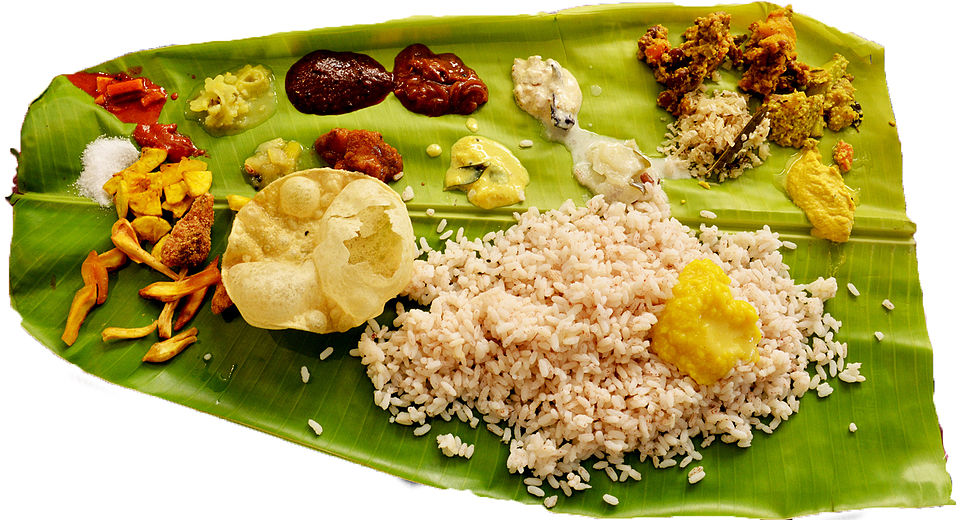
The banana leaf layout for a Sadya is not arbitrary. Every dish has a designated position that has been refined over centuries of communal serving practice — a position that reflects the order in which it will be eaten, its relationship to neighbouring dishes, and its Ayurvedic function in the overall meal sequence. The arrangement is so standardised that an experienced server can navigate a long row of diners, placing each dish in exactly the right position on each leaf, without pausing or consulting a reference.
The Serving Order — A Sequence Built on Two Thousand Years of Observation
The sequence in which Sadya dishes are served is one of the tradition's most sophisticated features — and one of its most misunderstood by those approaching it for the first time. The injipuli (ginger-tamarind pickle) is placed on the leaf before anything else — but it is the last thing eaten. The payasam (sweet dessert) appears to be a finale — but in some traditional serving protocols, a small amount of sweet is also offered at the very start. These apparent paradoxes are not inconsistencies; they are expressions of a coherent digestive philosophy.
| Stage | Dishes Served | Digestive / Functional Purpose |
|---|---|---|
| Before Rice | Banana, banana chips, sharkara upperi, papadam, pickles (injipuli, mango, lime), thoran, avial, kichadi, pachadi, koottukari, olan, erissery, kaalan | All these items are placed before rice arrives. The pickles and chutneys activate salivary glands and digestive juices. The snacks and dry preparations establish texture contrast for what follows |
| First Course | Hot rice served; parippu with ghee poured over rice first | Parippu with ghee is the ideal combination for the body's strongest digestive state — rich, caloric, warming, protein-dense. Eaten first when digestive fire (agni) is highest |
| Second Course | Sambar, avial, thoran, erissery — the main vegetable curry courses with fresh rice | Progressive introduction of more complex flavours as the palate adjusts. The sequencing follows the principle of moving from simpler to more complex taste combinations |
| Third Course | Rasam with rice — the peppery broth | Digestive function explicit: pepper and tamarind in rasam assist in breaking down the heavy earlier courses. Traditionally served as the transition between main courses and dessert |
| Dessert | Payasam (ada pradhaman, palada payasam) with banana and additional rice | The sweetness of payasam with the natural sugar of banana marks the meal's physical and emotional climax. Multiple payasams acknowledge the Sadya's celebratory function |
| Closing | Moru (spiced buttermilk); pickles again | Buttermilk's probiotic and cooling properties settle the stomach after a large meal. Pickles return to cut the extreme sweetness of payasam and restore acidic balance |
| Post-Meal | Injipuli (finally eaten), betel leaf (vettila murukkaan) in traditional settings | Ginger's anti-bacterial and anti-nausea properties protect against food poisoning after a large meal. Betel leaf with arecanut aids final digestion and is a traditional palatecleanser |
The Ayurvedic Logic — Six Tastes, One Leaf
Kerala is the homeland of Ayurveda — the ancient medical tradition that understands the human body as a system of elemental forces (doshas) that can be balanced or imbalanced through food, environment, and lifestyle. It is not coincidental that Kerala's most elaborate food tradition is also its most Ayurvedically sophisticated. The Sadya encodes Ayurvedic nutritional wisdom in every decision — which dishes appear, in what combinations, in what order.
The foundational principle is Shad Rasa — the six tastes of Ayurvedic food science. A complete and balanced meal must include all six in appropriate proportion:
"As per Ayurveda, sadya — which is dominated by the basic tastes of sweet, bitter, sour, salty, spicy, and umami — is a well-balanced meal. The sitting position (arthapadmasana), the eating direction (right hand, left to right), and the sequence of dishes all reflect a coherent understanding of how the body processes a large meal over several hours."
— Onmanorama, drawing from Kerala Ayurvedic traditionThe no-onion, no-garlic principle of traditional Sadya is also Ayurvedic in origin. Both onion and garlic are classified as tamasic (dulling, lowering) foods in the Ayurvedic and Sattvic food traditions associated with temple cooking and ritual feasting. A Sadya served as part of a temple ritual or sacred festival is prepared in the Sattvic tradition — without these rajasic/tamasic ingredients. The flavour complexity that onion and garlic might add is instead achieved through coconut, cumin, mustard seeds, green chillies, curry leaves, tamarind, and asafoetida — demonstrating the extraordinary depth of Kerala's flavour vocabulary even within significant constraints.
Onasadya — The Feast That Welcomes a King Home
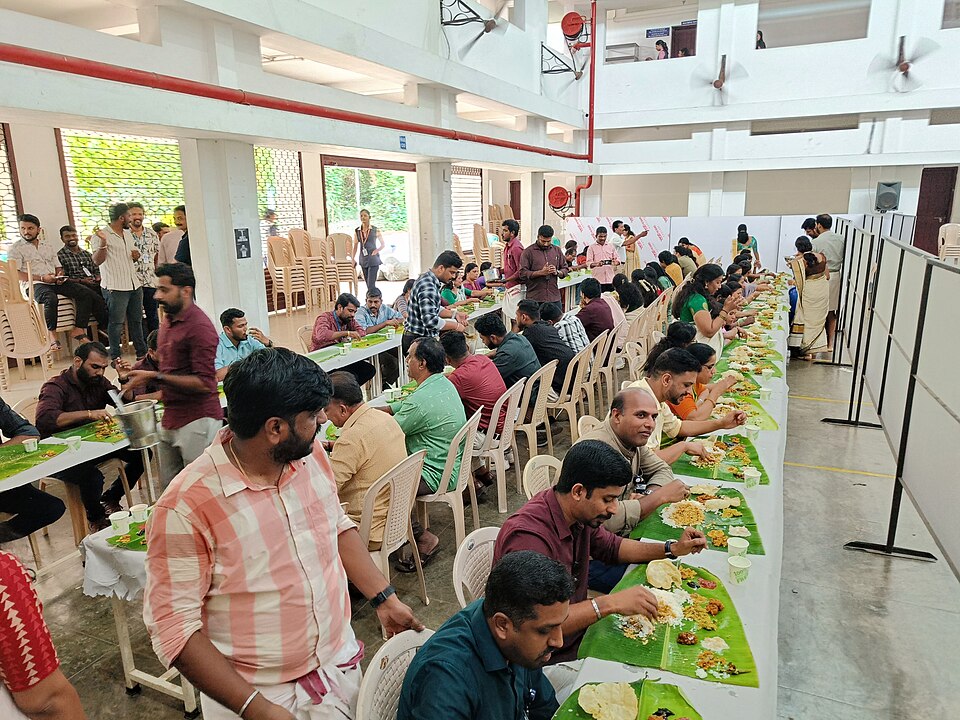
The Onasadya — the Sadya served on Onam's climactic day, Thiruvonam — is Kerala's most widely shared communal meal. On the same day, across Kerala and across every country where Keralites live, the same feast is prepared and shared. Onam 2025 Thiruvonam falls on Friday, 5 September 2025.
The proverb "Kanam vittum Onam unnanam" — "One must celebrate Onam even if it means selling one's property" — captures both the cultural imperative and the social stakes of the Onasadya. For families across Kerala's economic spectrum, Thiruvonam's Sadya represents the year's most deliberate culinary investment. Every household prepares according to its means, but the structure of the feast — the banana leaf, the sequence of dishes, the shared sitting — creates equivalence where the kitchen economy may differ.
The Onasadya's mythological frame is direct: it commemorates the legendary reign of King Mahabali — remembered as a golden age of equality, abundance, and justice in which every subject was equally provided for. The feast re-enacts that equality. When a high-caste household and a lower-caste household both serve the same Sadya on the same day in the same tradition, they are both enacting Mahabali's egalitarian kingdom — briefly, annually, through food.
Aranmula Vallasadya — 64 Dishes, 200,000 Guests, One Legend
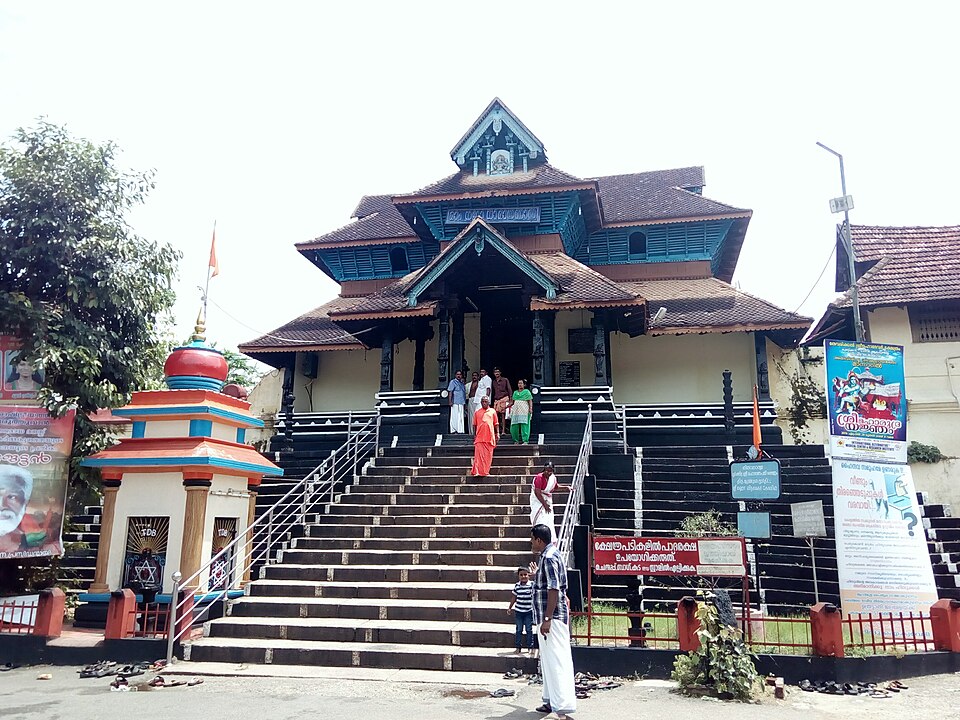
The most sacred, most elaborate, and most historically significant Sadya in Kerala's living tradition is not the household Onasadya — extraordinary as that is — but the Aranmula Vallasadya (Valla Sadya), served at the Aranmula Parthasarathy Temple in Pathanamthitta district on Ashtami Rohini day (Lord Krishna's birthday) during the Onam season.
With up to 64 dishes and an estimated 200,000 people fed annually, the Aranmula Vallasadya is one of the world's largest sacred communal meals. The feast is not merely large — it carries a specific origin mythology that makes every dish on its leaf an act of sacred memory.
The Aranmula Vallasadya originated from a specific historical act of community protection. A devout Brahmin named Mangatt Bhattathiri vowed annually to provide feast provisions for the temple's Thiruvona Sadya — the sacred feast for Lord Krishna. One year, the boat carrying these provisions (the Thiruvonathoni) was attacked by bandits. Palliyodam snake boats from neighbouring karas (villages) rushed to the rescue, protecting the feast and delivering it safely to the temple. The annual Aranmula Vallamkali boat race commemorates this rescue — and the feast that was rescued is what 200,000 people eat every Ashtami Rohini. See the complete story at our Kerala Boat Race page.
The sacred character of the Vallasadya is expressed in a unique protocol: oarsmen singing Vanchippattu (boat songs) can request any specific dish from the feast during the Aranmula Vallamkali boat race — and that request cannot be refused. The belief is that Lord Krishna himself, present among the oarsmen, is making the request. To withhold any requested dish would be to deny the deity. The Sadya, at Aranmula, is not merely a human feast — it is a divine meal that humans are privileged to share.
Folding the Leaf — The Gesture That Ends the Feast
When the meal is finished, the banana leaf is folded. This is not a housekeeping action. It is a communicative gesture with specific meaning that varies by occasion and direction — and getting it wrong in a traditional context carries social weight.
Folding away from you (toward the serving side) is the standard post-meal gesture at festivals, celebrations, weddings, and public feasts. It signals satisfaction — that the food was good, the hosting was generous, and you are complete. It is the socially correct fold in most contexts. The practical effect of this fold is also considerate: leftover liquids are contained, and the server can collect the leaf more easily.
Folding toward yourself has historically been associated with dissatisfaction — or, in some contexts, with the specific distinction of a meal served at a funeral or mourning ceremony (marana sadya). In contemporary practice, this distinction is less rigidly observed, but in traditional Kerala households and temple feast settings, the direction of the fold retains its communicative function.
"In Kerala, even the way you finish a meal is a statement. The leaf folded away from you says: I was fed well, and I am grateful. In a tradition where the act of feeding is an act of love, the proper acknowledgement is the least a guest can offer."
Regional Variations — How the Same Feast Changes Across Kerala
While the core structure of Kerala Sadya is consistent across the state, regional variations in ingredient selection, specific preparations, and local custom create a family of related but distinct Sadyas across Kerala's different geographic and cultural zones.
- North Kerala (Malabar): Bittergourd is added to avial, giving it a more complex flavour; fresh yoghurt is added with coconut paste in some dishes; the Muslim communities of Malabar serve their own versions of Sadya-like feasts at weddings, often including fish preparations alongside the vegetarian courses
- Central Kerala (Ernakulam, Kottayam, Thrissur): The most standardised Sadya region, where the traditional 26-dish arrangement is most rigidly observed; chakka (jackfruit) erissery and pineapple pachadi are particularly beloved regional additions
- Kuttanad (Alappuzha): White gourd (ash gourd) olan is a district specialty; the region's relationship with water agriculture means unusual vegetable varieties may appear in thoran and other preparations
- South Kerala (Thiruvananthapuram, Kollam): Trivandrum Sadhya has its own distinct character — the Onam Sadya here may include specific payasam varieties not seen elsewhere; the fish-growing coastal culture occasionally introduces its own non-vegetarian parallel feasts served alongside traditional Sadyas at household celebrations
- Diaspora: Keralites in the Gulf, the UK, the US, and Australia celebrate Onasadya at community organisations, temple halls, and restaurants. The meal is often served as a buffet rather than a served leaf feast — a necessary adaptation that preserves the social gathering function even when the traditional leaf-on-floor format is impractical
The Social Function — Why the Sadya Is a Political Act
Kerala Sadya's most powerful social dimension is invisible to those approaching it as a culinary event: the complete suspension of social hierarchy at the leaf. In traditional serving, everyone sits on the same floor level. The same dishes are served to all. The servers move along the rows without discrimination of recipient. The Sadya does not provide a premium version for the upper-caste guest and a reduced version for the lower.
In a state with a history of profound caste discrimination — where the same communities that were denied market access (see our Chantha article), denied temple entry, and denied public road access were simultaneously serving at feasts they were not permitted to eat at — the Sadya as an inclusive communal institution carries genuine political weight. The Aranmula Vallasadya, which feeds 200,000 people simultaneously at the temple complex, is one of the most direct expressions of this principle in practice: the feast of the deity is available to all who come.
Frequently Asked Questions — Kerala Sadya
What is Kerala Sadya?
What are the dishes in an Onasadya?
How do you eat a Kerala Sadya properly?
What does folding the banana leaf mean after sadya?
What is Aranmula Vallasadya?
What is the Ayurvedic significance of Kerala Sadya?
References & Image Credits
- 1Wikipedia. "Sadya." en.wikipedia.org/wiki/Sadya.
- 2Wikipedia. "Valla Sadhya." en.wikipedia.org/wiki/Valla_Sadhya.
- 3Onmanorama. "Serve right, sit well as you feast on Onam." onmanorama.com. Serving sequence and Ayurvedic context.
- 4Onmanorama. "Inwards or outwards? How to fold a banana leaf after Onam sadya." onmanorama.com. Leaf-folding etiquette.
- 5Live Kerala. "Traditional Kerala Sadhya: What's on the Banana Leaf?" livekerala.com. Dish positions and descriptions.
- 6Kerala Tourism. "Kerala Sadya — What is special about it?" keralatourism.org. Overview of Sadya tradition.
- 7KeralaFolklore.com. "Onam — Kerala's Harvest Festival." keralafolklore.com/onam.html.
- 8KeralaFolklore.com. "Kerala Boat Race — Vallamkali and Aranmula Vallasadya." keralafolklore.com/kerala-boat-race.html.
- Img 1RajeshUnuppally at Malayalam Wikipedia. "Aranmula Vallasadya." Wikimedia Commons. CC BY 3.0. aranmula-vallasadya1.jpg.
- Img 2Augustus Binu. "Kerala Sadya on banana leaf." Wikimedia Commons. CC BY-SA 3.0. kerala-sadya.jpg.
- Img 3AlfredgKodiyan. "Onasadya at Jyothi Engineering College." An Onam Sadya organized as part of the Onam celebrations at an engineering college. Wikimedia Commons. CC BY-SA 4.0. onasadya-at-jyothi-engg-college.jpg.