Every great culture has a single craft that captures, in its making, the complete character of that culture's knowledge and values. For Kerala's Malabar coast, that craft is the Beypore Uru — a wooden dhow so large it takes fifty craftsmen years to complete, so technically precise that its pre-calculated waterline aligns perfectly when it finally meets the sea, and so entirely knowledge-dependent that if the master craftsman forgets or dies without passing on what he knows, a tradition spanning two millennia ends with him.
What Is Beypore Uru — The World's Largest Handcrafted Wooden Vessel
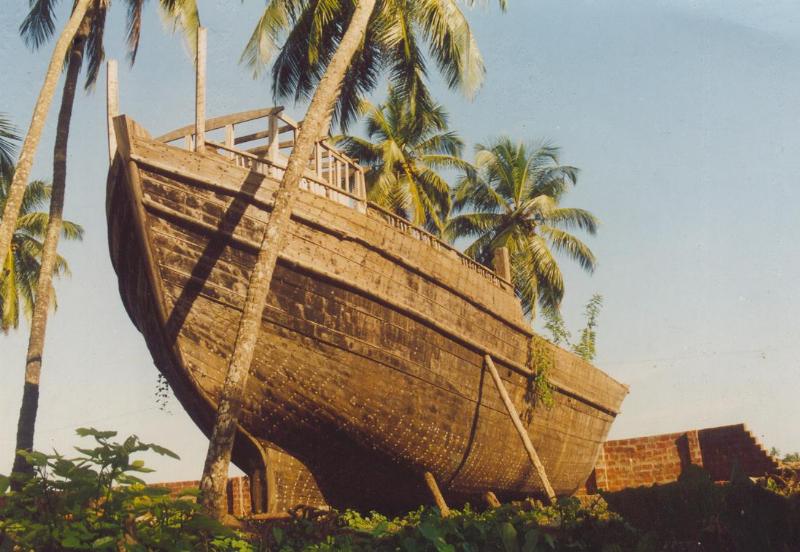
The Uru (ഉരു in Malayalam, also written as dhow in English) is a traditional large wooden sailing vessel built in Beypore, a port town at the mouth of the Chaliyar River in Kozhikode district, North Kerala. The name derives from the Arabic dhow — the generic Arabic term for a traditional sailing vessel of the Arabian Sea — but the Beypore version is distinctively Keralite in its construction materials, techniques, and the specific craftsmen communities who build it.
What makes the Beypore Uru unique in global shipbuilding history is the combination of its scale, its complete absence of modern tools or documentation, and its unbroken continuity across two millennia. A standard Uru is between 60 and 130 feet in length and displaces several hundred tonnes. It is built entirely of wood — primarily Malabar teak — jointed without metal nails using traditional wooden joinery techniques. No blueprint is drawn, no structural calculation is written down, no computer model is consulted. Everything is in the head of the Maistry (master craftsman), transmitted to the next generation through direct family apprenticeship.
Before a Beypore Uru is launched, the master craftsman marks a precise waterline around the hull — the level at which the completed, loaded vessel will float. When the Uru is launched and fully loaded, this pre-calculated line aligns exactly with the actual waterline. This calculation is performed entirely in the master's head, without instruments, based on accumulated knowledge of wood density, hull volume, and displacement physics transmitted through generations of apprenticeship. Naval architects who have witnessed this describe it as a demonstration of empirical engineering sophistication that rivals — in its accuracy — outcomes achieved through formal technical education.
Two Thousand Years on the Chaliyar — The Maritime History of Beypore
The story of Beypore's shipbuilding tradition is also the story of one of the world's most enduring maritime trade relationships: the 2,000-year commerce between the Malabar coast and the Arab world.
Beypore's strategic location — at the mouth of the Chaliyar River where it meets the Arabian Sea, close to the ancient port of Calicut (Kozhikode) — placed it at the intersection of Kerala's two key resources for shipbuilding: teak forests to the east (the Nilambur forests of the Western Ghats, among the world's finest teak sources) and the Arabian Sea trade routes to the west. Arab traders arrived on the Malabar coast in search of spices, and discovered that Kerala's teak and Kerala's craftsmen could build their dhows better than anywhere else on the Indian Ocean rim.
The tradition is believed to be approximately 1,500 to 2,000 years old. Arab vessels — dhows — were traditionally built in Arabia and the Persian Gulf using date palm timber and sewn construction techniques. When Arab merchants encountered Malabar teak — denser, harder, and more naturally water-resistant than any timber in Arabia — they began commissioning their vessels from the craftsmen of Beypore instead. According to Captain Iwata of Japan's Association of Sumerian Ships, Beypore may have been a Sumerian shipbuilding centre, pushing the tradition's roots even further back.
This Arab patronage was the engine that sustained Beypore's tradition through the medieval period. The 15th-century Arab geographer and traveller Ibn Battuta, visiting the Malabar coast, documented the shipbuilding of the region. The Italian explorer Ludovico di Varthema, writing in the early 16th century, praised Calicut's shipbuilding craft — specifically noting that local craftsmen joined hull planks without oakum (caulking material), a technique unheard of in Europe at the time.
"Once the Arab traders discovered wealthy Kerala, her solid timber, skilled craftsmen and her native technology centuries ago, they shifted their dhow construction to Malabar. This industry thrived till iron and steel took over as the dominant medium of ship construction."
— Kerala Tourism, documenting the historical arc of Beypore's tradeThe Craftsmen — Odayi, Khalasi, and the Hierarchy of Knowledge
The Beypore Uru is not built by a single community but by a precisely organised hierarchy of craftsmen communities, each with specific hereditary roles, specialised knowledge, and cultural identities that have evolved alongside the craft over centuries.
| Community | Role in Construction | Specialisation | Cultural Identity |
|---|---|---|---|
| Odayi (Mesthiri) | Master shipwright and lead carpenter — the knowledge holder of all design and structural decisions | Hull design, structural calculations, waterline marking, supervision of all carpentry; all information carried in memory without documentation | Hindu craftsmen community; required by tradition to maintain moral discipline (vritham) — clear mind considered essential for precise memory-dependent work |
| Mappila Khalasi | Dockworkers, heavy-lifters, and Uru launchers — the community responsible for moving and launching the completed vessel | Pulley-based heavy lifting using traditional tools (wooden poles, hawsers, ropes); Uru launch ceremony; maintenance and dry-dock repair | Mappila Muslim community; Khalasi derives from Arabic — dockyard worker; historically employed throughout the Indian Ocean maritime economy |
| Baraami (Barami) | Shipbuilding contractors and organisational managers — intermediaries between patrons and craftsmen | Client relationships, supply chain management (timber sourcing, tools, labour coordination) | Connected to the Al Mukalla tribe heritage; some accounts trace Baraami origins to Egyptian maritime traders who settled in Malabar |
| General Carpenters | Planking, joinery, and structural assembly under Odayi supervision | Manual timber joining, plank shaping, drilling; the physical execution of the Odayi's mental design | Mixed community; skill acquired through apprenticeship within the construction team rather than hereditary specialisation |
The Odayi tradition requires specific moral discipline from its practitioners — the principle that the master's mind must remain clear and free from vice to maintain the precise memory on which the entire enterprise depends. This is not merely cultural prescription; it is a recognition that the Odayi's memory IS the blueprint. Any degradation of that memory — through illness, substance abuse, or moral disorder — is literally a degradation of the ship's structural integrity.
Among the most celebrated Odayis in recent history, names like Edathumpadikkal Chathukutti, Pachu Mesthiri, and Edathumpadikkal Shivasankaran are recorded in the tradition's oral and documentary history. The Khalasis work under a leader called the Mooppan — the senior experienced master of the launch process who choreographs the extraordinary physical operation of moving a 400-tonne wooden vessel from the construction yard to the water using only traditional tools.
The Construction Process — Four Years of Pure Knowledge
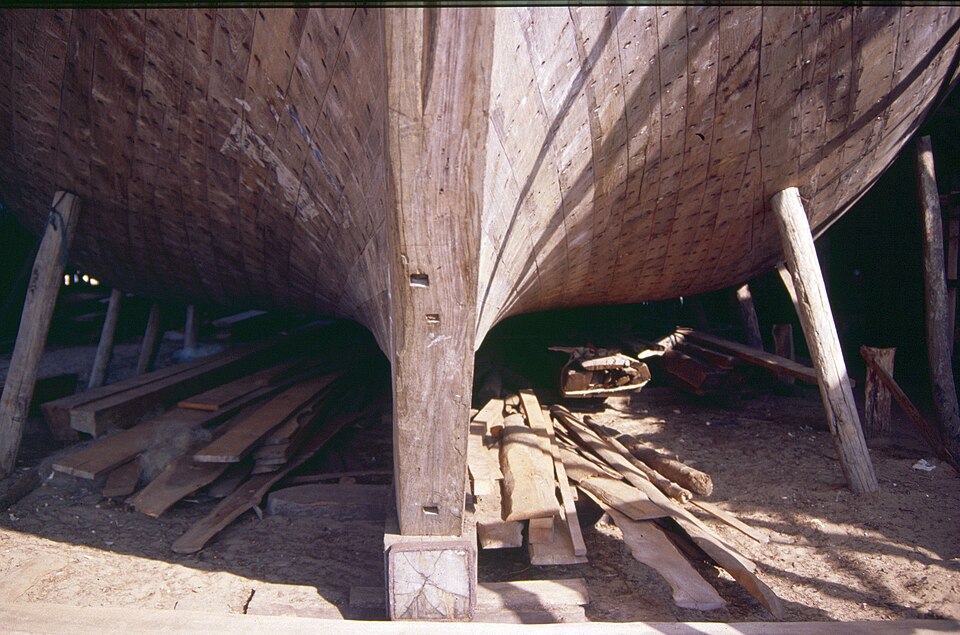
The Beypore Uru's construction process is one of the most extraordinary manufacturing sequences in the world — not because of its complexity (though it is complex) but because of the complete absence of any external documentation, measurement instrument, or modern tool throughout the process.
Malabar teak — historically from Nilambur forests, now primarily imported Malaysian teak — is selected for density, grain straightness, and moisture content. The Odayi inspects each plank by eye and touch. Selected timber is seasoned in the Chaliyar River itself, allowing natural processes to stabilise the wood's moisture content before construction begins. The river's specific water chemistry contributes to the seasoning process.
The keel — the Uru's structural backbone — is laid first on the Beypore shipyard's open ground, elevated on wooden supports. The keel's length, curvature, and cross-section are determined entirely by the Odayi's judgment. It is typically made from the largest, straightest teak available. The keel laying marks the formal beginning of construction and is often accompanied by a small ceremony at the shipyard.
Curved structural ribs are shaped from teak and attached to the keel at precisely calculated intervals. The curvature of each rib — which determines the hull's shape — is achieved by steam-bending or by selecting naturally curved timber. The Odayi directs every rib placement. The spacing and angle of each rib determines the final hull form, buoyancy characteristics, and cargo capacity — all calculated mentally.
Teak planks are fitted to the ribs from the keel outward and upward, each plank shaped to follow the hull's curves. Traditional Beypore planking uses no oakum caulking between planks — the planks are fitted with such precision that the joint itself is watertight. This technique, documented by 16th-century European travellers as remarkable, is achieved through the carpenter's trained eye and hand rather than through measurement instruments.
Traditional Beypore Uru construction uses a combination of wooden nails (treenails or kodams), coir rope lashing, and precise plank fitting rather than metal fasteners in its most authentic form. The coir-stitched hull is one of the oldest shipbuilding techniques in the Indian Ocean world — Arab and Indian Ocean navigators favoured sewn ships for their flexibility in rough seas, as stitched or lashed planks flex with wave action rather than fracturing under rigid metallic stress. The Odayi selects which fastening method to use for each structural element based on load requirements — a decision made from experience and memory.
Decking, interior compartments, the mast step, and fitting points are constructed according to the vessel's commissioned purpose — cargo, passenger, or luxury. Modern luxury Urus commissioned by Gulf Arab clients now include elaborate interior fittings, air conditioning systems, and modern navigation equipment — all integrated into the traditionally constructed hull.
Before the Khalasis begin the launch process, the Odayi marks the waterline — the precise point at which the fully loaded vessel will float. This line is marked entirely from the master's calculation, without instruments. When the vessel is launched and loaded, the line aligns with the actual waterline. Preparations for launch also include traditional rituals and prayers by the craftsmen and commissioning family.
Pulimootu — The Stone Pier That Guards the Ship Channel
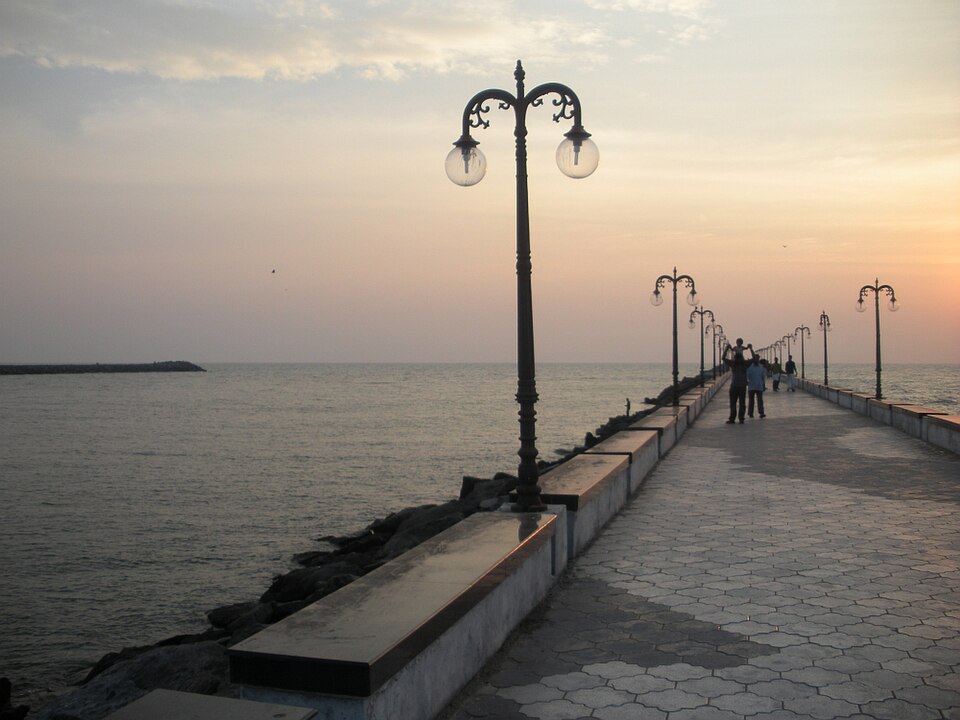
At the point where the Chaliyar River meets the Arabian Sea at Beypore beach stands one of the most practically important and visually striking structures in Kerala's maritime heritage — the Pulimootu (also written Pulimuttu or Pulimutt). It is not a woodworking technique. It is a massive stone breakwater pier extending approximately 1 to 2 kilometres into the Arabian Sea.
The Pulimootu's function is hydraulic engineering of elegant simplicity. The Chaliyar River meets the sea at Beypore through an estuary — and estuaries are naturally prone to sediment accumulation as the river current slows and drops its suspended sand and silt load at the meeting point with saltwater. Without intervention, this sediment builds up year by year, gradually filling the ship channel and making it too shallow for large vessels to navigate. A shallow channel would mean no Uru can leave the shipyard under its own power — the craft would be built only to be stranded ashore.
The Pulimootu solves this by projecting into the sea alongside the river mouth. According to the Wikimapia documentation of the structure: "Indigenous method used to make ship channels. If two Pulimootus are made in parallel to each other, in between them sand deposit will not occur, so depth will be ok for ships to travel inside." The pier's presence concentrates water flow through the channel between the two parallel structures, maintaining the current velocity needed to keep sediment from settling — a self-sustaining hydraulic solution that requires no machinery or maintenance.
Beyond its functional role in keeping the ship channel navigable, the Pulimootu has become Beypore's most popular public attraction — a rocky walkway over the sea where visitors experience panoramic views of the Arabian Sea, the Chaliyar River estuary, Beypore Port, and the distant Beypore Lighthouse. The walk along its length, with the sea on both sides and waves breaking against the stone base, is described by visitors as one of Kerala's most memorable coastal experiences. The structure that keeps the Uru's path clear is also the place where people come to watch the sun go down over the same waters the Urus sail.
The Uru Launch Ceremony — Pulleys, Physics, and 400 Tonnes
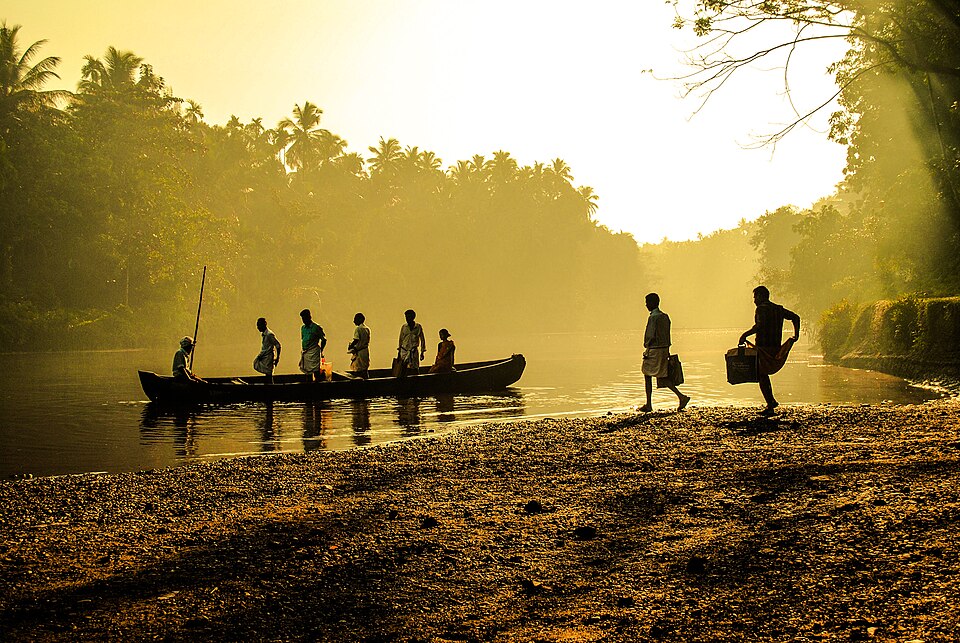
Once a completed Uru is ready — its waterline marked, its interior fitted, its hull fully planked — it must be moved from the open shipyard on land into the Chaliyar River and thence through the ship channel (kept navigable by the Pulimootu) to the open sea. This is the Khalasis' hour.
Using only traditional tools — wooden poles used as levers and axles, heavy rope hawsers, and a system of pulleys — the Mooppan (Khalasi leader) coordinates a team to move a vessel that may weigh several hundred tonnes across the Beypore shore and into the water. No crane. No bulldozer. No motorised winch. The operation uses pure Newtonian mechanics: mechanical advantage through pulley multiplication, friction reduction through wooden rollers under the hull, and the coordinated physical effort of dozens of Khalasi workers pulling in unison.
The launch is a public event. Crowds gather. The community that watched the Uru take shape over months or years gathers to see it meet the water. The Khalasis' songs — Vinchipattukal — coordinate the pulling effort, their rhythms timing the collective heave that moves the enormous structure inch by inch toward the river. When the hull finally touches the water and begins to float, the pre-calculated waterline the Odayi marked aligns precisely with the actual waterline — the master's mental calculation confirmed at the moment of maximum visibility, in front of everyone who worked to build it. It is one of the most extraordinary moments in any craft tradition on earth.
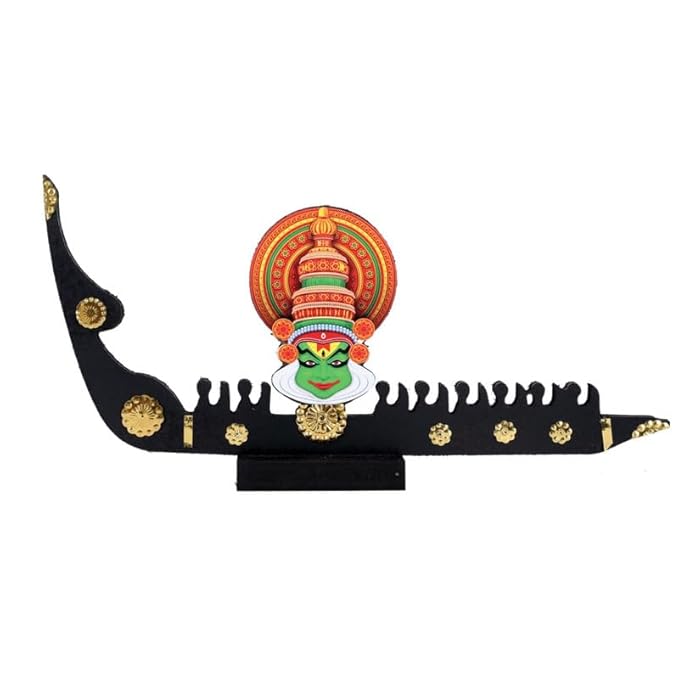
The Uru and Kathakali together represent Kerala's two great performance traditions — one on water, one on stage, both built on knowledge carried in the body rather than written down. A beautiful heritage gift celebrating Kerala's cultural depth, for home décor or gifting.
View on Amazon →Affiliate link — we earn a small commission at no extra cost to you.
The Songs of the Shipyard — Vinchipattukal and the Oral Culture of the Uru
The Beypore Uru tradition is not only a material craft — it carries a rich oral culture that reflects the spiritual and social world of the communities who build it. Several categories of traditional songs are associated with the Khalasi craftsmen, sung during the physically demanding work of construction and launching to maintain rhythm, motivation, and communal energy.
- Vinchipattukal — rhythmic work songs sung during the launching process, coordinating the Khalasis' physical effort and maintaining the precise timing required to move the vessel without damage
- Ambapattukal — devotional songs offered to the divine before and during specific phases of construction, reflecting the spiritual dimensions of the craft
- Elayya pattukal — lighter work songs sung during the carpentry phases, maintaining pace during the long hours of planking and joinery
These songs serve functions beyond motivation. They encode cultural memory — references to past vessels, celebrated craftsmen, specific incidents at the shipyard — that constitute a parallel oral documentation of the tradition's history. They have been documented and recorded as part of formal initiatives to preserve Beypore's intangible cultural heritage, recognising that the songs are as much a part of the tradition as the teak joints they accompany.
"The Uru is not built silently. The songs of the Khalasis are as much a part of its construction as the teak planks — the rhythm that keeps fifty men working as one body for years at a time."
Survival, Revival, and the GI Tag Movement
The Beypore Uru's modern history is a story of near-extinction and partial revival that illuminates the fragility of knowledge-dependent craft traditions in an industrial economy.
The Decline — Steel, Deforestation, and Lost Demand
By the 1970s, the global shipping industry's transition from wood to steel and fibreglass had dramatically reduced demand for wooden dhows. By the 1980s, the Beypore Uru construction industry had effectively halted — no new commissions, craftsmen dispersing to other livelihoods, the knowledge transmission chain breaking as masters aged without apprentices. The crisis was compounded by the depletion of Nilambur teak — increased forest protections from the 1980s effectively ended access to Kerala's native teak supply, forcing builders to source from Malaysia and dramatically increasing material costs.
By 2010, fewer than 50 active Uru craftsmen remained across the entire Beypore tradition — a community once numbering in the hundreds, across multiple generations of active shipyards.
The Gulf Revival — Arab Royalty Rediscovers the Uru
The tradition's rescue came from an unexpected direction: renewed interest from Gulf Arab royalty and wealthy collectors in authentic, luxury handcrafted wooden dhows. Qatar, the UAE, and Bahrain — countries whose own dhow traditions had given way entirely to fibreglass and steel — began commissioning luxury Urus from Beypore as prestige objects and heritage vessels. These were not the cargo dhows of the trade era but elaborately fitted luxury yachts: air-conditioned, electronically navigated, and finished with high-end materials — but built using the traditional Odayi-led, blueprint-free construction process.
By 2024, the number of active craftsmen had grown from fewer than 50 to over 200, and more than 150 young people had completed formal training programmes — an extraordinary reversal driven by the combination of Gulf commissions and formal heritage restoration initiatives.
The GI Tag Movement
The Kozhikode District Tourism Promotion Council has applied for a Geographical Indication (GI) tag for the Beypore Uru — a legal protection that would restrict use of the name to vessels built by traditional craftsmen in Beypore using traditional methods. The GI application argues that the Uru's quality is geographically dependent: the Chaliyar River, the Beypore port geography, the specific hereditary craftsmen communities, and the accumulated regional knowledge base cannot be transplanted elsewhere. A GI tag, if granted, would also create formal frameworks for knowledge documentation, apprenticeship support, and international market recognition.

Like the Beypore Uru, traditional Kerala Kathakali woodcraft is knowledge carried in the hands across generations — no blueprint, no factory, only the accumulated skill of craftsmen who learned from their parents. Authentic handcrafted Kathakali wooden figures from Kerala artisans: heritage you can hold.
View on Amazon →Affiliate link — we earn a small commission at no extra cost to you.
Visiting Beypore — A Living Heritage Experience
For visitors to Kozhikode (Calicut), Beypore is one of the most extraordinary heritage tourism destinations in Kerala — not because of a museum or a monument, but because of the living, active shipyard on the Chaliyar River banks where Urus are still being built today.
- Location: Beypore is approximately 10 km south of Kozhikode town, at the mouth of the Chaliyar River where it meets the Arabian Sea
- The Shipyard: The Beypore shipyard near the Chaliyar bank is the primary site — visitors can observe Urus at various stages of construction. The sheer scale of the partially built vessels, their skeletal teak ribs exposed against the sky, is immediately awe-inspiring
- Best time: During active construction phases — the shipyard is more interesting when craftsmen are at work. Early morning provides the best light and the most active workforce
- The Launch: When a completed Uru is launched, it is a major public event attended by large crowds. If a launch is scheduled during your visit, witnessing the Khalasis' pulley-based launch process is one of the most remarkable things you can see in Kerala
- Souvenir Urus: Small wooden model Urus are available from handicraft shops in Beypore and Kozhikode — authentic craft souvenirs that carry the tradition's visual heritage at a human scale
- Beypore Beach and Port: The wider Beypore area offers the beach, the historic port area with its fishing boats and cargo activity, and proximity to Kozhikode's rich Malabar culinary culture
Frequently Asked Questions — Beypore Uru
What is Beypore Uru?
How is Beypore Uru made without blueprints?
Who are the Khalasi craftsmen of Beypore?
What wood is used to make Beypore Uru?
What is Pulimootu at Beypore?
Does Beypore Uru have a GI tag?
References & Image Credits
- 1Kerala Tourism. "Beypore Uru — The Traditional Arabian Trading Vessel." keralatourism.org.
- 2Kerala Tourism. "Uru — A Fine Craft of Ship Building." keralatourism.org.
- 3Wikipedia. "Uru (boat)." en.wikipedia.org.
- 4Wikipedia. "Khalasi." en.wikipedia.org.
- 5Mankada, Shameerali. "Ship (Uru) Building in Beypore." shameeralimankada.wordpress.com, 2018.
- 6Green Destinations. "The Story of Beypore Uru — Good Practice 2025." greendestinations.org. Revival statistics: craftsmen 50→200 (2010–2024).
- 7The News Minute. "The Urus of Kerala's Beypore: These traditional boats find a home with wealthy Qataris." thenewsminute.com.
- 8National Geographic. "The Beypore Uru: A Lasting Tradition." National Geographic, 2015.
- 9Rajan, A.S. et al. "Historical Factors That Contributed to Ship (Uru) Building." RSIS International, vol. 2, no. 8. rsisinternational.org.
- Img 1KeralaFolklore.com. "Beypore Uru." beypore-uru.jpg.
- Img 2Ziegler175. "Beypore Uru under construction — hull framework at construction stage." Wikimedia Commons. CC BY-SA 3.0. beypore-uru-construction-stage.jpg.
- Img 3Pradeep717. "Beypore Pulimootu — stone breakwater pier extending into the Arabian Sea at Beypore beach, Kozhikode." Wikimedia Commons. CC BY-SA 3.0. beypore-pulimootu.jpg.
- Img 4KeralaFolklore.com. "Boat journey in the morning." boat-jpourney-in-morning.jpg.