In Kerala, the most beautiful things were also the most functional. The Nettur Petti — also called the Aada Petti, Amada Petti, or Malabar box — was the jewellery casket of Kerala's aristocratic women. But calling it a jewellery box is like calling the Sistine Chapel a ceiling. The Nettur Petti is a masterwork of applied mathematics, architectural philosophy, folk painting, and metalwork — compressed into an object small enough to sit on a dressing table and complex enough to take a master craftsman several days to complete.
What Is Nettur Petti — Kerala's Most Extraordinary Wooden Box
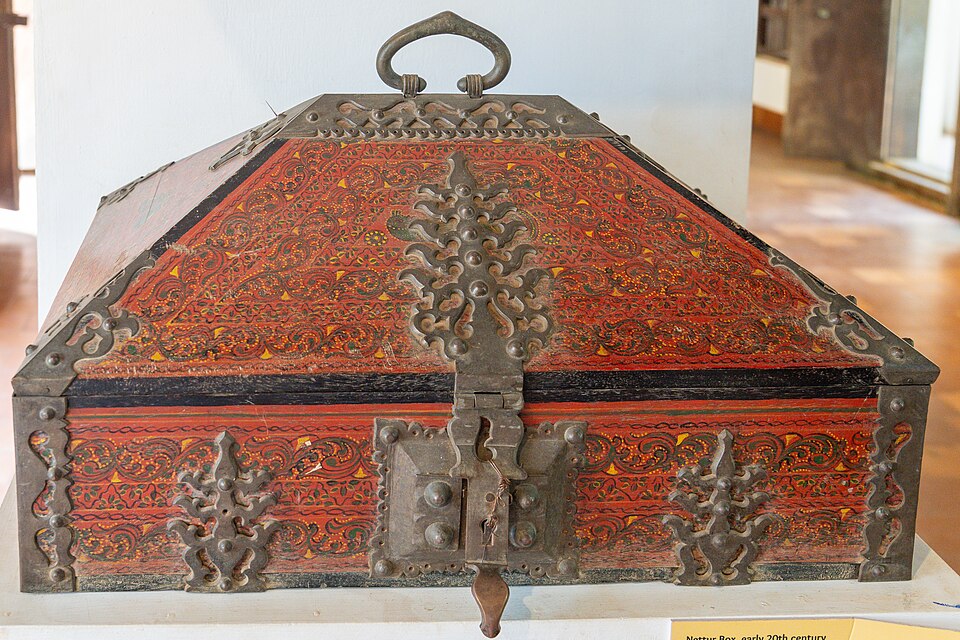
The Nettur Petti is a traditional handcrafted wooden jewellery box — a casket of stunning visual and structural sophistication that was once an essential possession of aristocratic and royal Kerala households. Its name comes from Nettur, the village near Thalassery (Tellicherry) in North Kerala's Malabar region where the craft is believed to have originated, combined with the Malayalam word petti — box.
What makes the Nettur Petti categorically different from any other jewellery box — traditional or contemporary — is the convergence of multiple sophisticated craft traditions in a single object. The wooden body is constructed according to Tachusastra (Kerala's ancient architectural science) mathematical principles. The pyramid-shaped lid is a deliberate architectural reference to traditional Kerala rooftops. The exterior panels are painted in enamel colours in the visual vocabulary of Kerala's mural painting and Theyyam ritual art. The brass hardware — hinges, corner pieces, the locking mechanism — is made entirely by hand. And inside, in addition to multiple fabric-lined compartments, there is a secret chamber — hidden, lockable, and designed to be invisible to anyone who does not know it is there.
This combination of architectural knowledge, craft skill, visual art, and metalwork makes the Nettur Petti not merely a functional object but an heirloom — a piece of heritage that families have passed across generations and that collectors worldwide now actively seek. An authentic Nettur Petti, made by a master craftsman, is not a souvenir. It is a museum-quality object that happens to still be useful.
History and Origins — From the Kolathiri Court to the Travancore Palace
The history of the Nettur Petti is also the history of a migration — a craft that was born in one kingdom, carried by royal intrigue to another, and has survived because the hands that made it never entirely stopped.
The Mushiga Dynasty — Where It All Began
The craft's origins are traced to the Mushiga dynasty — the Kolathiris, now known as the Chirakkal Rajahs — who ruled Malabar (North Kerala) from their seat near Kannur. The Kolathiri kingdom was one of the most culturally sophisticated of Kerala's medieval feudal states, with documented patronage of the arts that produced the region's distinctive temple architecture, mural painting tradition, and the extraordinary folk ritual art of Theyyam.
The Nettur Petti carries all three of these Kolathiri cultural signatures. Its construction principles derive from the same Tachusastra that governs Kolathiri temple building. Its decorative motifs echo the elephants, lotus patterns, and nature imagery of North Kerala mural paintings. And the enamel colour palette — red, yellow, orange, black, green — is the same palette used in Theyyam costume and ritual object painting. The box is, in a sense, a portable North Kerala cultural archive.
The 14th-Century Migration — How the Craft Moved South
The craft's journey from North to South Kerala is documented in one of Kerala's most politically dramatic episodes. In the 14th century, the Travancore kingdom (then known as Kupaka) was seeking to consolidate its royal lineage. The ruling figure Sangamadheera arranged for two Kolathiri princesses to become the formal successors of his kingdom. The Kolathiri king was deeply reluctant to see his sisters absorbed into the Tamil cultural milieu of the south.
As a resolution — whether a concession or a strategic protection — a portion of the Kupaka kingdom was carved out and organised as a miniature version of the Kolathiri homeland. Not just the physical space was recreated: the entire social ecosystem of the North Kerala court was transplanted. Soldiers, retainers, craftsmen, artisans, and all the skills required to maintain the Kolathiri way of life were brought south. The coir-thatchers, the mural painters, the brass workers, and the box-makers all made the journey. The Nettur Petti — and the knowledge of how to make it — came with them.
"Not only was Thirivirattukkavu Bhagavati concentrated here as the principal goddess, but even retainers, soldiers, artisans, craftsmen, slaves and other moral factors were brought together all the way from the homeland of the princesses, rather than being recruited locally. Such history of Kerala is the mere example to showcase how the authentic Malabar box, now called Nettur Petti, travelled from North Kerala to South Kerala."
— Gaatha.org, drawing from Kerala historical recordsToday, there are no craftsmen making Nettur Petti in North Kerala — the region where the craft originated. The craft survives almost entirely in South Kerala: in Thiruvananthapuram, in Chakai, and in parts of Ernakulam. The box that was born in Malabar now lives in Travancore — a testament to the strange paths that craft traditions take through history.
The Design — When a Box Is Built Like a Temple
The Nettur Petti's most immediately striking feature is its pyramid-shaped lid — the sloping, multi-tiered top that rises from a rectangular base to a pointed or truncated peak. This is not a decorative whim. It is a direct architectural quotation from the nadumuttam (central courtyard rooflines) and gopuram forms of Kerala's temple architecture — the same sloping, layered roofscape that defines the distinctive silhouette of traditional Kerala buildings.
Tachusastra Vidhi — Building a Box by Temple Mathematics
Tachusastra (literally "science of carpentry" in Sanskrit) is Kerala's ancient architectural canon — the body of mathematical and geometric knowledge that governs the proportioning, orientation, and structural design of traditional Kerala buildings, from the humblest homestead to the grandest temple. It is the same knowledge system that underpins the Nalukettu (four-sided courtyard house), the Ettukettu (eight-wing mansion), and the proportions of Kerala's most celebrated temple structures.
The Nettur Petti is constructed following Tachusastra Vidhi — the craftsman's application of Tachusastra principles to the box's dimensions. The relationship between the base, the walls, the lid height, the overhang, and the internal compartment divisions are not arbitrary. They follow the same mathematical ratios that govern traditional Kerala architecture — ratios that Tachusastra scholars describe as encoding the proportions of the human body, the cosmos, and the principles of structural stability simultaneously.
This means that a genuine Nettur Petti is not merely a box that looks like a Kerala building — it is a box whose every measurement is in the same mathematical conversation as a Kerala building. The craftsman who builds it must know Tachusastra, not merely carpentry. This is why the number of people capable of making an authentic Nettur Petti is so small: the knowledge required is not a single craft skill but the intersection of architectural science, woodworking, painting, and metalwork.
The Enamel Paintings — Theyyam in Miniature
The exterior panels of a Nettur Petti are painted in enamel pigments — red, yellow, orange, black, and green — depicting motifs drawn from Kerala's richest visual traditions. Elephants in ceremonial caparison. Lotus blossoms and stylised leaves. Peacocks and swans. Geometric borders derived from temple floor designs. These motifs connect the box to two specific visual traditions: Kerala's ancient temple mural paintings (which use the same colour palette and the same iconographic vocabulary) and the costume and ritual object decoration of Theyyam — North Kerala's extraordinary ritual art form in which performers are transformed into deities through elaborate painted costumes.
The visual connection to Theyyam is not coincidental — both the Nettur Petti and Theyyam emerged from the same Kolathiri cultural context, using the same artistic vocabulary to decorate objects understood as carrying divine energy. A Theyyam performer's headdress and a Nettur Petti's lid occupy different scales of the same aesthetic world — one enormous and worn in fire-lit village clearings, the other intimate and kept in a zenana — but both speak in the same colour language.
The Secret Chamber — The Box Within the Box
Perhaps the most distinctive and least-known feature of an authentic Nettur Petti is the presence of a hidden secret chamber inside the box — a concealed compartment, accessible only to someone who knows its location and mechanism, designed to store the most precious items away from casual detection. The mechanism of the secret chamber varies between craftsmen and between boxes. Some involve a false floor; others a sliding panel on one of the interior walls; others a small drawer activated by pressing a specific point on the wood.
This feature reflects the Nettur Petti's original function as the secure storage vessel for genuinely valuable items — gold jewellery, gemstones, important documents, dowry pieces — in households where personal security could not always be guaranteed. The secret chamber was not theatrical; it was practical. And its presence in an authentic Nettur Petti is one of the most reliable indicators of a piece made by a craftsman with genuine knowledge of the tradition rather than a simplified reproduction.
The Craft Process — Why Each Box Takes Days to Complete
An authentic Nettur Petti is made by one craftsman, often with the assistance of a single assistant, using skills accumulated over years of apprenticeship. There is no production line, no standardised template, no CNC router. Each box is a distinct object — its dimensions following Tachusastra principles but its specific details (the panel proportions, the painting motifs, the interior arrangement) determined by the craftsman's individual knowledge and the customer's requirements.
Rosewood, teak, mahogany, jack wood (wild jackfruit wood), or jungle jack — the wood is selected for density, grain, and workability. Traditional Tachusastra principles specify which woods are appropriate for which dimensions and purposes. The selected planks must be properly seasoned to prevent future cracking or warping — in a hand-finished object of this precision, movement in the wood after completion is catastrophic.
Following Tachusastra Vidhi, the craftsman calculates the precise dimensions of the base, walls, lid, and interior divisions. No dimension is arbitrary — all proportions follow the mathematical ratios of Kerala's architectural tradition. This is the step that separates a Nettur Petti craftsman from a general woodworker: the knowledge required is architectural as much as carpentral.
Planks are shaped using traditional tools: the Cheevuli (a hand planer for levelling surfaces to precision flatness), the Gushimattom (for shaping precise angular joints), and the Pozhichuli (for carving decorative grooves along panel edges). Traditional joinery methods — dovetail joints, mortise and tenon — are used without nails or modern adhesives in the most authentic pieces, creating structural bonds that strengthen with age and humidity cycling.
The pyramid-shaped lid is the most technically demanding element — its multiple angled planes must meet precisely at the ridge or apex without gaps or misalignment. The angle of each slope follows Tachusastra's roofline proportions. The lid must fit its base with a close tolerance that keeps it secure but allows it to be opened smoothly. This single element can take as long as the entire box body to construct correctly.
All brass fittings — corner pieces, hinge plates, lock body, key, decorative boss plates — are made by hand from sheet brass. This requires a separate metalworking skill set that in traditional practice was either possessed by the craftsman themselves or sourced from a specialist brass worker. The lock mechanism is the most complex element: it must be functional, secure, and aesthetically consistent with the box's overall design vocabulary.
Enamel pigments in the traditional colour palette (red, yellow, orange, black, green) are applied to the exterior panels using fine brushes. The painting follows traditional motif conventions — elephants, lotus flowers, peacocks, geometric borders — but allows for individual craftsman's interpretive choices within the established visual vocabulary. The painting is applied over a prepared ground and sealed to protect against humidity and handling.
The interior is divided into compartments — typically at least two or three distinct storage areas — lined with fabric (traditionally silk in high-end pieces, cotton in standard work). The secret chamber is installed at this stage: its location and mechanism are the craftsman's specific knowledge, passed within the craft tradition and not visible to the outside observer. Final quality inspection, brass polishing, and assembly complete the piece.
The Kerala Traditional Box Family — More Than Just the Nettur Petti
The Nettur Petti is the best-known and most celebrated member of a larger family of Kerala traditional wooden boxes — each designed for a specific purpose in the household, temple, or professional life of traditional Kerala society. Understanding the full range of these boxes reveals how sophisticated the tradition's response to functional requirements was:
| Box Name | Malayalam Name | Lid Type | Traditional Purpose |
|---|---|---|---|
| Nettur Petti / Aada Petti | നെട്ടൂർ പെട്ടി | Pyramid-shaped (sloping, temple-roof form) | Jewellery, ornaments, valuables; royal and aristocratic households |
| Kaala Petti | കാല പെട്ടി | Flat lid, raised on legs | Important documents, land records, legal papers; the "filing cabinet" of traditional Kerala households |
| Kathakali Petti / Aata Petti | കഥകളി പെട്ടി | Semi-circular (arched) lid | Storage of Kathakali costume, headgear, and ornaments; used by dance companies and individual performers |
| Ari Petti | അരി പെട്ടി | Flat or gently pitched lid | Grain and rice storage; a large-format box used in the household's food storage area |
| Arapu Petti | അരപ്പ് പെട്ടി | Flat lid, divided interior | Spice storage; multiple compartments for different spices; the kitchen's spice chest |
| Chella Petti | ചെല്ല പെട്ടി | Small, hinged lid | Betel leaf (vettila) and arecanut (adakka) storage; the pan box used after meals and in social hosting |
| Vaidya Petti (Medicine Chest) | വൈദ്യ പെട്ടി | Cabinet form, multiple drawers | Ayurvedic physician's medicine cabinet; 16–18 individual drawers for different herbs and preparations; used by traditional Kerala physicians |
| Kai Petti | കൈ പെട്ടി | Flat lid with handle | Personal travel box; the traditional equivalent of a briefcase, carried by hand for short journeys |
The Artisans — The Hands That Keep the Tradition Alive
The most urgent fact about the Nettur Petti is that it is made by very few hands — and that number has been declining with each generation. The craft's intersection of Tachusastra knowledge, woodworking skill, enamel painting, and brass fabrication means that learning to make an authentic Nettur Petti requires either a lengthy formal apprenticeship or the fortunate accident of being born into a family that still practices the tradition.
V.V. Suresh Kumar and V.V. Ramesh Kumar — Thiruvananthapuram
Among the most prominent living masters of the Nettur Petti tradition are brothers V.V. Suresh Kumar and V.V. Ramesh Kumar — third-generation craftsmen based in Thiruvananthapuram who inherited the craft from their father, Vishwanathan Achari. Vishwanathan Achari was not only an award-winning master craftsman but also a systematic preserver of the tradition: he founded a training school aimed at formalising knowledge transmission, and in 1987 was awarded the Best Craftsman Award by the Government of Kerala in recognition of his role in keeping the craft alive. His father had worked as chief craftsman at Natesan Antiqarts in Bangalore — one of South India's most prestigious antique establishments — a position that speaks to the esteem in which his work was held in the collector world even then.
Suresh Kumar, despite holding a commerce degree, chose to return to Thiruvananthapuram and dedicate his professional life to the craft. Every element of the box that emerges from his workshop — the wooden body, the brass fittings, the lock and key — is still made by hand, often taking several days to complete a single piece. This is not inefficiency; it is the craft's integrity in physical form.
"Every element, from the wooden body to the brass fittings and even the locks, is still handmade, often taking several days to complete a single piece. The box is a document of patience."
Where to Find and Buy an Authentic Nettur Petti
If you want to own a genuine Nettur Petti — whether as a functional heirloom, a collector's piece, or a deeply meaningful gift — there are several paths to authentic sourcing. The key distinction is between an authentic handmade piece from a trained craftsman and a mass-produced decorative approximation that borrows the form without the knowledge. The difference in quality, longevity, and cultural integrity is enormous. The price difference between the two is justified by the difference in what you are actually receiving.
- Direct from master craftsmen in Thiruvananthapuram: The workshops of craftsmen like V.V. Suresh Kumar produce authentic Nettur Petti pieces to commission. This is the ideal path for buyers who want the full provenance of their piece and a direct relationship with the craft tradition
- Kerala government craft emporia: SMSM Institute (Government of Kerala's craft exhibition and sales centre in Thiruvananthapuram) and other state craft agencies periodically stock authentic Nettur Petti and related traditional box types
- DakshinChitra, Chennai: The living heritage museum near Chennai maintains connections with Kerala artisan communities and is a recommended source for culturally verified traditional craft objects
- Craft exhibitions and state fairs: Kerala's major craft fairs — particularly the annual Crafts Expo and regional exhibitions — provide direct access to artisan-made Nettur Petti in person
- Trusted online platforms: For buyers outside India, select online marketplaces including Amazon carry Kerala artisan-made Nettur Petti pieces — described below
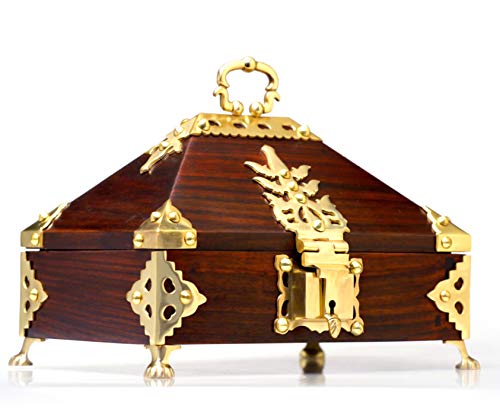
Handcrafted traditional Nettur Petti with the characteristic pyramid-shaped lid, brass fittings, and painted enamel decoration. A genuine piece of Kerala material heritage — functional as a jewellery box and beautiful as a display object. Ships internationally. A meaningful gift for anyone connected to Kerala's culture, or for any collector of South Asian decorative arts.
View on AmazonAffiliate link — we earn a small commission at no extra cost to you.
Caring for a Nettur Petti — Keeping Heritage Alive
An authentic Nettur Petti is designed to last generations — but it requires appropriate care to fulfil that promise. Rosewood and teak are dense, stable hardwoods that respond well to tropical conditions, but the enamel painting and brass hardware are more vulnerable to neglect.
- Wood care: Apply a thin coating of natural beeswax or lemon oil to the wooden surfaces twice a year — this maintains the wood's moisture balance, prevents drying and cracking, and deepens the natural lustre of the grain. Avoid synthetic furniture polishes, which can damage the enamel painting
- Enamel painting: Dust with a soft, dry brush (never wet cloth). The enamel is durable but can be chipped by hard contact or harsh chemical cleaners. Keep away from direct, prolonged sunlight, which fades the pigments over time
- Brass hardware: Polish with a natural brass cleaner (tamarind paste is the traditional Kerala method — its mild acid removes tarnish without abrasive damage) to maintain the warm golden lustre. A light application of mineral oil after cleaning protects against future tarnishing
- Storage: Keep the box in a stable humidity environment — Kerala's tropical humidity is actually ideal for the wood, but sudden shifts between very dry and very humid conditions can cause wood movement. Avoid placing on radiators or in direct air conditioning airflow
- The lock: Traditional brass locks benefit from a tiny drop of oil on the key mechanism annually. If a key is lost, a traditional locksmith familiar with Kerala brass hardware may be able to cut a replacement — do not force the mechanism
The Nettur Petti's Cultural Significance — More Than an Object
The Nettur Petti's position in Kerala's cultural imagination exceeds its function as a storage object. In the households where it was used, the box was the repository of what a family considered most worth keeping — gold jewellery that represented multiple generations of accumulated wealth, gemstones that were part of a bride's dowry, documents that established land rights and lineage. Opening a Nettur Petti was an act with weight to it.
The box was also gendered in its social meaning. It was specifically the jewellery box of Kerala's aristocratic women — stored in the inner rooms of the tharavadu (ancestral house), accessible to the women of the family, a physical marker of the household's prosperity and the woman's personal inheritance. In a social structure where women's economic autonomy was tightly constrained, the Nettur Petti represented a specific, legitimate domain of personal ownership.
It was also a temple object. Nettur Petti boxes were used by Kerala's temples to store the ornaments and jewellery of the deity — the gold earrings, necklaces, and arm bangles that adorned the idol and were stored between ritual use in exactly the same kind of secure, beautifully crafted box as those used in aristocratic homes. The box that stored a queen's jewellery and the box that stored a goddess's ornaments were the same object — the same craft tradition serving both domestic and sacred purposes.
Frequently Asked Questions — Nettur Petti
What is a Nettur Petti?
Where does the Nettur Petti come from?
What makes Nettur Petti design unique?
What wood is used to make Nettur Petti?
What are the different types of Kerala traditional boxes?
Where can I buy an authentic Nettur Petti?
References & Image Credits
- 1Gaatha.org. "Nettur Petti, Maradu, Ernakulam — Documentation." gaatha.org. Definitive documentation of Nettur Petti history and craft.
- 2Handicrafts Development Corporation of Kerala / Ministry of Textiles. "Nettoor Box." handicrafts.nic.in. Official craft documentation including tools and construction methods.
- 3The Better India. "Meet Suresh Kumar Who is Keeping The Legacy of Kerala's Nettur Petti Alive." thebetterindia.com. Profile of the Kumar brothers and the Vishwanathan Achari lineage.
- 4Mannarcraft. "The Timeless Elegance of Nettoor Petti: A Journey Through History and Design." mannarcraft.com. Historical context and design analysis.
- 5Dailyhunt/Homegrown. "The Nettur Petti, a traditional wooden jewellery box from Kerala." dailyhunt.in. Contemporary craft survival documentation.
- 6D'Source, IIT Bombay. "Nettur Petti — Design Documentation." dsource.in. Academic documentation of the craft tradition.
- 7Resham Dor. "Craft — Netturpeti." reshamdor.com. Contemporary artisan profile and craft documentation.
- 8Kultureshoppe. "Nettur Petti — Echoing Kerala's Illustrious History." cultureshoppe.com. Historical and design overview.
- Img 1DakshinChitra. "Nettur box — traditional Kerala wooden jewellery box." Wikimedia Commons. CC BY-SA 4.0. nettur-box.jpg.
- AffiliateAmazon affiliate link: amzn.to/3QsJVGl. Kerala Nettur Petti wooden jewellery box with brass. We earn a small commission on purchases made through this link at no additional cost to the buyer.